

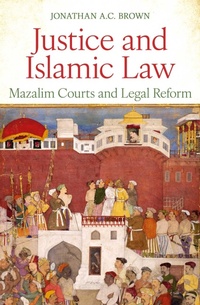
Justice and Islamic Law
Mazalim Courts and Legal Reform
Will be published approx. on 12. March 2026
Book
Hardback
384 pages
978-1-83643-200-5 (ISBN)
Description
What do you do when divine law and the justice demanded by your conscience clash? Muslims have wrestled with this problem since the earliest caliphates. The mazalim courts, dating back to the eighth century, were the answer: courts where any subject could appeal directly to an Islamic ruler regarding any matter of justice. Mazalim courts, which were not bound by the rulings of an established school of Islamic law, could address crises in authority and order that Shariah courts could not. Bestselling author Jonathan A.C. Brown unveils the history of mazalim courts, analyses the political, legal and theological thought of its tradition and contends that mazalim courts did not oppose or transcend Shariah. Mazalim courts allowed the state to step in and provide substantive justice when procedural justice failed its subjects.
Reviews / Votes
'This learned and engaging book... Brown (who is himself Muslim) seems to be laying the ground for a kind of Islamic post-liberalism, where politics and law are shaped by Aristotelian-cum-Islamic notions of justice and the common good.' Fitzroy Morrissey, The Critic 'In this composite volume, Jonathan Brown does the field a great service, first by deploying an extensive analysis and commentary on the mazalim tribunals across centuries, and second, by offering a translation of two treatises on the subject. This is an important work that will for long remain a reference for historians.' Wael B. Hallaq, author of Radical Separation of Powers 'This deeply learned book explores both the concrete history and the ethico-religious significance of an important Islamic legal institution. It remains consistently vivid and engaging while grappling with key scholarly questions in the history of Islamic law.' Marion H. Katz, author of Wives and Work 'Many political systems and theories define themselves in some way as "the rule of law not of men" - from Aristotle to modern constitutional democracy. This reflects aspirations for justice, rationality, and impartiality in political life. Such political theories often worry, however, that sometimes the application of the letter of the law might result in an injustice, and so allow that the law may be tempered by such considerations as equity or mercy. Islam is just such a worldview in this tradition, but has the added belief that its law comes not from history or a wise founder but from God, and thus represents perfect justice, rationality, and impartiality. How could the application of God's law ever be unjust? And yet premodern Islamic states also feared that the application of the divine law might result in injustice, and thus created certain institutions and practices to remedy this in the name of equity, chief among them being the ma?alim courts. For the first time, we have a full scholarly exploration of the theory and history of the ma?alim courts in pre-modern Islam. Written by the most creative and able scholar of Islam of his generation, this book deftly weaves together history, textual excavation, and expert comparative conceptual analysis. It will be read for decades to come.' Andrew March, author of Islam and Liberal CitizenshipMore details
Language
English
Place of publication
London
United Kingdom
Target group
Professional and scholarly
College/higher education
Dimensions
Height: 238 mm
Width: 157 mm
Thickness: 37 mm
Weight
590 gr
ISBN-13
978-1-83643-200-5 (9781836432005)
Copyright in bibliographic data and cover images is held by Nielsen Book Services Limited or by the publishers or by their respective licensors: all rights reserved.
Schweitzer Classification
Other editions
Additional editions
E-Book
03/2026
Oneworld Academic
€44.51
Available for download
Person
Jonathan A.C. Brown is Professor and Alwaleed bin Talal Chair of Islamic Civilization in the School of Foreign Service at Georgetown University. He is the author of Islam and Blackness, Misquoting Muhammad and Hadith: Muhammad's Legacy in the Medieval and Modern World, all of which are published by Oneworld.