

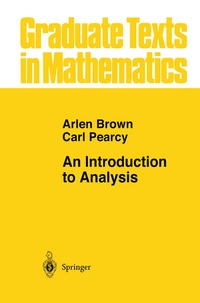
An Introduction to Analysis
Published on 16. December 1994
Book
Hardback
VII, 300 pages
978-0-387-94369-5 (ISBN)
Description
As its title indicates, this book is intended to serve as a textbook for an introductory course in mathematical analysis. In preliminary form the book has been used in this way at the University of Michigan, Indiana University, and Texas A&M University, and has proved serviceable. In addition to its primary purpose as a textbook for a formal course, however, it is the authors' hope that this book will also prove of value to readers interested in studying mathematical analysis on their own. Indeed, we believe the wealth and variety of examples and exercises will be especially conducive to this end. A word on prerequisites. With what mathematical background might a prospective reader hope to profit from the study of this book? Our con scious intent in writing it was to address the needs of a beginning graduate student in mathematics, or, to put matters slightly differently, a student who has completed an undergraduate program with a mathematics ma jor. On the other hand, the book is very largely self-contained and should therefore be accessible to a lower classman whose interest in mathematical analysis has already been awakened.
More details
Series
Edition
1995 ed.
Language
English
Place of publication
New York
United States
Target group
Primary & secondary/elementary & high school
Graduate
Illustrations
VII, 300 p.
Dimensions
Height: 241 mm
Width: 160 mm
Thickness: 22 mm
Weight
635 gr
ISBN-13
978-0-387-94369-5 (9780387943695)
DOI
10.1007/978-1-4612-0787-0
Schweitzer Classification
Other editions
Additional editions
Arlen Brown | Carl Pearcy
An Introduction to Analysis
E-Book
12/2012
Springer
€53.49
Available for download
Arlen Brown | Carl Pearcy
An Introduction to Analysis
Book
09/2012
Springer
€53.49
Shipment within 15-20 days
Content
1 The rudiments of set theory.- 2 Number systems.- 3 Linear analysis.- 4 Cardinal numbers.- 5 Ordinal numbers.- 6 Metric spaces.- 7 Continuity and limits.- 8 Completeness and compactness.- 9 General topology.