

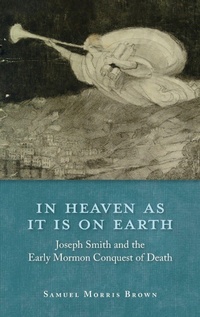
In Heaven as It Is on Earth
Joseph Smith and the Early Mormon Conquest of Death
1st Edition
Published on 12. January 2012
Book
Hardback
408 pages
978-0-19-979357-0 (ISBN)
Description
A compelling new interpretation of early Mormonism, Samuel Brown's In Heaven as It Is On Earth views this religion through the lens of founder Joseph Smith's profound preoccupation with the specter of death.
Revisiting historical documents and scripture from this novel perspective, Brown offers new insight into the origin and meaning of some of Mormonism's earliest beliefs and practices. The world of early Mormonism was besieged by death--infant mortality, violence, and disease were rampant. A prolonged battle with typhoid fever, punctuated by painful surgeries including a threatened leg amputation, and the sudden loss of his beloved brother Alvin cast a long shadow over Smith's own life. Smith embraced and was deeply influenced by the culture of "holy dying"--with its emphasis on deathbed salvation, melodramatic bereavement, and belief in the Providential nature of untimely death--that sought to cope with the widespread mortality of the period. Seen in this light, Smith's treasure quest, search for Native origins, distinctive approach to scripture, and belief in a post-mortal community all acquire new meaning, as do early Mormonism's Masonic-sounding temple rites and novel family system. Taken together, the varied themes of early Mormonism can be interpreted as a campaign to extinguish death forever. By focusing on Mormon conceptions of death, Brown recasts the story of first-generation Mormonism, showing a religious movement and its founder at once vibrant and fragile, intrepid and unsettled, human and otherworldly.
A lively narrative history, In Heaven As It Is on Earth illuminates not only the foundational beliefs of early Mormonism but also the larger issues of family and death in American religious history.
Revisiting historical documents and scripture from this novel perspective, Brown offers new insight into the origin and meaning of some of Mormonism's earliest beliefs and practices. The world of early Mormonism was besieged by death--infant mortality, violence, and disease were rampant. A prolonged battle with typhoid fever, punctuated by painful surgeries including a threatened leg amputation, and the sudden loss of his beloved brother Alvin cast a long shadow over Smith's own life. Smith embraced and was deeply influenced by the culture of "holy dying"--with its emphasis on deathbed salvation, melodramatic bereavement, and belief in the Providential nature of untimely death--that sought to cope with the widespread mortality of the period. Seen in this light, Smith's treasure quest, search for Native origins, distinctive approach to scripture, and belief in a post-mortal community all acquire new meaning, as do early Mormonism's Masonic-sounding temple rites and novel family system. Taken together, the varied themes of early Mormonism can be interpreted as a campaign to extinguish death forever. By focusing on Mormon conceptions of death, Brown recasts the story of first-generation Mormonism, showing a religious movement and its founder at once vibrant and fragile, intrepid and unsettled, human and otherworldly.
A lively narrative history, In Heaven As It Is on Earth illuminates not only the foundational beliefs of early Mormonism but also the larger issues of family and death in American religious history.
Reviews / Votes
One of this work's many virtues is that it provides the best explanation of Mormon temple worship ever published. Moreover, as Brown makes his case that this religion's 'end goal is the conquest of death,' he clarifies much about Mormon belief that is mysterious to outsiders (p. 170). * Journal of American History * For the emphasis on the centrality of death if for nothing else, this book deserves a place on the Mormon bookshelf. It does so much more than this, however, in helping the reader thoroughly contextualise the Restoration of the Gospel and the development of the various revelations that Joseph received. * James Holt, International Journal of Mormon Studies *More details
Language
English
Place of publication
New York
United States
Target group
College/higher education
Scholars and students of Mormonism, American religion and history
Dimensions
Height: 240 mm
Width: 161 mm
Thickness: 28 mm
Weight
846 gr
ISBN-13
978-0-19-979357-0 (9780199793570)
Copyright in bibliographic data and cover images is held by Nielsen Book Services Limited or by the publishers or by their respective licensors: all rights reserved.
Schweitzer Classification
Other editions
Additional editions
E-Book
01/2012
1st Edition
OUP eBook
€32.99
Available for download
E-Book
12/2011
1st Edition
OUP eBook
€25.49
Available for download
Person
Samuel Brown is Assistant Professor of Pulmonary and Critical Care Medicine at the University of Utah and the translator of Aleksandr Men's Son of Man.
Content
Part I: Death, Dying, and the Dead ; Chapter 1. "Melancholly Reflections": Joseph Smith and Holy Dying ; Chapter 2. The Corpse and its Rest ; Chapter 3. Relics, Graves, and the Treasure Quest ; Chapter 4. Hallowed Ground: Tombs, Indians, and Eden ; Chapter 5. Seerhood, Pure Language, and the Silence of the Grave ; Part II: Everlasting Communities ; Chapter 6. The New and Everlasting Covenant ; Chapter 7. Negotiating Death and Afterlife in Nauvoo ; Chapter 8. The "Lineage of my Preast Hood" and the Chain of Belonging ; Chapter 9. Divine Anthropology: Translating the Suprahuman Chain ; Chapter 10. "Death Cannot Conquer the Hero Again": The Death and Afterlife of a Martyr