

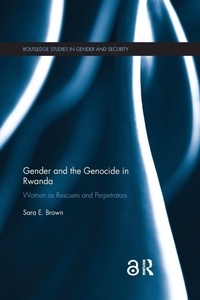
Gender and the Genocide in Rwanda
Women as Rescuers and Perpetrators
1st Edition
Published on 5. March 2019
Book
Paperback/Softback
186 pages
978-0-367-18809-2 (ISBN)
Description
This book examines the mobilization, role, and trajectory of women rescuers and perpetrators during the 1994 genocide in Rwanda.
While much has been written about the victimization of women during the 1994 genocide in Rwanda, very little has been said about women who rescued targeted victims or perpetrated crimes against humanity. This book explores and analyzes the role played by women who exercised agency as rescuers and as perpetrators during the genocide in Rwanda. As women, they took actions and decisions within the context of a deeply entrenched patriarchal system that limited their choices.
This work examines two diverging paths of women's agency during this period: to rescue from genocide or to perpetrate genocide. It seeks to answer three questions: First, how were certain Rwandan women mobilized to participate in genocide, and by whom? Second, what were the specific actions of women during this period of violence and upheaval? Finally, what were the trajectories of women rescuers and perpetrators after the genocide? Comparing and contrasting how women rescuers and perpetrators were mobilized, the actions they undertook, and their post-genocide trajectories, and concluding with a broader discussion of the long-term impact of ignoring these women, this book develops a more nuanced and holistic view of women's agency and the genocide in Rwanda.
This book will be of much interest to students of gender studies, genocide studies, African politics and critical security studies.
While much has been written about the victimization of women during the 1994 genocide in Rwanda, very little has been said about women who rescued targeted victims or perpetrated crimes against humanity. This book explores and analyzes the role played by women who exercised agency as rescuers and as perpetrators during the genocide in Rwanda. As women, they took actions and decisions within the context of a deeply entrenched patriarchal system that limited their choices.
This work examines two diverging paths of women's agency during this period: to rescue from genocide or to perpetrate genocide. It seeks to answer three questions: First, how were certain Rwandan women mobilized to participate in genocide, and by whom? Second, what were the specific actions of women during this period of violence and upheaval? Finally, what were the trajectories of women rescuers and perpetrators after the genocide? Comparing and contrasting how women rescuers and perpetrators were mobilized, the actions they undertook, and their post-genocide trajectories, and concluding with a broader discussion of the long-term impact of ignoring these women, this book develops a more nuanced and holistic view of women's agency and the genocide in Rwanda.
This book will be of much interest to students of gender studies, genocide studies, African politics and critical security studies.
Reviews / Votes
'..this study contributes to the knowledge of issues related to gender, perpetrators, and reconciliation in post-genocide Rwanda. Summing Up: Recommended. Upper-division undergraduates and above; professionals.'--P. G. Conway, SUNY College at Oneonta, CHOICE'This book will interest scholars across a vast range of disciplines, including international law, genocide studies, history and feminist studies. It will also be of interest to anyone who wishes to hear from the women and men of Rwanda whose voices are so often silenced or filtered before they reach outside audiences. Through her engagement with the moving and confronting oral histories of those who were affected by the violence in Rwanda, Brown achieves her objectives of "finding the right flashlight" and complicating the narrative of women's roles in the genocide. The result is a persuasive and engaging read.'--Katherine Fallah, University of Technology Sydney, State Crime Journal
More details
Series
Language
English
Place of publication
London
United Kingdom
Publishing group
Taylor & Francis Ltd
Target group
College/higher education
Professional and scholarly
Illustrations
2 s/w Tabellen
2 Tables, black and white
Dimensions
Height: 234 mm
Width: 156 mm
Thickness: 10 mm
Weight
295 gr
ISBN-13
978-0-367-18809-2 (9780367188092)
Copyright in bibliographic data and cover images is held by Nielsen Book Services Limited or by the publishers or by their respective licensors: all rights reserved.
Schweitzer Classification
Other editions
Additional editions
Book
08/2017
1st Edition
Routledge
€207.30
Shipment within 10-20 days
E-Book
08/2017
Routledge
€0.00
Available for download
E-Book
08/2017
Routledge
€0.00
Available for download
Person
Sara E. Brown is a Fellow at the USC Shoah Foundation - The Institute for Visual History and Education, and has a PhD in Comparative Genocide Studies from Clark University, USA.
Content
Introduction: A Study in Contrasts
1. Finding the Right Flashlight
2. History of Rwanda
3. Mobilization and Militarization
4. Rescuers
5. Perpetrators
6. Post-Genocide Trajectories
7. Sharing Salt
Epilogue
1. Finding the Right Flashlight
2. History of Rwanda
3. Mobilization and Militarization
4. Rescuers
5. Perpetrators
6. Post-Genocide Trajectories
7. Sharing Salt
Epilogue