

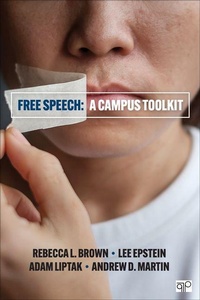
Free Speech
A Campus Toolkit
Published on 19. November 2025
Book
Paperback/Softback
232 pages
978-1-0719-7342-4 (ISBN)
Description
Free Speech: A Campus Toolkit equips readers with the tools they need to make informed judgments about campus controversies for themselves. Prominent scholars and experts Rebecca L. Brown, Lee Epstein, Adam Liptak, and Andrew D. Martin weave theoretical and historical analysis with contemporary examples to develop an understanding of what free speech actually is and the profound implications for democracy.
More details
Language
English
Place of publication
United States
Product notice
Paperback (trade)
Unsewn / adhesive bound
Weight
308 gr
ISBN-13
978-1-0719-7342-4 (9781071973424)
Copyright in bibliographic data and cover images is held by Nielsen Book Services Limited or by the publishers or by their respective licensors: all rights reserved.
Schweitzer Classification
Persons
Lee Epstein (PhD, Emory University) is the University Professor of Law & Political Science and the Hilliard Distinguished Professor of Law at the University of Southern California. She is a fellow of the American Academy of Arts and Sciences and the American Academy of Political and Social Science. A recipient of 12 grants from the National Science Foundation, Epstein has authored or co-authored more than 100 articles and essays and 18 books. She is currently co-editing The Oxford Handbook of Comparative Judicial Behaviour. Professor Epstein's empirical research is frequently cited in the New York Times, among other news media.
Content
About the Authors
Preliminaries
The Book in a Nutshell
The Website
Instructors' Materials
Chapter 1. Classic Justifications for Free Speech
Introduction
1. Discovering Truth through the "Marketplace of Ideas"
2. Facilitating Participation in a Democracy
3. Assuring Individual Self-Fulfillment
4. Creating a More Adaptable and Stable Society (The "Safety Valve")
5. Promoting Tolerance
Chapter 2. Free Speech in the U.S. Supreme Court
Introduction
1. An Overview of Free Speech Doctrine
2. What Is Expression?
3. Is there State Action?
4. Does the Speech Fall into an Unprotected Category?
5. Who Is Speaking?
6. Is the Regulation a Prior Restraint on Expression?
7. Is the Regulation Vague or Overbroad (or Both)?
8. Is the Regulation Content-Neutral or Content-Based/Viewpoint-Based?
Chapter 3. What Free Speech Can Learn from Social Science
Introduction
1. What People Say about Free Speech
2. Why People Say What They Do (and Why Justices Vote as They Do)
3. Strategies for Neutralizing In-Group Bias
Chapter 4. The Role of Academic Freedom in Campus Speech
Introduction
1. Universities Are a "They," Not an "It"
2. The Meaning of Academic Freedom
3. The Relationship between Free Speech and Academic Freedom
Chapter 5. Campus Speech in Historical Context
Introduction
1. The Turn of the 20th Century and the First Red Scare
2. The Second Red Scare: McCarthyism and Another Setback for Campus Speech
3. Students Take the Stage: Campus Activism in the 1960s and 1970s
4. A New Tension Between Campus Speech and Equality
5. Campus Speech in the 21st Century
Coda
Preliminaries
The Book in a Nutshell
The Website
Instructors' Materials
Chapter 1. Classic Justifications for Free Speech
Introduction
1. Discovering Truth through the "Marketplace of Ideas"
2. Facilitating Participation in a Democracy
3. Assuring Individual Self-Fulfillment
4. Creating a More Adaptable and Stable Society (The "Safety Valve")
5. Promoting Tolerance
Chapter 2. Free Speech in the U.S. Supreme Court
Introduction
1. An Overview of Free Speech Doctrine
2. What Is Expression?
3. Is there State Action?
4. Does the Speech Fall into an Unprotected Category?
5. Who Is Speaking?
6. Is the Regulation a Prior Restraint on Expression?
7. Is the Regulation Vague or Overbroad (or Both)?
8. Is the Regulation Content-Neutral or Content-Based/Viewpoint-Based?
Chapter 3. What Free Speech Can Learn from Social Science
Introduction
1. What People Say about Free Speech
2. Why People Say What They Do (and Why Justices Vote as They Do)
3. Strategies for Neutralizing In-Group Bias
Chapter 4. The Role of Academic Freedom in Campus Speech
Introduction
1. Universities Are a "They," Not an "It"
2. The Meaning of Academic Freedom
3. The Relationship between Free Speech and Academic Freedom
Chapter 5. Campus Speech in Historical Context
Introduction
1. The Turn of the 20th Century and the First Red Scare
2. The Second Red Scare: McCarthyism and Another Setback for Campus Speech
3. Students Take the Stage: Campus Activism in the 1960s and 1970s
4. A New Tension Between Campus Speech and Equality
5. Campus Speech in the 21st Century
Coda