

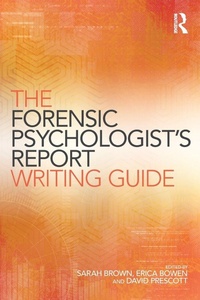
The Forensic Psychologist's Report Writing Guide
1st Edition
Published on 9. May 2017
Book
Paperback/Softback
256 pages
978-1-138-84151-2 (ISBN)
Description
The Forensic Psychologist's Reporting Writing Guide is the first book to provide both student trainees and practitioners with best practice guidance for one of the core skills of their role.
Written and edited by an international range of experts from the UK, North America and Australasia, it provides clear advice on a range of assessments, from psychometric tests to personality functioning, and includes real-life examples to illustrate key points. Uniquely, the book also offers guidance on the range of different client groups that forensic psychologists work with across both civil and legal contexts, including juveniles, female clients, couples and those with cognitive impairments. From core principles to writing style to key issues, each chapter also includes a checklist of advice and further reading.
Comprehensive and practical, The Forensic Psychologist's Reporting Writing Guide is a user-friendly companion to this critical and often overlooked skill, and will be essential reading for both neophyte and experienced forensic psychologists alike.
Written and edited by an international range of experts from the UK, North America and Australasia, it provides clear advice on a range of assessments, from psychometric tests to personality functioning, and includes real-life examples to illustrate key points. Uniquely, the book also offers guidance on the range of different client groups that forensic psychologists work with across both civil and legal contexts, including juveniles, female clients, couples and those with cognitive impairments. From core principles to writing style to key issues, each chapter also includes a checklist of advice and further reading.
Comprehensive and practical, The Forensic Psychologist's Reporting Writing Guide is a user-friendly companion to this critical and often overlooked skill, and will be essential reading for both neophyte and experienced forensic psychologists alike.
Reviews / Votes
'Those who aspire to excellence in forensic and correctional report-writing will find that the various chapters in The Forensic Psychologists' Report Writing Guide offer superb guidance. It will be supremely helpful to psychologists who write such reports, attorneys who use them in litigation, judges who rely on them to inform their decisions, and clinical administrators who seek high quality in their reports.' - Kirk Heilbrun, Drexel University, Philadelphia, USA'This volume is an excellent resource for students developing their report writing skills, and an essential desk reference for practitioners. An international team of leading academics and practitioners take an evidence-based approach supported by concrete real world examples and advice on the diverse range of reports that forensic psychologists are asked to write.' - Caoilte O Ciardha, University of Kent, Canterbury, UK
"Overall, I thoroughly recommend this book to trainee and qualified practitioners. The editors have done an excellent job of collating accessible and practical expertise from the current field. New assessors will find it a useful primer and existing assessors will find chapters on neglected areas stimulating for new reflection. I recommend using it alongside a writing style guide and maintaining a critical stance, remembering that we can still improve the accessibility, language and cultural sensitivity of our reports." - Sophie Ellis, Trainee Forensic Psychologist, Institute of Criminology: Cambridge University, Forensic Update (British Psychological Society)
More details
Language
English
Place of publication
London
United Kingdom
Publishing group
Taylor & Francis Ltd
Target group
College/higher education
Postgraduate, Professional, and Professional Practice & Development
Illustrations
4 s/w Zeichnungen, 3 s/w Tabellen
3 Tables, black and white; 4 Line drawings, black and white
Dimensions
Height: 234 mm
Width: 156 mm
Thickness: 15 mm
Weight
418 gr
ISBN-13
978-1-138-84151-2 (9781138841512)
Copyright in bibliographic data and cover images is held by Nielsen Book Services Limited or by the publishers or by their respective licensors: all rights reserved.
Schweitzer Classification
Other editions
Additional editions
Sarah Brown | Erica Bowen | David Prescott
The Forensic Psychologist's Report Writing Guide
Book
05/2017
1st Edition
Routledge
€231.90
Shipment within 10-20 days
Sarah Brown | Erica Bowen | David Prescott
The Forensic Psychologist's Report Writing Guide
E-Book
05/2017
Routledge
€59.49
Available for download
Sarah Brown | Erica Bowen | David Prescott
The Forensic Psychologist's Report Writing Guide
E-Book
05/2017
Routledge
€59.49
Available for download
Persons
Sarah Brown is a Professor in the Centre for Research in Psychology, Behaviour and Achievement at Coventry University, UK.
Erica Bowen was a Professor in the Centre for Research in Psychology, Behaviour and Achievement at Coventry University, UK and moved in 2016 to become Professor of Prevention of Violence and Abuse at the University of Worcester, UK.
David Prescott is a practising forensic practitioner in New England, USA.
Erica Bowen was a Professor in the Centre for Research in Psychology, Behaviour and Achievement at Coventry University, UK and moved in 2016 to become Professor of Prevention of Violence and Abuse at the University of Worcester, UK.
David Prescott is a practising forensic practitioner in New England, USA.
Content
Introduction
Section 1: general issues of reporting across different types of assessments
Chapter 1: Reporting psychometric tests
Chapter 2: Reporting intellectual capacity/cognitive functioning
Chapter 3: Reporting actuarial risk
Chapter 4: Reporting case formulation and opinion
Chapter 5: Reporting structured professional judgement
Chapter 6: Reporting personality functioning
Chapter 7: Reporting change
Section 2: considerations when reporting on specific client groups
Chapter 8: Reporting on juvenile clients
Chapter 9: Reporting on female clients
Chapter 10: Reporting on vulnerable clients including those with cognitive impairments
Chapter 11: Reporting on relationships, e.g. parenting competence, couples' assessments
Section 3: considerations when reporting in specific contexts
Chapter 12: Reporting in secure settings, e.g. prisons, forensic hospitals
Chapter 13: Reporting for parole or other hearings, e.g. mental health tribunals
Chapter 14: Reporting for community contexts, e.g. probation, community-based programmes/organisations
Appendix 1: Example Report 1
Appendix 2: Example Report 2
Appendix 3: Example Report 3
Section 1: general issues of reporting across different types of assessments
Chapter 1: Reporting psychometric tests
Chapter 2: Reporting intellectual capacity/cognitive functioning
Chapter 3: Reporting actuarial risk
Chapter 4: Reporting case formulation and opinion
Chapter 5: Reporting structured professional judgement
Chapter 6: Reporting personality functioning
Chapter 7: Reporting change
Section 2: considerations when reporting on specific client groups
Chapter 8: Reporting on juvenile clients
Chapter 9: Reporting on female clients
Chapter 10: Reporting on vulnerable clients including those with cognitive impairments
Chapter 11: Reporting on relationships, e.g. parenting competence, couples' assessments
Section 3: considerations when reporting in specific contexts
Chapter 12: Reporting in secure settings, e.g. prisons, forensic hospitals
Chapter 13: Reporting for parole or other hearings, e.g. mental health tribunals
Chapter 14: Reporting for community contexts, e.g. probation, community-based programmes/organisations
Appendix 1: Example Report 1
Appendix 2: Example Report 2
Appendix 3: Example Report 3