

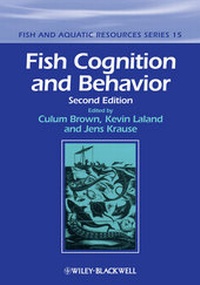
Fish Cognition and Behavior
2nd Edition
Published on 5. August 2011
Book
Hardback
472 pages
978-1-4443-3221-6 (ISBN)
Description
In the second edition of this fascinating book an international team of experts have been brought together to explore all major areas of fish learning, including:
* Foraging skills
* Predator recognition
* Social organisation and learning
* Welfare and pain
Three new chapters covering fish personality, lateralisation, and fish cognition and fish welfare, have been added to this fully revised and expanded second edition.
Fish Cognition and Behavior, Second Edition contains essential information for all fish biologists and animal behaviorists and contains much new information of commercial importance for fisheries managers and aquaculture personnel. Libraries in all universities and research establishments where biological sciences, fisheries and aquaculture are studied and taught will find it an important addition to their shelves.
Reviews / Votes
"With the inclusion of new aspects and the update of the content of the first edition this book is a must for all researchers in the field of fish behaviour and interaction." (Bulletin of Fish Biology, 1 October 2011)"Summing Up: Recommended. Upper-division undergraduates through professionals." (Choice, 1 March 2012)
More details
Series
Edition
2. Auflage
Language
English
Place of publication
Hoboken
United Kingdom
Publishing group
John Wiley and Sons Ltd
Target group
Professional and scholarly
Product notice
sewn/stitched
Cloth over boards
Dimensions
Height: 250 mm
Width: 175 mm
Thickness: 30 mm
Weight
992 gr
ISBN-13
978-1-4443-3221-6 (9781444332216)
Schweitzer Classification
Other editions
Additional editions
Culum Brown | Kevin Laland | Jens Krause
Fish Cognition and Behavior
E-Book
06/2011
2nd Edition
Wiley-Blackwell
€182.99
Available for download
Culum Brown | Kevin Laland | Jens Krause
Fish Cognition and Behavior
E-Book
06/2011
2nd Edition
Wiley-Blackwell
€182.99
Available for download
Previous edition

Culum Brown | Kevin Laland | Jens Krause
Fish Cognition and Behavior
Book
10/2006
Wiley-Blackwell
€160.94
Article exhausted; check for reprint
Persons
Culum Brown is at the Department of Biological Sciences, Macquarie University, Sydney, Australia.
Kevin Laland is at the Centre for Social Learning and Cognitive Evolution, School of Biology, University of St Andrews, UK.
Jens Krause is at the Department of Biology and Ecology of Fishes, Leibniz-Institute of Freshwater Ecology and Inland Fisheries, and also at Humboldt University, both in Berlin, Germany.
Content
Preface and Acknowledgements.
Series Foreword.
List of Contributors.
1 Fish Cognition and Behaviour (Brown, Laland and Krause).
1.1 Introduction.
1.2 Contents of this book.
References.
2 Learning of Foraging Skills by Fish (Warburton and Hughes).
2.1 Introduction.
2.2 Some factors affecting the learning process.
2.3 Patch use and probability matching.
2.4 Performance.
2.5 Tracking environmental variation.
2.6 Competition.
2.7 Learning and fish feeding: some applications.
2.8 Conclusions.
Acknowledgements.
References.
3 Learned Defences and Counterdefences in Predator-Prey Interactions (Kelley and Magurran).
3.1 Introduction.
3.2 The predator-prey sequence.
3.3 Summary and discussion .
Acknowledgements.
References.
4 Learning about Danger: Chemical Alarm Cues and Threat-Sensitive Assessment of Predation Risk by Fishes (Brown, Ferrari and Chivers).
4.1 Introduction.
4.2 Chemosensory cues as sources of information.
4.3 Variable predation risk and flexible learning.
4.4 Generalisation of risk.
4.5 Predator recognition continuum hypothesis.
4.6 Retention: the forgotten component of learning.
4.7 Conservation, management and learning.
4.8 Conclusions.
Acknowledgements.
References.
5 Learning and Mate Choice (Witte and N¨obel).
5.1 Introduction.
5.2 Sexual imprinting.
5.3 Learning after reaching maturity.
5.4 Eavesdropping .
5.5 Mate-choice copying.
5.6 Social mate preferences overriding genetic preferences.
5.7 Cultural evolution through mate-choice copying.
5.8 Does mate-choice copying support the evolution of a novel male trait?
5.9 Is mate-choice copying an adaptive mate-choice strategy?
5.10 Outlook.
5.11 Conclusions.
References.
6 Aggressive Behaviour in Fish: Integrating Information about
Contest Costs (Hsu, Earley and Wolf).
6.1 Introduction.
6.2 Information about resource value.
6.3 Information about contest costs.
6.4 Physiological mechanisms.
6.5 Conclusions and future directions.
Acknowledgements.
References.
7 Personality Traits and Behaviour (Budaev and Brown).
7.1 Introduction.
7.2 Observation and description of personality.
7.3 Proximate causation.
7.4 Ontogeny and experience.
7.5 Is personality adaptive?
7.6 Evolution.
7.7 Wider implications.
7.8 Conclusions.
Acknowledgements.
References.
8 The Role of Learning in Fish Orientation (Odling-Smee, Simpson and Braithwaite).
8.1 Introduction.
8.2 Why keep track of location?
8.3 The use of learning and memory in orientation
8.4 Learning about landmarks.
8.5 Compass orientation.
8.6 Water movements.
8.7 Inertial guidance and internal 'clocks'.
8.8 Social cues.
8.9 How flexible is orientation behaviour?
8.10 Salmon homing - a case study.
8.11 Conclusion.
Acknowledgements.
References.
9 Social Recognition of Conspecifics (Griffiths and Ward).
9.1 Introduction.
9.2 Recognition of familiars.
9.3 Familiarity or kin recognition?
9.4 Conclusion.
References.
10 Social Organisation and Information Transfer in Schooling Fish (Ioannou, Couzin, James, Croft and Krause).
10.1 Introduction.
10.2 Collective motion.
10.3 Emergent collective motion in the absence of external stimuli.
10.4 Response to internal state and external stimuli: Information processing within schools.
10.5 Informational status, leadership and collective decision-making in fish schools.
10.6 The structure of fish schools and populations.
10.7 Social networks and individual identities.
10.8 Community structure in social networks.
10.9 Conclusions and future directions.
Acknowledgements.
References.
11 Social Learning in Fishes (Brown and Laland).
11.1 Introduction.
11.2 Anti-predator behaviour.
11.3 Migration and orientation.
11.4 Foraging.
11.5 Mate choice.
11.6 Aggression.
11.7 Trade-offs in reliance on social and asocial sources of information.
11.8 Concluding remarks.
Acknowledgements.
References.
12 Cooperation and Cognition in Fishes (Alfieri and Dugatkin).
12.1 Introduction.
12.2 Why study cooperation in fishes?
12.3 Cooperation and its categories.
12.4 Conclusion.
Acknowledgements.
References.
13 Machiavellian Intelligence in Fishes (Bshary).
13.1 Introduction.
13.2 Evidence for functional aspects of Machiavellian intelligence.
13.3 Evidence for cognitive mechanisms in fishes.
13.4 Discussion.
Acknowledgements.
References.
14 Lateralization of Cognitive Functions in Fish (Bisazza and Brown).
14.1 Introduction.
14.2 Lateralized functions in fish.
14.3 Individual differences in lateralization.
14.4 Ecological consequences of lateralization of cognitive functions.
14.5 Summary and future research.
Acknowledgements.
References.
15 Brain and Cognition in Teleost Fish (Broglio, G´omez, Dur´an, Salas and Rodr´iguez).
15.1 Introduction.
15.2 Classical conditioning.
15.3 Emotional learning.
15.4 Spatial cognition.
15.5 Concluding remarks.
Acknowledgements .
References.
16 Fish Behaviour, Learning, Aquaculture and Fisheries (Fern¨o, Huse, Jakobsen, Kristiansen and Nilsson).
16.1 Fish learning skills in the human world.
16.2 Fisheries.
16.3 Aquaculture.
16.4 Stock enhancement and sea-ranching.
16.5 Escapees from aquaculture .
16.6 Capture-based aquaculture.
16.7 Conclusions and perspectives.
Acknowledgements.
References.
17 Cognition and Welfare (Sneddon).
17.1 Introduction.
17.2 What is welfare?
17.3 What fishes want.
17.4 What fishes do not want.
17.5 Pain and fear in fish.
17.6 Personality in fish.
17.7 Wider implications for the use of fish.
17.8 Conclusion.
Acknowledgements.
References.
Species List.
Index.