

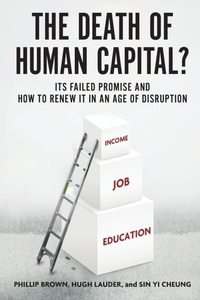
The Death of Human Capital?
Its Failed Promise and How to Renew It in an Age of Disruption
Published on 4. November 2020
Book
Paperback/Softback
314 pages
978-0-19-064431-4 (ISBN)
Description
Human capital theory, or the notion that there is a direct relationship between educational investment and individual and national prosperity, has dominated public policy on education and labor for the past fifty years. In The Death of Human Capital?, Phillip Brown, Hugh Lauder, and Sin Yi Cheung argue that the human capital story is one of false promise: investing in learning isn't the road to higher earnings and national prosperity. Rather than abandoning human capital theory, however, the authors redefine human capital in an age of smart machines. They present a new human capital theory that rejects the view that automation and AI will result in the end of waged work, but see the fundamental problem as a lack of quality jobs offering interesting, worthwhile, and rewarding opportunities. A controversial challenge to the reigning ideology, The Death of Human Capital? connects with a growing sense that capitalism is in crisis, felt by students and the wider workforce, shows what's at stake in the new human capital while offering hope for the future.
Reviews / Votes
...this new theory is appealing. Recommended. All levels. * E. P. Hoffman, Western Michigan University, CHOICE * The Death of Human Capital? challenges the conventional wisdom of human capital theory when analyzing higher education, graduate employment, and youth transition from education to work. It is not only thought-provoking, but breaks new ground for offering comparative and international perspectives in understanding global competition, new technologies, and economic inequalities in the highly globalized world." -Ka Ho Mok, Chair Professor of Comparative Policy, Lingnan University, Hong Kong Human capital theory and the policies spawned from it have promised much, delivered little, and trapped us all in an endless cycle of chasing the next credential. Brown, Lauder, and Chueng provide a clear and compelling argument for an alternative vision of labor markets that accounts for job creation, job destruction, and job skills, providing a roadmap for coming to terms with real inequalities in opportunity and life chances." -Kevin T. Leicht, Professor of Sociology, University of Illinois Urbana-ChampaignMore details
Language
English
Place of publication
New York
United States
Target group
College/higher education
Illustrations
28 black and white figures; 3 tables
Dimensions
Height: 234 mm
Width: 156 mm
Thickness: 17 mm
Weight
480 gr
ISBN-13
978-0-19-064431-4 (9780190644314)
Copyright in bibliographic data and cover images is held by Nielsen Book Services Limited or by the publishers or by their respective licensors: all rights reserved.
Schweitzer Classification
Other editions
Additional editions

Phillip Brown | Hugh Lauder | Sin Yi Cheung
The Death of Human Capital?
Its Failed Promise and How to Renew It in an Age of Disruption
Book
11/2020
Oxford University Press Inc
€150.30
Shipment within 15-20 days

Phillip Brown | Hugh Lauder | Sin Yi Cheung
The Death of Human Capital?
Its Failed Promise and How to Renew It in an Age of Disruption
E-Book
09/2020
OUP eBook
€20.99
Available for download

Phillip Brown | Hugh Lauder | Sin Yi Cheung
The Death of Human Capital?
Its Failed Promise and How to Renew It in an Age of Disruption
E-Book
09/2020
OUP eBook
€20.99
Available for download
Persons
Phillip Brown is a Distinguished Research Professor in the School of Social Sciences at Cardiff University. His publications include 18 books and over 100 academic articles and reports. He has given presentations in over twenty countries. He Chaired an Independent Review for the Welsh Government examining the impact of digital innovation for the economy and the future of work in Wales, UK, and is currently leading a six-country research program examining digital transformation and the future of work, education and skills, in collaboration with the Research and Innovation Division, Institute of Adult Learning, Singapore University of Social Sciences (SUSS). He also serves on the Council of Management, National Institute for Economic and Social Research, London.
Hugh Lauder is Professor of Education and Political Economy at the University of Bath. He specializes in the relationship of education to the economy and has for over 20 years worked on national skill strategies and the global economy. His current work is on the alternatives to human capital and skill bias technical change theories.
Sin Yi Cheung is Professor of Sociology at the School of Social Sciences at Cardiff University. Her research addresses different forms of social inequalities in Britain and in comparative perspective. She has published on the changing inequalities in higher education, ethno-religious penalties in the labor market, lone parents on benefits, claimants' dynamics, children in care, migration and refugee integration.
Hugh Lauder is Professor of Education and Political Economy at the University of Bath. He specializes in the relationship of education to the economy and has for over 20 years worked on national skill strategies and the global economy. His current work is on the alternatives to human capital and skill bias technical change theories.
Sin Yi Cheung is Professor of Sociology at the School of Social Sciences at Cardiff University. Her research addresses different forms of social inequalities in Britain and in comparative perspective. She has published on the changing inequalities in higher education, ethno-religious penalties in the labor market, lone parents on benefits, claimants' dynamics, children in care, migration and refugee integration.
Content
1. Introduction Part One - The Rise of Human Capital Theory
2. Origins
3. The High Tide Part Two - The Failed Promise
4. Learning Isn't Earning 5. Winners and Losers
6. The Mirage of Opportunity 7. The Failed Promise of Development
8. A Revisionist History Part Three - The New Human Capital 9. Starting Principles
10. Rethinking Labor Supply
11. Rethinking Job Demand
12. Rethinking Economic Returns 13. Conclusion: A Race Against Time Appendix
Notes
2. Origins
3. The High Tide Part Two - The Failed Promise
4. Learning Isn't Earning 5. Winners and Losers
6. The Mirage of Opportunity 7. The Failed Promise of Development
8. A Revisionist History Part Three - The New Human Capital 9. Starting Principles
10. Rethinking Labor Supply
11. Rethinking Job Demand
12. Rethinking Economic Returns 13. Conclusion: A Race Against Time Appendix
Notes