

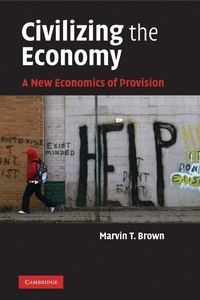
Civilizing the Economy
A New Economics of Provision
1st Edition
Published on 1. April 2010
Book
Paperback/Softback
282 pages
978-0-521-15246-4 (ISBN)
Description
When a handful of people thrive while whole industries implode and millions suffer, it is clear that something is wrong with our economy. The wealth of the few is disconnected from the misery of the many. In Civilizing the Economy, Marvin Brown traces the origin of this economics of dissociation to early capitalism, showing how this is illustrated in Adam Smith's denial of the central role of slavery in wealth creation. In place of the Smithian economics of property, Brown proposes that we turn to the original meaning of economics as household management. He presents a new framework for the global economy that reframes its purpose as the making of provisions instead of the accumulation of property. This bold new vision establishes the civic sphere as the platform for organizing an inclusive economy and as a way to move toward a more just and sustainable world.
Reviews / Votes
'As we humans puzzle our way to an understanding of how to live sustainably within Earth's carrying capacity, Marvin Brown has provided a crucial piece of the puzzle. Civilizing the Economy is an important book because it expresses a keystone idea of the new economic system that must evolve if our species is to survive and live up to its potential.' Ray Anderson, Founder and Chairman, Interface, Inc. 'Marvin Brown's intriguing argument sets out a compelling roadmap for directing the world's economy at this critical stage of human history. Instead of turning toward disparate, atomic strategies (such as property maximization at any cost), Brown steers us toward a holistic strategy that combines environmental sustainability, corporate responsibility (broadly conceived to include ethical and humanitarian concerns), and real economic development that will provide for all the peoples of the world. The property vs. provision paradigm is a foundational discussion that will both stimulate scholars as well as prompt constructive classroom debate.' Michael Boylan, Professor of Philosophy, Marymount University 'In the current debate about the future of capitalism, Marvin Brown provides essential benchmarks to separate the wheat from the chaff in moving toward a civilized economy. His provocative and well-argued vision not only criticizes the dominant role of property in capitalism but also ventures into a novel design of economics, 'the economics of provision' which values economic activity over economic possessions. Moreover, against the 'economization' of society, he vigorously places economic activity within the frame of a civic agenda, giving a balanced account of both economic and civic demands and limitations. This book is a must-read in redefining capitalism.' Georges Enderle, John T. Ryan Jr Professor of International Business Ethics, University of Notre Dame 'This book is a must-read for all of us who believe we must change our operating economic paradigms, and a foreshadowing of the dire consequences for all of us if we don't. Marvin Brown offers us a new economic path - a theory of provisions morally trumping property - which if followed might just lead us to the true meaning of civilization.' W. Michael Hoffman, Hieken Professor of Business and Professional Ethics, Bentley University 'In this profound and courageous book, Marvin Brown asks the question that moral philosophers and political economists have pondered since Socrates: What is a just society? In a spirit similar to E. F. Schumacher's 'economics as if people mattered', he limns a bold, fresh and scholarly vision of a new, 'civilized' economic order with a fairer distribution of income, wealth, and goods.' James O'Toole, Daniels Distinguished Professor of Business Ethics, University of Denver 'Marvin Brown offers a creative new perspective on the economy, much needed in the face of two global crises: climate change and the economic collapse of 2008 that highlights the flaws of current economic thinking. This creative approach will stimulate, provoke, and, hopefully, move the conversation about what economy should look like in the future forward.' Sandra Waddock, Galligan Chair of Strategy, Boston CollegeMore details
Language
English
Place of publication
Cambridge
United Kingdom
Target group
Professional and scholarly
Product notice
Paperback (trade)
Illustrations
3 Tables, unspecified; 33 Line drawings, unspecified
Dimensions
Height: 229 mm
Width: 152 mm
Thickness: 15 mm
Weight
416 gr
ISBN-13
978-0-521-15246-4 (9780521152464)
Copyright in bibliographic data and cover images is held by Nielsen Book Services Limited or by the publishers or by their respective licensors: all rights reserved.
Schweitzer Classification
Other editions
Additional editions
E-Book
05/2010
1st Edition
Cambridge University Press
€35.49
Available for download
Book
04/2010
1st Edition
Cambridge University Press
€102.70
Shipment within 15-20 days
Person
Marvin T. Brown teaches business and organizational ethics in the Philosophy department at the University of San Francisco and in the Organizational Systems program at Saybrook University in San Francisco. His previous books include Working Ethics (1990), The Ethical Process (2003), and Corporate Integrity (Cambridge University Press, 2005).
Content
List of figures; List of tables; Preface; 1. Introduction: creating a just and sustainable economy; Part I. Creating a New Economic Framework: 2. Adam Smith's silence and an economics of property; 3. Reclaiming the notions of provision and family; 4. Making provisions in a dangerous world; Part II. The Civic Option: 5. From property relations to civic relations; 6. Society, civil society and the market; 7. Restoring reciprocity; 8. Civic norms and market competition; Part III. A Civic View of Labor, Land, and Money: 9. Labor: employment as engagement; 10. Land: ownership as a concession; 11. Money: commodity or credit; Part IV. Civilizing Economic Systems: 12. A world of systems; 13. Imagining stakeholder economy; 14. The ethics of economic systems; 15. Changing systems of provision; Part V. A Civic Agenda: 16. The civic obligations of corporations: 17. Creating circumstances for civic conversations; Appendix: free enterprise and the economics of slavery; Bibliography; Index.