

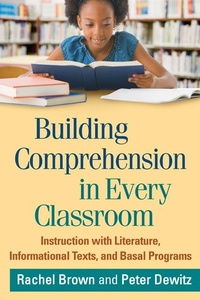
Building Comprehension in Every Classroom
Instruction with Literature, Informational Texts, and Basal Programs
1st Edition
Published on 10. December 2013
Book
Paperback/Softback
286 pages
978-1-4625-1120-4 (ISBN)
Description
This book presents a practical model and specific unit- and lesson-planning ideas for enhancing students' reading comprehension in any 2-8 classroom. The authors provide innovative suggestions that help teachers construct a comprehension curriculum organized around literature, informational texts, or a basal reading program. Vivid case examples and vignettes bring to life ways to build the knowledge, strategies, and motivation that children need to engage with different types of texts and become proficient, enthusiastic readers. Graphic elements throughout the volume link instructional and assessment practices directly to the Common Core standards.
Reviews / Votes
With rich classroom examples, this book shows grade 2-8 teachers how to make reading comprehension instruction meaningful and effective. Brown and Dewitz detail ways to help students become knowledgeable, strategic, metacognitive, and motivated--outcomes that meet the expectations set in the Common Core State Standards. Perfect for teachers and teacher candidates in reading courses, this book will be a powerful tool for professional development.--Mariam Jean Dreher, PhD, Department of Teaching, Learning, Policy, and Leadership, University of Maryland, College ParkIn order to be a highly effective classroom teacher, I need to understand what children are doing when they attempt to comprehend. Brown and Dewitz do an outstanding job describing this invisible process within the successful reader's mind. Their instructional suggestions and ideas line up with Common Core State Standards and are presented in a teacher-friendly format that can fit into your existing program. The 'Looking Back, Looking Forward' section at the end of each chapter keeps the reader reassessing the whole comprehension puzzle with which teachers are challenged as they teach.--Kay M. Dimon, MEd, fourth-grade teacher, Fremont Elementary School, East Syracuse, New York
The authors offer well-defined and illustrative core comprehension principles that are beneficial for teacher-training programs and daily use by classroom teachers. The book embodies the very essence of what needs to occur in classrooms across the nation to provide our children with vital reading strategies.--Nora Laaksonen, MEd, reading specialist, Accomack County (Virginia) Public Schools - With rich classroom examples, this book shows grade 2-8 teachers how to make reading comprehension instruction meaningful and effective. Brown and Dewitz detail ways to help students become knowledgeable, strategic, metacognitive, and motivated--outcomes that meet the expectations set in the Common Core State Standards. Perfect for teachers and teacher candidates in reading courses, this book will be a powerful tool for professional development.--Mariam Jean Dreher, PhD, Department of Teaching, Learning, Policy, and Leadership, University of Maryland, College Park
A In order to be a highly effective classroom teacher, I need to understand what children are doing when they attempt to comprehend. Brown and Dewitz do an outstanding job describing this invisible process within the successful reader's mind. Their instructional suggestions and ideas line up with Common Core State Standards and are presented in a teacher-friendly format that can fit into your existing program. The 'Looking Back, Looking Forward' section at the end of each chapter keeps the reader reassessing the whole comprehension puzzle with which teachers are challenged as they teach.--Kay M. Dimon, MEd, fourth-grade teacher, Fremont Elementary School, East Syracuse, New York
The authors offer well-defined and illustrative core comprehension principles that are beneficial for teacher-training programs and daily use by classroom teachers. The book embodies the very essence of what needs to occur in classrooms across the nation to provide our children with vital reading strategies.--Nora Laaksonen, MEd, reading specialist, Accomack County (Virginia) Public Schools
A
-
More details
Language
English
Place of publication
New York
United States
Publishing group
Guilford Publications
Target group
Professional and scholarly
Professional Practice & Development
Product notice
Paperback (trade)
Unsewn / adhesive bound
Dimensions
Height: 228 mm
Width: 152 mm
Thickness: 20 mm
Weight
422 gr
ISBN-13
978-1-4625-1120-4 (9781462511204)
Copyright in bibliographic data and cover images is held by Nielsen Book Services Limited or by the publishers or by their respective licensors: all rights reserved.
Schweitzer Classification
Other editions
Additional editions

Rachel Brown | Peter Dewitz
Building Comprehension in Every Classroom
Instruction with Literature, Informational Texts, and Basal Programs
Book
12/2013
1st Edition
Guilford Press
€90.55
Article exhausted; check different version
Rachel Brown | Peter Dewitz
Building Comprehension in Every Classroom
Instruction with Literature, Informational Texts, and Basal Programs
E-Book
10/2013
The Guilford Press
€41.99
Available for download
Persons
Rachel Brown, PhD, is Associate Professor in the Reading and Language Arts Center at Syracuse University, where she teaches graduate courses in literacy education and is affiliated with the undergraduate and graduate elementary teacher education programs. Previously she worked as a middle school learning specialist in the American School in London. Dr. Brown is a recipient of a Graduate Teaching Recognition Award from Syracuse University and an Elva Knight Research Grant from the International Reading Association. Her research and publications focus on elementary and middle school literacy instruction, with specific interests in comprehension strategies instruction, self-regulated learning, teacher professional development, and technology and literacy.
Peter Dewitz, PhD, is Professor of Education at Mary Baldwin College. Formerly he taught at California State University, Los Angeles; the University of Toledo; and the University of Virginia. Dr. Dewitz is also a researcher and staff developer who has worked with many public schools to help them improve their reading comprehension instruction. His staff development work spans many states, school districts, and countries. Prior to becoming a professor, he taught fifth and sixth grade in Los Angeles. Dr. Dewitz has written three previous books and over 40 articles on reading instruction and reading programs.
A
Peter Dewitz, PhD, is Professor of Education at Mary Baldwin College. Formerly he taught at California State University, Los Angeles; the University of Toledo; and the University of Virginia. Dr. Dewitz is also a researcher and staff developer who has worked with many public schools to help them improve their reading comprehension instruction. His staff development work spans many states, school districts, and countries. Prior to becoming a professor, he taught fifth and sixth grade in Los Angeles. Dr. Dewitz has written three previous books and over 40 articles on reading instruction and reading programs.
A
Content
Foreword, Nell K. Duke
1. What Does Good Comprehension Look Like? 2. Beyond the Reader: Texts and Contexts of Comprehension 3. Teaching Comprehension 4. Assessment 5. Planning Comprehension Instruction in a Literature-Based Framework 6. Teaching Reading Comprehension with Literature 7. Planning Comprehension Instruction in an Inquiry Framework 8. Teaching Reading Comprehension with Informational Texts 9. Planning Comprehension Instruction in a Basal Program Framework 10. Teaching Reading Comprehension with a Basal Reading Program 11. Conclusion: What We Hoped You Have Learned
1. What Does Good Comprehension Look Like? 2. Beyond the Reader: Texts and Contexts of Comprehension 3. Teaching Comprehension 4. Assessment 5. Planning Comprehension Instruction in a Literature-Based Framework 6. Teaching Reading Comprehension with Literature 7. Planning Comprehension Instruction in an Inquiry Framework 8. Teaching Reading Comprehension with Informational Texts 9. Planning Comprehension Instruction in a Basal Program Framework 10. Teaching Reading Comprehension with a Basal Reading Program 11. Conclusion: What We Hoped You Have Learned