

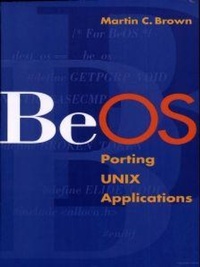
BeOS
Porting UNIX Applications
Published on 29. September 1998
Book
Paperback/Softback
496 pages
978-1-55860-532-9 (ISBN)
Description
The BeOS is the exciting new operating system designed natively for the Internet and digital media. Programmers are drawn to the BeOS by its many state-of-the-art features, including pervasive multithreading, a symmetric multiprocessing architecture, and an integrated multithreaded graphics system. The Be engineering team also built in many UNIX-like capabilities as part of a POSIX toolkit. Best of all, the BeOS runs on a variety of Intel architectures and PowerPC platforms and uses off-the-shelf hardware. This book explores the BeOS from a POSIX programmer's point of view, providing a comprehensive and practical guide to porting UNIX and other POSIX-based software to the BeOS. BeOS: Porting UNIX Applications will help you move your favorite UNIX software to an environment designed from the ground up for high-performance applications.
More details
Language
English
Place of publication
San Francisco
United States
Publishing group
Elsevier Science & Technology
Target group
Professional and scholarly
UNIX programmer and programmers working on other POSIX compliant systems interested in porting applications from those systems to the BeOS.
Product notice
Paperback (trade)
Unsewn / adhesive bound
Dimensions
Height: 229 mm
Width: 178 mm
Thickness: 26 mm
Weight
726 gr
ISBN-13
978-1-55860-532-9 (9781558605329)
Copyright in bibliographic data and cover images is held by Nielsen Book Services Limited or by the publishers or by their respective licensors: all rights reserved.
Schweitzer Classification
Person
Martin C. Brown is one of the most active programmers outside of Be porting UNIX applications to the BeOS. He has worked with most varieties of UNIX, Mac, and Windows systems, doing everything from software development to system administration. When he's not on the job as an IT manager, he is enthusiastically involved in the Be development effort.
Content
Part I - Preparation
Chapter 1 - Introduction to the Porting Process
Chapter 2 - BeOS Structure
Chapter 3 - Were not in UNIX Anymore
Chapter 4 - Useful Tools
Chapter 5 - Sources
Chapter 6 - Revisions and Backups
Part II - The Porting Process
Chapter 7 - Getting Started
Chapter 8 - Configuring the Package
Chapter 9 - Makefiles
Chapter 10 - Configuration Scripts
Chapter 11 - Smart Compilers
Chapter 12 - bison and flex
Chapter 13 - The Compiler and Linker
Chapter 14 - The Debugger
Chapter 15 - Building the Package
Chapter 16 - Overview of BeOS Programming
Chapter 17 - POSIX
Chapter 18 - Kernel Support
Chapter 19 - Time Support
Chapter 20 - Terminals and Devices
Chapter 21 - Files and Directories
Chapter 22 - Networking
Chapter 23 - Summary
Appendix A - Resources
Appendix B - Releasing the Software
Chapter 1 - Introduction to the Porting Process
Chapter 2 - BeOS Structure
Chapter 3 - Were not in UNIX Anymore
Chapter 4 - Useful Tools
Chapter 5 - Sources
Chapter 6 - Revisions and Backups
Part II - The Porting Process
Chapter 7 - Getting Started
Chapter 8 - Configuring the Package
Chapter 9 - Makefiles
Chapter 10 - Configuration Scripts
Chapter 11 - Smart Compilers
Chapter 12 - bison and flex
Chapter 13 - The Compiler and Linker
Chapter 14 - The Debugger
Chapter 15 - Building the Package
Chapter 16 - Overview of BeOS Programming
Chapter 17 - POSIX
Chapter 18 - Kernel Support
Chapter 19 - Time Support
Chapter 20 - Terminals and Devices
Chapter 21 - Files and Directories
Chapter 22 - Networking
Chapter 23 - Summary
Appendix A - Resources
Appendix B - Releasing the Software