

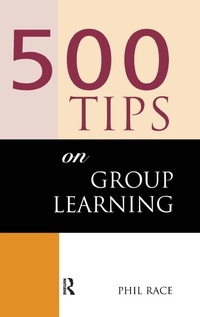
500 Tips on Group Learning
1st Edition
Published on 26. April 2017
Book
Hardback
148 pages
978-1-138-17984-4 (ISBN)
Description
Including sections on creative thinking, problems in groups, feedback mechanisms, dealing with conflict, and gender issues within groups, this volume is designed to aid educators and trainers to create more effective group learning situations.
More details
Series
Language
English
Place of publication
London
United Kingdom
Publishing group
Taylor & Francis Ltd
Target group
Professional and scholarly
Academic and Professional Practice & Development
Dimensions
Height: 240 mm
Width: 161 mm
Thickness: 13 mm
Weight
394 gr
ISBN-13
978-1-138-17984-4 (9781138179844)
Copyright in bibliographic data and cover images is held by Nielsen Book Services Limited or by the publishers or by their respective licensors: all rights reserved.
Schweitzer Classification
Other editions
Additional editions
Sally Brown | Phil Race
500 Tips on Group Learning
E-Book
05/2014
1st Edition
Routledge
€69.99
Available for download
Sally Brown | Phil Race
500 Tips on Group Learning
E-Book
05/2014
1st Edition
Routledge
€69.99
Available for download

Book
04/2000
Routledge Falmer
€75.80
Shipment within 10-20 days
Persons
Content
Part 1 Learning with others; Chapter 1 Learning about learning; Chapter 2 Group learning means learning by doing; Chapter 3 Group learning means learning through feedback; Chapter 4 Things going wrong can be good group learning; Chapter 5 Group learning means motivation... wanting to learn...; Chapter 6 Behaviours of a good leader; Chapter 7 Group learning includes following; Chapter 8 Benefits of group learning; Part 2 Getting groups going; Chapter 9 Preparing learners for group work; Chapter 10 Ways of forming groups; Chapter 11 Group size considerations; Chapter 12 Getting groups started; Chapter 13 Icebreakers: some ideas; Chapter 14 Establishing ground rules for groups; Chapter 15 Reducing the bystander effect; Chapter 16 Creating group cohesion; Chapter 17 Setting shared goals; Part 3 Particular group learning contexts; Chapter 18 Tutorials; Chapter 19 Tutorials for adult distance learners; Chapter 20 Home groups; Chapter 21 Action learning sets; Chapter 22 Tutorless groups; Chapter 23 Be a group member yourself!; Chapter 24 Team teaching; Part 4 Exercises and processes for groups; Chapter 25 Ringing the changes; Chapter 26 Post-it exercise on how people learn; Chapter 27 Feedback exercise for groups; Chapter 28 Post-its and flipcharts; Chapter 29 Helping learners to write reflections on group learning; Chapter 30 Virtual group work; Chapter 31 A case study; Part 5 Groups behaving badly?; Chapter 32 Group member behaviours that damage group work; Chapter 33 Group facilitator behaviours that can damage group work; Chapter 34 Institutional factors that can damage group work; Chapter 35 Conflict in group work; Chapter 36 Gender issues in group work; Part 6 Assessing group learning; Chapter 37 Take the simplest path; Chapter 38 Divide and concur; Chapter 39 Add differentials; Chapter 40 Add contribution marks; Chapter 41 Add more tasks; Chapter 42 Test them orally; Chapter 43 Test them in writing;