

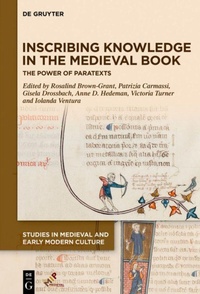
Inscribing Knowledge in the Medieval Book
The Power of Paratexts
1st Edition
Will be published approx. on 3. December 2019
Book
Hardback
416 pages
978-1-5015-1788-4 (ISBN)
Description
This collection, which brings together scholars
from the history of the book, law, science, medicine, literature, art, and philosophy, interrogates the role played by paratexts in establishing
authority, constructing bodies of knowledge, promoting education, shaping
reader response, and preserving or subverting tradition in medieval manuscript
culture.
from the history of the book, law, science, medicine, literature, art, and philosophy, interrogates the role played by paratexts in establishing
authority, constructing bodies of knowledge, promoting education, shaping
reader response, and preserving or subverting tradition in medieval manuscript
culture.
More details
Series
Language
English
Place of publication
New York
United States
Target group
Professional and scholarly
US School Grade: College Graduate Student
Product notice
sewn/stitched
Cloth over boards
Illustrations
50 s/w Abbildungen, 10 s/w Tabellen, 80 farbige Abbildungen
100 Illustrations, color
Dimensions
Height: 231 mm
Width: 157 mm
Thickness: 28 mm
Weight
748 gr
ISBN-13
978-1-5015-1788-4 (9781501517884)
Copyright in bibliographic data and cover images is held by Nielsen Book Services Limited or by the publishers or by their respective licensors: all rights reserved.
Schweitzer Classification
Other editions
Additional editions
Rosalind Brown-Grant | Patrizia Carmassi | Gisela Drossbach
Inscribing Knowledge in the Medieval Book
The Power of Paratexts
E-Book
01/2020
1st Edition
Medieval Institute Publications
€169.95
Available for download
Rosalind Brown-Grant | Patrizia Carmassi | Gisela Drossbach
Inscribing Knowledge in the Medieval Book
The Power of Paratexts
E-Book
01/2020
1st Edition
De Gruyter
€169.95
Available for download
Persons
Rosalind Brown-Grant is Professor of Late Medieval French Literature at the University of Leeds, publishing on Christine de Pizan, prose romances, and text-image relations in manuscripts. Patrizia Carmassi's research interests include the history of the medieval Church and liturgy, Latin philology, text-image relationships, paleography, codicology, and the history of libraries. Gisela Drossbach is Professor of European Regional History at the University of Augsburg, working on medieval law, history of religious institutions, and text-image relations. Anne D. Hedeman, Judith Harris Murphy Distinguished Professor of Art History at the University of Kansas, works on text-image relationships in vernacular late medieval French secular manuscripts. Victoria Turner is a Lecturer in French at the University of St Andrews working on medieval representations of gender, race, and otherness and narratives of travel and exploration. Iolanda Ventura, Associate Professor of Classical Philology and Italian Studies at the University of Bologna, works on the history of medicine and pharmacology, medical texts, and manuscripts.
Editor
Professor of Late Medieval French LiteratureUniversity of Leeds, School of Languages, Cultures, and Societies
Professor of European Regional HistoryUniversitaet Augsburg, LMU Muenchen
Professor of Medieval Art HistoryUniversity of Kansas
Lecturer in FrenchUniversity of St Andrews, School of Modern Languages
Associate Professor of Classical Philology and Italian StudiesUniversity of Bologna
Content
List of Figures
Editorial Principles
Preface and Acknowledgements
Introduction by the Editors
Part 1: Constructing Bodies of Knowledge
Juridical Late Medieval Paratexts and the Growth of European Jurisprudence by Mario Ascheri and Paola Maffei
Prefaces in Canon Law Books by Gisela Drossbach
"Depingo ut ostendam, depictum ita est expositio": Diagrams as an Indispensable Complement to the Cosmological Teaching of the Liber Nemroth de astronomia by Isabelle Draelants
Part 2: Negotiating Tradition, Creating Practice
From Text to Diagram: Giambattista Da Monte and the Practice of Medicine by Concetta Pennuto
Immortal Souls and an Angel Intellect: Some Thoughts on the Function and Meaning of Christian Iconography in Medieval Aristotle Textbooks by Hanna Wimmer
Writing in the Margin-Drawing in the Margin: Reading Practices of Medieval Jurists by Joanna Fronska
Structuring, Stressing, or Recasting Knowledge on the Page? Rubrication in the Manuscript Copies of the Pelerinage de l'ame by Guillaume de Deguileville by Geraldine Veysseyre
Part 3: Adopting Tradition, Empowering Readers
From Troy to Aachen: Ancient Rome and the Carolingian Reception of Vergil by Sinead O'Sullivan
Translating Prologues and Prologue Illustration in French Historical Texts by Anne D. Hedeman
Paratext and the Politics of Conquest: Questing Knights and Colonial Rule in Le Canarien by Victoria Turner
Prefaces and Frontispieces in Prose Romance Manuscripts by Rosalind Brown-Grant
Part 4: Appropriating Tradition, Expressing Ownership, Embodying the Book
Visualizing Pontifical Power: Paratextual Elements in Some French Liturgical Books, Thirteenth-Fifteenth Centuries by Alison Stones
Paratext in the Manuscripts of Hartmann Schedel by Outi Merisalo
Book Material, Production, and Use from the Point of View of the Paratext by Patrizia Carmassi
List of Manuscripts and Early Printed Editions Cited
Bibliography
Notes on Contributors and Editors
Index
Editorial Principles
Preface and Acknowledgements
Introduction by the Editors
Part 1: Constructing Bodies of Knowledge
Juridical Late Medieval Paratexts and the Growth of European Jurisprudence by Mario Ascheri and Paola Maffei
Prefaces in Canon Law Books by Gisela Drossbach
"Depingo ut ostendam, depictum ita est expositio": Diagrams as an Indispensable Complement to the Cosmological Teaching of the Liber Nemroth de astronomia by Isabelle Draelants
Part 2: Negotiating Tradition, Creating Practice
From Text to Diagram: Giambattista Da Monte and the Practice of Medicine by Concetta Pennuto
Immortal Souls and an Angel Intellect: Some Thoughts on the Function and Meaning of Christian Iconography in Medieval Aristotle Textbooks by Hanna Wimmer
Writing in the Margin-Drawing in the Margin: Reading Practices of Medieval Jurists by Joanna Fronska
Structuring, Stressing, or Recasting Knowledge on the Page? Rubrication in the Manuscript Copies of the Pelerinage de l'ame by Guillaume de Deguileville by Geraldine Veysseyre
Part 3: Adopting Tradition, Empowering Readers
From Troy to Aachen: Ancient Rome and the Carolingian Reception of Vergil by Sinead O'Sullivan
Translating Prologues and Prologue Illustration in French Historical Texts by Anne D. Hedeman
Paratext and the Politics of Conquest: Questing Knights and Colonial Rule in Le Canarien by Victoria Turner
Prefaces and Frontispieces in Prose Romance Manuscripts by Rosalind Brown-Grant
Part 4: Appropriating Tradition, Expressing Ownership, Embodying the Book
Visualizing Pontifical Power: Paratextual Elements in Some French Liturgical Books, Thirteenth-Fifteenth Centuries by Alison Stones
Paratext in the Manuscripts of Hartmann Schedel by Outi Merisalo
Book Material, Production, and Use from the Point of View of the Paratext by Patrizia Carmassi
List of Manuscripts and Early Printed Editions Cited
Bibliography
Notes on Contributors and Editors
Index