

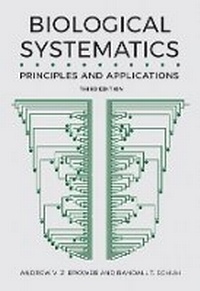
Biological Systematics
Principles and Applications
3rd Edition
Published on 15. March 2021
Book
Hardback
456 pages
978-1-5017-5277-3 (ISBN)
Description
Understanding the history and philosophy of biological systematics (phylogenetics, taxonomy and classification of living things) is key to successful practice of the discipline.
In this thoroughly revised Third Edition of the classic Biological Systematics, Andrew V. Z. Brower and Randall T. Schuh provide an updated account of cladistic principles and techniques, emphasizing their empirical and epistemological clarity. Brower and Schuh cover:
-the history and philosophy of systematics
-the mechanics and methods of character analysis, phylogenetic inference, and evaluation of results
-the practical application of systematic results to:
-biological classification
-adaptation and coevolution
-biodiversity, and conservation
-new chapters on species and molecular clocks
Biological Systematics is both a textbook for students studying systematic biology and a desk reference for practicing systematists. Part explication of concepts and methods, part exploration of the underlying epistemology of systematics, This third edition addresses why some methods are more empirically sound than others.
In this thoroughly revised Third Edition of the classic Biological Systematics, Andrew V. Z. Brower and Randall T. Schuh provide an updated account of cladistic principles and techniques, emphasizing their empirical and epistemological clarity. Brower and Schuh cover:
-the history and philosophy of systematics
-the mechanics and methods of character analysis, phylogenetic inference, and evaluation of results
-the practical application of systematic results to:
-biological classification
-adaptation and coevolution
-biodiversity, and conservation
-new chapters on species and molecular clocks
Biological Systematics is both a textbook for students studying systematic biology and a desk reference for practicing systematists. Part explication of concepts and methods, part exploration of the underlying epistemology of systematics, This third edition addresses why some methods are more empirically sound than others.
Reviews / Votes
This lovely book is a godsend to those of us who teach systematics. I believe that Biological Systematics is the best textbook currently available for courses focusing on the theory and practice of cladistics.(Cladistics) This is an excellent book. Written by a practicing systematist with a keen interest in the theoretical development of systematics, it has a blend of theory and empiricism that results in a very authoritative treatment. In total, I thoroughly recommend this book. It demands to be read as much for its readability as its content.
(Paleontological Association Newsletter)
More details
Edition
Third Edition
Language
English
Place of publication
Ithaca
United States
Publishing group
Cornell University Press
Edition type
New edition
Product notice
Paper over boards
Illustrations
22 b&w halftones, 46 b&w line drawings - 46 Line drawings, black and white - 22 Halftones, black and white
Dimensions
Height: 229 mm
Width: 152 mm
Thickness: 32 mm
Weight
907 gr
ISBN-13
978-1-5017-5277-3 (9781501752773)
Copyright in bibliographic data and cover images is held by Nielsen Book Services Limited or by the publishers or by their respective licensors: all rights reserved.
Schweitzer Classification
Other editions
Additional editions
E-Book
03/2021
3rd Edition
Comstock Publishing Associates
€47.99
Available for download
Persons
Andrew V. Z. Brower is an Assistant Director of the National Identification Service, Plant Protection and Quarantine, and Animal and Plant Health Inspection Service with the United States Department of Agriculture. He is also a Research Associate with the American Museum of Natural History, New York, and the National Museum of Natural History, Washington, DC.
Randall T. Schuh is George T. Willett Curator Emeritus of Entomology and Professor Emeritus at the American Museum of Natural History, New York. He is also affiliated, in emeritus status, with Cornell University and City University of New York.
Randall T. Schuh is George T. Willett Curator Emeritus of Entomology and Professor Emeritus at the American Museum of Natural History, New York. He is also affiliated, in emeritus status, with Cornell University and City University of New York.
Content
Section I: HISTORICAL AND PHILOSOPHICAL BACKGROUND FOR SYSTEMATICS
1. Introduction to Systematics: First Principles and Practical Tools
2. Systematics and the Philosophy of Science
Section II: CLADISTIC METHODS
3. Characters and Character States
4. Character Polarity and Inferring Homology
5. Tree-Building Algorithms and Philosophies
6. Evaluating Results
Section III: APPLICATION OF CLADISTIC RESULTS
7. Species: Concepts, Recognition, and Analytical Problems
8. Nomenclature, Classifications, and SystematicDatabases
9. The Integration of Phylogenetics, Historical Biogeography, and Host-Parasite Coevolution
10. Evaluating Hypothetical Scenarios of Evolution,Ecology and Adaptation
11. Understanding Molecular Clocks and Time Trees
12. Biodiversity and Conservation
Postscript: Parsimony and the Future of Systematics
1. Introduction to Systematics: First Principles and Practical Tools
2. Systematics and the Philosophy of Science
Section II: CLADISTIC METHODS
3. Characters and Character States
4. Character Polarity and Inferring Homology
5. Tree-Building Algorithms and Philosophies
6. Evaluating Results
Section III: APPLICATION OF CLADISTIC RESULTS
7. Species: Concepts, Recognition, and Analytical Problems
8. Nomenclature, Classifications, and SystematicDatabases
9. The Integration of Phylogenetics, Historical Biogeography, and Host-Parasite Coevolution
10. Evaluating Hypothetical Scenarios of Evolution,Ecology and Adaptation
11. Understanding Molecular Clocks and Time Trees
12. Biodiversity and Conservation
Postscript: Parsimony and the Future of Systematics