

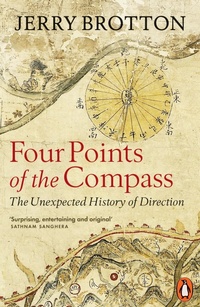
Four Points of the Compass
The Unexpected History of Direction
Published on 4. September 2025
Book
Paperback/Softback
208 pages
978-0-14-199956-2 (ISBN)
Description
A sparkling exploration of direction, by the acclaimed author of A History of the World in 12 Maps
North, south, east and west: almost all societies use the four cardinal directions to orientate themselves, to understand who they are by projecting where they are. For millennia, these four directions have been foundational to our travel, navigation and exploration and are central to the imaginative, moral and political geography of virtually every culture in the world. Yet they are far more subjective and various - sometimes contradictory - than we might realize.
The Four Points of the Compass takes the reader on a journey of directional discovery. Jerry Brotton reveals why Hebrew culture privileges east; why Renaissance Europeans began drawing north at the top of their maps; why the early Islam revered the south; why the Aztecs used five colour-coded cardinal directions; and why no societies, primitive or modern, have ever orientated themselves westwards. He ends by reflecting on our digital age in which we, the little blue dot on the screen, have become the most important compass point. Throughout, Brotton shows that the directions reflect a human desire to create order and that they only have meaning, literally and metaphorically, depending on where you stand.
North, south, east and west: almost all societies use the four cardinal directions to orientate themselves, to understand who they are by projecting where they are. For millennia, these four directions have been foundational to our travel, navigation and exploration and are central to the imaginative, moral and political geography of virtually every culture in the world. Yet they are far more subjective and various - sometimes contradictory - than we might realize.
The Four Points of the Compass takes the reader on a journey of directional discovery. Jerry Brotton reveals why Hebrew culture privileges east; why Renaissance Europeans began drawing north at the top of their maps; why the early Islam revered the south; why the Aztecs used five colour-coded cardinal directions; and why no societies, primitive or modern, have ever orientated themselves westwards. He ends by reflecting on our digital age in which we, the little blue dot on the screen, have become the most important compass point. Throughout, Brotton shows that the directions reflect a human desire to create order and that they only have meaning, literally and metaphorically, depending on where you stand.
More details
Language
English
Place of publication
London
United Kingdom
Target group
Professional and scholarly
College/higher education
Product notice
Paperback (UK-B)
Dimensions
Height: 197 mm
Width: 129 mm
Thickness: 15 mm
Weight
184 gr
ISBN-13
978-0-14-199956-2 (9780141999562)
Copyright in bibliographic data and cover images is held by Nielsen Book Services Limited or by the publishers or by their respective licensors: all rights reserved.
Schweitzer Classification
Other editions
Additional editions
E-Book
09/2024
Penguin Books Ltd
€10.99
Available for download
Person
Jerry Brotton is Professor of Renaissance Studies at Queen Mary University of London. He is a regular broadcaster and critic as well the author of The Sale of the Late King's Goods: Charles I and his Art Collection (shortlisted for the Samuel Johnson Prize for Non-Fiction and the Hessell-Tiltman History Prize), This Orient Isle: Elizabethan England and the Islamic World, and the bestselling and award-winning A History of the World in Twelve Maps, which has been translated into twenty languages.