

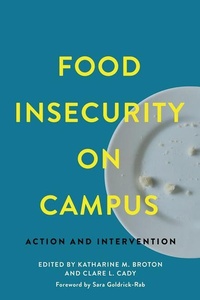
Food Insecurity on Campus
Action and Intervention
Published on 7. July 2020
Book
Paperback/Softback
312 pages
978-1-4214-3772-9 (ISBN)
Description
The hidden problem of student hunger on college campuses is real. Here's how colleges and universities are addressing it.
As the price of college continues to rise and the incomes of most Americans stagnate, too many college students are going hungry. According to researchers, approximately half of all undergraduates are food insecure. Food Insecurity on Campus-the first book to describe the problem-meets higher education's growing demand to tackle the pressing question "How can we end student hunger?"
Essays by a diverse set of authors, each working to address food insecurity in higher education, describe unique approaches to the topic. They also offer insights into the most promising strategies to combat student hunger, including
* utilizing research to raise awareness and enact change;
* creating campus pantries, emergency aid programs, and meal voucher initiatives to meet immediate needs;
* leveraging public benefits and nonprofit partnerships to provide additional resources;
* changing higher education systems and college cultures to better serve students; and
* drawing on student activism and administrative clout to influence federal, state, and local policies.
Arguing that practice and policy are improved when informed by research, Food Insecurity on Campus combines the power of data with detailed storytelling to illustrate current conditions. A foreword by Sara Goldrick-Rab further contextualizes the problem. Offering concrete guidance to anyone seeking to understand and support college students experiencing food insecurity, the book encourages readers to draw from the lessons learned to create a comprehensive strategy to fight student hunger.
Contributors: Talia Berday-Sacks, Denise Woods-Bevly, Katharine M. Broton, Clare L. Cady, Samuel Chu, Sarah Crawford, Cara Crowley, Rashida M. Crutchfield, James Dubick, Amy Ellen Duke-Benfield, Sara Goldrick-Rab, Jordan Herrera, Nicole Hindes, Russell Lowery-Hart, Jennifer J. Maguire, Michael Rosen, Sabrina Sanders, Rachel Sumekh
As the price of college continues to rise and the incomes of most Americans stagnate, too many college students are going hungry. According to researchers, approximately half of all undergraduates are food insecure. Food Insecurity on Campus-the first book to describe the problem-meets higher education's growing demand to tackle the pressing question "How can we end student hunger?"
Essays by a diverse set of authors, each working to address food insecurity in higher education, describe unique approaches to the topic. They also offer insights into the most promising strategies to combat student hunger, including
* utilizing research to raise awareness and enact change;
* creating campus pantries, emergency aid programs, and meal voucher initiatives to meet immediate needs;
* leveraging public benefits and nonprofit partnerships to provide additional resources;
* changing higher education systems and college cultures to better serve students; and
* drawing on student activism and administrative clout to influence federal, state, and local policies.
Arguing that practice and policy are improved when informed by research, Food Insecurity on Campus combines the power of data with detailed storytelling to illustrate current conditions. A foreword by Sara Goldrick-Rab further contextualizes the problem. Offering concrete guidance to anyone seeking to understand and support college students experiencing food insecurity, the book encourages readers to draw from the lessons learned to create a comprehensive strategy to fight student hunger.
Contributors: Talia Berday-Sacks, Denise Woods-Bevly, Katharine M. Broton, Clare L. Cady, Samuel Chu, Sarah Crawford, Cara Crowley, Rashida M. Crutchfield, James Dubick, Amy Ellen Duke-Benfield, Sara Goldrick-Rab, Jordan Herrera, Nicole Hindes, Russell Lowery-Hart, Jennifer J. Maguire, Michael Rosen, Sabrina Sanders, Rachel Sumekh
More details
Language
English
Place of publication
Baltimore, MD
United States
Target group
Professional and scholarly
Product notice
Paperback (trade)
Dimensions
Height: 151 mm
Width: 228 mm
Thickness: 21 mm
Weight
418 gr
ISBN-13
978-1-4214-3772-9 (9781421437729)
DOI
10.1353/book.74952
Copyright in bibliographic data and cover images is held by Nielsen Book Services Limited or by the publishers or by their respective licensors: all rights reserved.
Schweitzer Classification
Other editions
Additional editions

E-Book
07/2020
Johns Hopkins University Press
€29.99
Available for download
Persons
Katharine M. Broton is an assistant professor in the Department of Educational Policy and Leadership Studies and (by courtesy) the Department of Sociology at the University of Iowa. Clare L. Cady is the director and cofounder of the College and University Food Bank Alliance.
Content
Foreword, by Sara Goldrick-Rab
Acknowledgments
Introduction
Katharine M. Broton and Clare L. Cady
Chapter 1. Food Insecurity in Higher Education
Katharine M. Broton
Chapter 2. If Not Us, Who? Building National Capacity to Address Student Food Insecurity through CUFBA
Clare L. Cady
Chapter 3. The American Federation of Teachers Local 212 / MATC FAST (Faculty and Students Together) Fund
Michael Rosen
Chapter 4. Channeling Student Idealism and Energy through Campus Organizing
Talia Berday-Sacks and James Dubick
Chapter 5. Student Action and Nonprofit Partnership: The Swipe Out Hunger Story
Rachel Sumekh
Chapter 6. The Trampoline of Public Benefits: Using Existing Resources to Fight Food Insecurity
Sarah Crawford and Nicole Hindes
Chapter 7. Transformational Change for Student Success: The California State University Basic Needs Initiative
Denise Woods-Bevly and Sabrina Sanders
Chapter 8. Research as a Catalyst for Positive Systemic Change
Jennifer J. Maguire and Rashida M. Crutchfield
Chapter 9. Amarillo College: Loving Your Student from Enrollment to Graduation
Russell Lowery-Hart, Cara Crowley, and Jordan Herrera
Chapter 10. Addressing Student Hunger through Policy Change: Leveraging Federal Food Benefits to Support College Completion
Amy Ellen Duke-Benfield and Samuel Chu
Conclusion
Katharine M. Broton and Clare L. Cady
Index
Acknowledgments
Introduction
Katharine M. Broton and Clare L. Cady
Chapter 1. Food Insecurity in Higher Education
Katharine M. Broton
Chapter 2. If Not Us, Who? Building National Capacity to Address Student Food Insecurity through CUFBA
Clare L. Cady
Chapter 3. The American Federation of Teachers Local 212 / MATC FAST (Faculty and Students Together) Fund
Michael Rosen
Chapter 4. Channeling Student Idealism and Energy through Campus Organizing
Talia Berday-Sacks and James Dubick
Chapter 5. Student Action and Nonprofit Partnership: The Swipe Out Hunger Story
Rachel Sumekh
Chapter 6. The Trampoline of Public Benefits: Using Existing Resources to Fight Food Insecurity
Sarah Crawford and Nicole Hindes
Chapter 7. Transformational Change for Student Success: The California State University Basic Needs Initiative
Denise Woods-Bevly and Sabrina Sanders
Chapter 8. Research as a Catalyst for Positive Systemic Change
Jennifer J. Maguire and Rashida M. Crutchfield
Chapter 9. Amarillo College: Loving Your Student from Enrollment to Graduation
Russell Lowery-Hart, Cara Crowley, and Jordan Herrera
Chapter 10. Addressing Student Hunger through Policy Change: Leveraging Federal Food Benefits to Support College Completion
Amy Ellen Duke-Benfield and Samuel Chu
Conclusion
Katharine M. Broton and Clare L. Cady
Index