

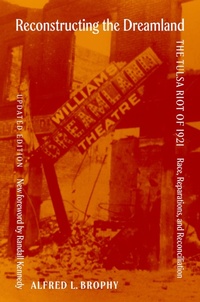
Reconstructing the Dreamland Updated Edition
The Tulsa Riot of 1921: Race, Reparations, and Reconciliation
Published on 23. April 2025
Book
Paperback/Softback
208 pages
978-0-19-760766-4 (ISBN)
Description
The 1921 Tulsa Race Riot was the country's bloodiest civil disturbance of the century. Thirty city blocks were burned to the ground, perhaps 150 died, and the prosperous black community of Greenwood, Oklahoma, was turned to rubble.
Alfred L. Brophy draws on his own extensive research into contemporary accounts and court documents to chronicle this devastating riot, showing how and why the rule of law quickly eroded. Brophy shines his lights on mob violence and racism run amok, both on the night of the riot and the following morning. Equally important, he shows how the city government and police not only permitted looting, shootings, and the burning of Greenwood, but actively participated in it by deputizing white citizens haphazardly, giving out guns and badges, or sending men to arm themselves. Likewise, the National Guard acted unconstitutionally, arresting every black resident they found, leaving property vulnerable to the white mob.
Brophy's stark narrative concludes with a discussion of reparations for victims of the riot through lawsuits and legislative action. That case has implications for other reparations movements, including reparations for slavery. This updated edition features a new foreword by Randall Kennedy.
Alfred L. Brophy draws on his own extensive research into contemporary accounts and court documents to chronicle this devastating riot, showing how and why the rule of law quickly eroded. Brophy shines his lights on mob violence and racism run amok, both on the night of the riot and the following morning. Equally important, he shows how the city government and police not only permitted looting, shootings, and the burning of Greenwood, but actively participated in it by deputizing white citizens haphazardly, giving out guns and badges, or sending men to arm themselves. Likewise, the National Guard acted unconstitutionally, arresting every black resident they found, leaving property vulnerable to the white mob.
Brophy's stark narrative concludes with a discussion of reparations for victims of the riot through lawsuits and legislative action. That case has implications for other reparations movements, including reparations for slavery. This updated edition features a new foreword by Randall Kennedy.
Reviews / Votes
Meticulously researched...., A good job of showing how the true history of the riot was whitewashed, and how difficult it has been for white Tulsa * and white America for that matterto acknowledge its racist past.San Diego Union Tribune * Brophy's history of reparations is fascinating. * St. Louis Post Dispatch * Recovers a largely forgotten history of black activism in one of the grimmest periods of race relations, emphasizing the black militancy of the World War I era and how assertive black demands for racial equality threatened white Tulsans. Linking history with advocacy, Brophy also offers a reasoned defense of reparations for the riot's victims. * Washington Post Book World * At once meticulously factual and riveting, Alfred Brophy's moving account of a 1921 race riot that destroyed an economically self-reliant, vibrant African-American community clarifies why political action and enforcement of legal and human rights are indispensable perquisites for black economic opportunity and material progress. Brophy also clarifies why Americans need to find the courage to acknowledge injustices of the recent past and contrive amends to help heal still-unresolved consequences scarring both victims and perpetrators. * Jane Jacobs * Timely, well documented and powerfully written...vividly illustrates a chapter of America's sordid racist past by focusing on the Tulsa Race Riots of 1921. If we are to transcend the barriers to racial progress, we all must read Brophy's compelling work and use it as a seminal case in our path to avoid conflicts at all costs.... Brophy's book is the best-written account of the Tulsa riots, and captures the people of Tulsa's resolve to never allow a similar travesty to occur again. Every person interested in racial justice should have this book at his or her disposal. * Charles J. Ogletree, Jr., Jesse Climenko Professor of Law, Harvard Law School * Meticulously researched...., A good job of showing how the true history of the riot was whitewashed, and how difficult it has been for white Tulsa * and white America for that matterto acknowledge its racist past.San Diego Union Tribune * Brophy's history of reparations is fascinating. * St. Louis Post Dispatch * Recovers a largely forgotten history of black activism in one of the grimmest periods of race relations, emphasizing the black militancy of the World War I era and how assertive black demands for racial equality threatened white Tulsans. Linking history with advocacy, Brophy also offers a reasoned defense of reparations for the riot's victims. * Thomas J. Sugrue, Washington Post Book World * At once meticulously factual and riveting, Alfred Brophy's moving account of a 1921 race riot that destroyed an economically self-reliant, vibrant African-American community clarifies why political action and enforcement of legal and human rights are indispensable perquisites for black economic opportunity and material progress. Brophy also clarifies why Americans need to find the courage to acknowledge injustices of the recent past and contrive amends to help heal still-unresolved consequences scarring both victims and perpetrators. * Jane Jacobs * Timely, well documented and powerfully written...vividly illustrates a chapter of America's sordid racist past by focusing on the Tulsa Race Riots of 1921. If we are to transcend the barriers to racial progress, we all must read Brophy's compelling work and use it as a seminal case in our path to avoid conflicts at all costs.... Brophy's book is the best-written account of the Tulsa riots, and captures the people of Tulsa's resolve to never allow a similar travesty to occur again. Every person interested in racial justice should have this book at his or her disposal. * Charles J. Ogletree, Jr., Harvard Law School * A timely contribution to a variety of important and contentious discussions involving American history, African American culture, and the problems encountered in attempting to right past wrongs.... Brophy reminds us that deadly, cruel, racial violence is not something that only happens 'out there' in the rest of the world but is something that has also happened here in the United States on a massive scale and that just as others out there have fallen short in reckoning with their pasts, so too have Americans. * Randall Kennedy, from the Preface * Exceptionally fine use of illustrations and photographs. Useful connection to modern-day reparations debate. * William L. Van Deburg, University of Wisconsin *More details
Language
English
Place of publication
New York
United States
Target group
College/higher education
Product notice
Paperback (trade)
Unsewn / adhesive bound
Illustrations
15 black and white halftones
Dimensions
Height: 235 mm
Width: 155 mm
Thickness: 11 mm
Weight
308 gr
ISBN-13
978-0-19-760766-4 (9780197607664)
Copyright in bibliographic data and cover images is held by Nielsen Book Services Limited or by the publishers or by their respective licensors: all rights reserved.
Schweitzer Classification
Other editions
Additional editions
Alfred Brophy
Reconstructing the Dreamland Updated Edition
The Tulsa Riot of 1921: Race, Reparations, and Reconciliation
E-Book
01/2025
OUP eBook
€16.49
Available for download
Alfred Brophy
Reconstructing the Dreamland Updated Edition
The Tulsa Riot of 1921: Race, Reparations, and Reconciliation
E-Book
01/2025
OUP eBook
€16.49
Available for download
Person
Alfred L. Brophy is the former D. Paul Jones, Jr. & Charlene Jones Chairholder of Law at the University of Alabama School of Law. He is the author of University, Court, and Slave: Proslavery Thoughts in Southern Colleges and Courts and the Coming of Civil War (OUP, 2016) and Reparations: Pro and Con (OUP, 2006), among other books. He contributed to the report to the Tulsa Race Riot Commission, a body created by the Oklahoma Legislature to investigate the riot and make recommendations for reparations. Brophy has appeared on CNN's News Night with Aaron Brown, NBC Nightly News, NPR's "Fresh Air," the "Tavis Smiley Show," and "Talk of the Nation," and has been quoted in such newspapers as the Chicago Tribune, Los Angeles Times, New York Times, and Washington Post.
Content
New foreword by Randall Kennedy
Acknowledgments
Prologue
1. Seeking Justice and the Origins of the Riot 2. "Thinking He Can Whip the World": The Riot
3. Picturing the Riot
4. "A White Wash Brush and a Big One in Operation in Tulsa": Tulsa Interprets the Riot
5. Tulsa Will! Tulsa Will? Tulsa Will Dodge: The Failure of Reconstruction
Epilogue
Notes Bibliographic Essay
Index
Acknowledgments
Prologue
1. Seeking Justice and the Origins of the Riot 2. "Thinking He Can Whip the World": The Riot
3. Picturing the Riot
4. "A White Wash Brush and a Big One in Operation in Tulsa": Tulsa Interprets the Riot
5. Tulsa Will! Tulsa Will? Tulsa Will Dodge: The Failure of Reconstruction
Epilogue
Notes Bibliographic Essay
Index