

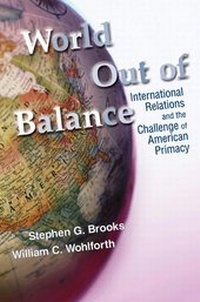
World Out of Balance
International Relations and the Challenge of American Primacy
Published on 3. August 2008
Book
Hardback
248 pages
978-0-691-12699-9 (ISBN)
Description
"World Out of Balance" is the most comprehensive analysis to date of the constraints on the United States' use of power in pursuit of its security interests. Stephen Brooks and William Wohlforth overturn conventional wisdom by showing that in a unipolar system, where the United States is dominant in the scales of world power, the constraints featured in international relations theory are generally inapplicable. In fact, the authors argue that the U.S. will not soon lose its leadership position; rather, it stands before a twenty-year window of opportunity for reshaping the international system. Although American primacy in the world is unprecedented, analysts routinely stress the limited utility of such preeminence.The authors examine arguments from each of the main international relations theories - realism, institutionalism, constructivism, and liberalism. They also cover the four established external constraints on U.S. security policy - international institutions, economic interdependence, legitimacy, and balancing. The prevailing view is that these external constraints conspire to undermine the value of U.S. primacy, greatly restricting the range of security policies the country can pursue.
Brooks and Wohlforth show that, in actuality, the international environment does not tightly constrain U.S. security policy. "World Out of Balance" underscores the need for an entirely new research agenda to better understand the contours of international politics and the United States' place in the world order.
Brooks and Wohlforth show that, in actuality, the international environment does not tightly constrain U.S. security policy. "World Out of Balance" underscores the need for an entirely new research agenda to better understand the contours of international politics and the United States' place in the world order.
Reviews / Votes
Even as pundits are proclaiming the end of the United States' unipolar moment, scholars are still trying to understand the exact nature of U.S. primacy. If the United States is the most powerful state the world has seen, what constrains or disciplines its security pursuits? In this important book, Brooks and Wohlforth survey the leading schools of thought looking for answers. Foreign Affairs The authors dispute both the logic and the evidence that has been adduced in support of such claims and make the case so clearly that World out of Balance can be used in upper-division undergraduate courses and also read with profit by members of the profession. It will stand as a major book for years to come. -- Robert Jervis Perspectives on PoliticsMore details
Language
English
Place of publication
New Jersey
United States
Target group
College/higher education
Professional and scholarly
Product notice
Trade binding
Illustrations
4 line illus. 11 tables.
Dimensions
Height: 229 mm
Width: 152 mm
Weight
482 gr
ISBN-13
978-0-691-12699-9 (9780691126999)
Copyright in bibliographic data and cover images is held by Nielsen Book Services Limited or by the publishers or by their respective licensors: all rights reserved.
Schweitzer Classification
Other editions
Additional editions
Stephen G. Brooks | William C. Wohlforth
World Out of Balance
International Relations and the Challenge of American Primacy
E-Book
06/2015
1st Edition
Princeton University Press
€38.49
Available for download
Stephen G. Brooks | William C. Wohlforth
World Out of Balance
International Relations and the Challenge of American Primacy
Book
07/2008
Princeton University Press
€32.80
Article not available at the moment
Persons
Stephen G. Brooks is associate professor of government at Dartmouth College and the author of "Producing Security" (Princeton). William C. Wohlforth is professor of government at Dartmouth and the author of "The Elusive Balance".
Content
List of Illustrations ix Preface xi Acknowledgments xiii CHAPTER ONE: Introduction 1 CHAPTER TWO: Realism, Balance-of-Power Theory, and the Counterbalancing Constraint 22 CHAPTER THREE: Realism, Balance-of-Threat Theory, and the "Soft Balancing" Constraint 60 CHAPTER FOUR: Liberalism, Globalization, and Constraints Derived from Economic Interdependence 98 CHAPTER FIVE: Institutionalism and the Constraint of Reputation 148 CHAPTER SIX: Constructivism and the Constraint of Legitimacy 171 CHAPTER SEVEN: A New Agenda 208 Index 219