

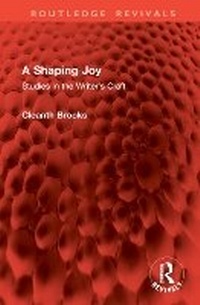
A Shaping Joy
Studies in the Writer's Craft
1st Edition
Published on 31. October 2024
Book
Hardback
416 pages
978-1-032-86129-6 (ISBN)
Description
In A Shaping Joy (originally published in 1971), Cleanth Brooks writes about modern literature and the criticism that has been developed to deal with it. Most of the essays concern poets and novelists of the twentieth century, but there are also discussions of nineteenth-century American writers such as Mark Twain and Edgar Allen Poe, and of traditional English poets such as Wordsworth, Milton, and Marlowe.
Among the functions of literature described in the first essay are those of nourishing the imagination and keeping the language alive and the channels of communication open. The criticism contained in the essays that follow admirably exemplifies these concerns. Whether writing on the world of William Faulkner and the literature of the American South, or on subjects more familiar to the British reader-Joyce, Auden, and T.S. Eliot, for example-Professor Brooks keeps the methods of communication marvelously unblocked. It is criticism of the rarest kind-alert, imaginative and wholly invigorating.
This book will be a beneficial read for students and researchers of English literature, particularly of literary criticism.
Among the functions of literature described in the first essay are those of nourishing the imagination and keeping the language alive and the channels of communication open. The criticism contained in the essays that follow admirably exemplifies these concerns. Whether writing on the world of William Faulkner and the literature of the American South, or on subjects more familiar to the British reader-Joyce, Auden, and T.S. Eliot, for example-Professor Brooks keeps the methods of communication marvelously unblocked. It is criticism of the rarest kind-alert, imaginative and wholly invigorating.
This book will be a beneficial read for students and researchers of English literature, particularly of literary criticism.
More details
Series
Language
English
Place of publication
London
United Kingdom
Publishing group
Taylor & Francis Ltd
Target group
College/higher education
Postgraduate
Dimensions
Height: 234 mm
Width: 156 mm
Weight
740 gr
ISBN-13
978-1-032-86129-6 (9781032861296)
Copyright in bibliographic data and cover images is held by Nielsen Book Services Limited or by the publishers or by their respective licensors: all rights reserved.
Schweitzer Classification
Other editions
Additional editions
Book
01/2026
1st Edition
Routledge
€49.50
Shipment within 10-20 days
E-Book
10/2024
1st Edition
Routledge
€41.99
Available for download
E-Book
10/2024
1st Edition
Routledge
€41.99
Available for download
Person
Cleanth Brooks was an American literary critic and professor whose work was important in establishing the New Criticism, which stressed close reading and structural analysis of literature. Brooks taught at Yale University from 1947 to 1975 and was also a Library of Congress fellow (1951-62) and cultural attache at the U.S. embassy in London (1964-66).
Content
Introduction 1. The Uses of Literature (1963) 2. The Modern Writer and his Community (1965) 3. T.S. Eliot: Thinker and Artist (1965) 4. Poetry Since The Waste Land (1964) 5. Joyce's Ulysses: Symbolic Poem, Biography or Novel (1968) 6. Poetry and Poeticality (1966) 7. W. B. Yeats as a Literary Critic (1968) 8. Auden as a Literary Critic (1962) 9. The Criticism of Fiction: The Role of Close Analysis (1959) 10. American Literature: Mirror, Lens or Prism? (1966) 11. The American "Innocence" in James, Fitzgerald and Faulkner (1964) 12. The Southern Temper (1965) 13. Southern Literature: The Wellsprings of its Vitality (1962) 14. Faulkner's Treatment of the Racial Problem: Typical Examples (1967) 15. Faulkner as a Poet (1968) 16. The Doric Delicacy (1948) 17. Edgar Allan Poe as an Interior Decorator (1968) 18. A.E. Housman (1959) 19. Wordsworth and Human Suffering: Notes on Two Early Poems (1964) 20. Milton and the New Criticism (1951) 21. Eve's Awakening (1954) 22. The Unity of Marlowe's Doctor Faustus (1965)