

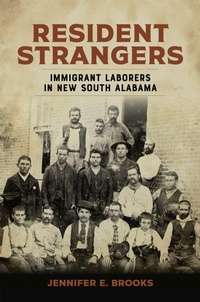
Resident Strangers
Immigrant Laborers in New South Alabama
Published on 13. April 2022
Book
Hardback
277 pages
978-0-8071-7665-8 (ISBN)
Description
Immigrant laborers who came to the New South in the late nineteenth and early twentieth centuries found themselves poised uncomfortably between white employers and the Black working class, a liminal and often precarious position. Campaigns to recruit immigrants primarily aimed to suppress Black agency and mobility. If that failed, both planters and industrialists imagined that immigrants might replace Blacks entirely. Thus, white officials, citizens, and employers embraced immigrants when they acted in ways that sustained Jim Crow. However, when they directly challenged established political and economic power structures, immigrant laborers found themselves ostracized, jailed, or worse, by the New South order. Both industrial employers and union officials lauded immigrants' hardworking and noble character when it suited their purposes, and both denigrated and racialized them when immigrant laborers acted independently.
Jennifer E. Brooks's Resident Strangers restores immigrant laborers to their place in the history of the New South, considering especially how various immigrant groups and individuals experienced their time in New South Alabama. Brooks utilizes convict records, censuses, regional and national newspapers, government documents, and oral histories to construct the story of immigrants in New South Alabama. The immigrant groups she focuses on appeared most often as laborers in the records, including the Chinese, southern Italians, and the diverse nationals of the Austro-Hungarian Empire, along with a sprinkling of others. Although recruitment crusades by Alabama's employers and New South boosters typically failed to bring in the vast numbers of immigrants they had envisioned, significant populations from around the world arrived in industries and communities across the state, especially in the coal- and ore-mining district of Birmingham.
Resident Strangers reveals that immigrant laborers' presence and individual agency complicated racial categorization, disrupted labor relations, and diversified southern communities. It also presents a New South that was far from isolated from the forces at work across the nation or in the rest of the world. Immigrant laborers brought home to New South Alabama the turbulent world of empire building, deeply embedding the region in national and global networks of finance, trade, and labor migration.
Jennifer E. Brooks's Resident Strangers restores immigrant laborers to their place in the history of the New South, considering especially how various immigrant groups and individuals experienced their time in New South Alabama. Brooks utilizes convict records, censuses, regional and national newspapers, government documents, and oral histories to construct the story of immigrants in New South Alabama. The immigrant groups she focuses on appeared most often as laborers in the records, including the Chinese, southern Italians, and the diverse nationals of the Austro-Hungarian Empire, along with a sprinkling of others. Although recruitment crusades by Alabama's employers and New South boosters typically failed to bring in the vast numbers of immigrants they had envisioned, significant populations from around the world arrived in industries and communities across the state, especially in the coal- and ore-mining district of Birmingham.
Resident Strangers reveals that immigrant laborers' presence and individual agency complicated racial categorization, disrupted labor relations, and diversified southern communities. It also presents a New South that was far from isolated from the forces at work across the nation or in the rest of the world. Immigrant laborers brought home to New South Alabama the turbulent world of empire building, deeply embedding the region in national and global networks of finance, trade, and labor migration.
More details
Language
English
Place of publication
Baton Rouge
United States
Target group
Professional and scholarly
Product notice
sewn/stitched
Cloth over boards
Dimensions
Height: 229 mm
Width: 152 mm
Thickness: 21 mm
Weight
590 gr
ISBN-13
978-0-8071-7665-8 (9780807176658)
Copyright in bibliographic data and cover images is held by Nielsen Book Services Limited or by the publishers or by their respective licensors: all rights reserved.
Schweitzer Classification
Person
Jennifer E. Brooks is associate professor of history at Auburn University and the author of Defining the Peace: World War II Veterans, Race, and the Remaking of Southern Political Tradition.