

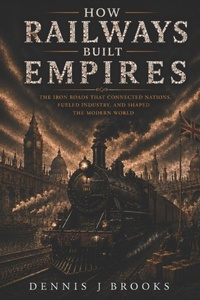
How Railways Built Empires
Description
Industrial revolutions did not begin in parliaments or palaces. They began on steel tracks.
Before the rise of modern railways, empires were limited by distance, geography, and the slow movement of goods, armies, and information. Horses, wagons, and rivers could only carry civilisation so far. But with the arrival of steam power and the railway age, the world changed forever. Nations expanded faster, industries exploded in scale, armies mobilised at unprecedented speed, and global empires stretched across entire continents.
How Railways Built Empires explores the extraordinary history of the railroads that transformed civilisation, reshaped warfare, fueled industrialisation, and became the backbone of modern global power.
From the smoke-filled workshops of Industrial Revolution Britain to the vast colonial rail networks of India, Africa, Europe, and North America, this book traces how railways became far more than transportation systems. They became tools of conquest, economic expansion, political control, military strategy, and technological dominance.
Inside this book, you will discover:
- The origins of steam locomotives and the birth of railway engineering
- How Britain used railways to strengthen and expand the British Empire
- The role of railroads during the Industrial Revolution
- How railways transformed trade, manufacturing, and urban growth
- The construction of the Transcontinental Railroad and the rise of industrial America
- The impact of rail transport during the American Civil War and both World Wars
- How railways revolutionised military logistics and strategic warfare
- The exploitation, labour, and human cost behind massive railway projects
- Why rail networks became essential to imperial control and national power
- The decline of traditional rail empires and the rise of modern high-speed systems
- How modern nations such as China continue to use rail infrastructure to project economic and geopolitical influence
Blending military history, industrial history, political strategy, engineering, economics, and global geopolitics, How Railways Built Empires reveals how rail infrastructure shaped the modern world more profoundly than almost any other invention in human history.
This is not simply the story of trains.
It is the story of industrial power, technological ambition, colonial expansion, economic transformation, and the relentless race to control distance itself.
From steam engines and iron bridges to wartime logistics and continental expansion, railways became the arteries of empire - carrying soldiers, coal, steel, trade, and political influence across entire continents.
For readers interested in military history, industrial revolution history, railway history, transportation history, steam locomotives, empire building, engineering history, global trade, infrastructure, economic history, geopolitics, and the technological foundations of modern civilisation, this book offers a powerful and accessible exploration of one of humanity's most transformative inventions.
The railway did not merely connect cities.
It connected empires.