

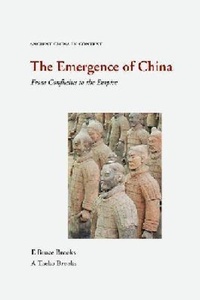
The Emergence of China
From Confucius to the Empire
Published on 31. December 2015
Book
Paperback/Softback
256 pages
978-1-936166-75-6 (ISBN)
Description
The Emergence of China presents the classical period in its own terms. It contains more than 500 translated excerpts from the classical texts, linked by a running commentary which traces the evolution and interaction of the different schools of thought. These are shown in dialogue about issues from tax policy to the length of the mourning period for a parent. Some texts labor to establish the legal and political structures of the new state, while others passionately oppose its war orientation, or amusingly ridicule those who supported it. Here are the arguments of the Hundred Schools of classical thought, for the first time restored to life and vividly presented.
There are six topical chapters, each treating a major subject in chronological order, framed by a preliminary background chapter and a concluding survey of the eventual Empire. Each chapter includes several brief Methodological Moments, as samples of the philological method on which the work is based. Occasional footnotes point to historical parallels in Greece, Rome, the Ancient Near East, and the mediaeval-to-modern transition in Europe, which at many points the Chinese classical period resembles. At the back of the book are a guide to alternate Chinese romanizations, a list of passages translated, and a subject index.
A preliminary version of The Emergence of China was classroom-tested, and the suggestions of teachers and students were incorporated into the final version. The results of those classroom trials, in both history and philosophy classes, were favorable.
This is the only account of early Chinese thought which presents it against the background of the momentous changes taking place in the early Chinese state, and the only account of the early Chinese state which follows its development, by correctly dated documents, from its beginnings in the palace states of Spring and Autumn to the economically sophisticated bureaucracies of late Warring States times. In this larger context, the insights of the philosophers remain, but their failure to influence events is also noted. The fun of the Jwangdz is transmitted, but along with its underlying pain. The achievements of the Chinese Imperial formation process are duly registered, but so is their human cost. Special attention is given to the contribution of non-Chinese peoples to the eventual Chinese civilization.
There are six topical chapters, each treating a major subject in chronological order, framed by a preliminary background chapter and a concluding survey of the eventual Empire. Each chapter includes several brief Methodological Moments, as samples of the philological method on which the work is based. Occasional footnotes point to historical parallels in Greece, Rome, the Ancient Near East, and the mediaeval-to-modern transition in Europe, which at many points the Chinese classical period resembles. At the back of the book are a guide to alternate Chinese romanizations, a list of passages translated, and a subject index.
A preliminary version of The Emergence of China was classroom-tested, and the suggestions of teachers and students were incorporated into the final version. The results of those classroom trials, in both history and philosophy classes, were favorable.
This is the only account of early Chinese thought which presents it against the background of the momentous changes taking place in the early Chinese state, and the only account of the early Chinese state which follows its development, by correctly dated documents, from its beginnings in the palace states of Spring and Autumn to the economically sophisticated bureaucracies of late Warring States times. In this larger context, the insights of the philosophers remain, but their failure to influence events is also noted. The fun of the Jwangdz is transmitted, but along with its underlying pain. The achievements of the Chinese Imperial formation process are duly registered, but so is their human cost. Special attention is given to the contribution of non-Chinese peoples to the eventual Chinese civilization.
More details
Series
Language
English
Place of publication
United States
Product notice
Paperback (trade)
Dimensions
Height: 233 mm
Width: 154 mm
Thickness: 20 mm
Weight
440 gr
ISBN-13
978-1-936166-75-6 (9781936166756)
Copyright in bibliographic data and cover images is held by Nielsen Book Services Limited or by the publishers or by their respective licensors: all rights reserved.
Schweitzer Classification
Persons
E. BRUCE BROOKS is research professor of Chinese and A. TAEKO BROOKS is research associate at the University of Massachusetts Amherst.
Content
Introduction
1. Antiquity
2. The Economy
3. The State
4. War and Peace
5. The Civilian Elite
6. The People
7. Transcendence
8. The Empire
1. Antiquity
2. The Economy
3. The State
4. War and Peace
5. The Civilian Elite
6. The People
7. Transcendence
8. The Empire