

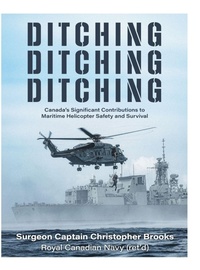
Ditching, Ditching, Ditching
Canada's Significant Contributions to Maritime Helicopter Safety and Survival
Published on 6. February 2026
Book
Hardback
92 pages
978-1-0383-6480-7 (ISBN)
Description
This booklet describes many years of struggling to make flying in a helicopter over water much safer. It analyses why, still in 2026, if you ditch, the awful statistic is that around 20% of crew and passengers will not survive, principally due to drowning. It is hoped that aircrew, passengers, scientists, engineers, clothing designers, regulators, and anyone interested in flight safety will find value in its contents and be able to read it without difficulty.
Dr. Christopher Brooks, physician, scientist, inventor and historian, enjoyed an extensive and highly satisfying medical career in the navy, industry and private practice. From one extreme to another-service in a Polaris nuclear submarine to dangling from the hoist of the revered old Sea King to service at the Transportation Appeal Tribunal of Canada-after 57 years, he has tied up alongside and finished with main engines and steering.
More details
Person
Dr. Christopher Brooks spent the better part of his life, in the navy and after, struggling to make flying in a helicopter over water much safer.
Between 1978 and 1998, he served in postings at the Defence and Civil Institute of Environmental Medicine (DCIEM), including for eight years as deputy director. There, he researched and published on marine survival problems extensively, including life jackets and survival suits, as a leading expert in the field and helped foster improvements in marine standards worldwide.
In writing this detailed history of helicopter flight safety practices, he hoped that many would benefit, particularly aircrew and passengers, but also scientists, engineers, clothing designers, and regulators. Through a theoretical and practical understanding, he describes watershed moments in research over the decades, highlighting major Canadian achievements in the field and situating the DCIEM as a key contributor.