

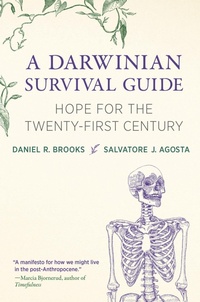
A Darwinian Survival Guide
Hope for the Twenty-First Century
Published on 6. February 2024
Book
Hardback
264 pages
978-0-262-04868-2 (ISBN)
Description
How humanity brought about the climate crisis by departing from its evolutionary trajectory 15,000 years ago-and how we can use evolutionary principles to save ourselves from the worst outcomes.
Despite efforts to sustain civilization, humanity faces existential threats from overpopulation, globalized trade and travel, urbanization, and global climate change. In A Darwinian Survival Guide, Daniel Brooks and Salvatore Agosta offer a novel-and hopeful-perspective on how to meet these tremendous challenges by changing the discourse from sustainability to survival. Darwinian evolution, the world's only theory of survival, is the means by which the biosphere has persisted and renewed itself following past environmental perturbations, and it has never failed, they explain. Even in the aftermath of mass extinctions, enough survivors remain with the potential to produce a new diversified biosphere.
Drawing on their expertise as field biologists, Brooks and Agosta trace the evolutionary path from the early days of humans through the Late Pleistocene and the beginning of the Anthropocene all the way to the Great Acceleration of technological humanity around 1950, demonstrating how our creative capacities have allowed humanity to survive. However, constant conflict without resolution has made the Anthropocene not only unsustainable, but unsurvivable. Guided by the four laws of biotics, the authors explain how humanity should interact with the rest of the biosphere and with each other in accordance with Darwinian principles. They reveal a middle ground between apocalypse and utopia, with two options: alter our behavior now at great expense and extend civilization or fail to act and rebuild in accordance with those same principles. If we take the latter, then our immediate goal ought to focus on preserving as many of humanity's positive achievements-from high technology to high art-as possible to shorten the time needed to rebuild.
Despite efforts to sustain civilization, humanity faces existential threats from overpopulation, globalized trade and travel, urbanization, and global climate change. In A Darwinian Survival Guide, Daniel Brooks and Salvatore Agosta offer a novel-and hopeful-perspective on how to meet these tremendous challenges by changing the discourse from sustainability to survival. Darwinian evolution, the world's only theory of survival, is the means by which the biosphere has persisted and renewed itself following past environmental perturbations, and it has never failed, they explain. Even in the aftermath of mass extinctions, enough survivors remain with the potential to produce a new diversified biosphere.
Drawing on their expertise as field biologists, Brooks and Agosta trace the evolutionary path from the early days of humans through the Late Pleistocene and the beginning of the Anthropocene all the way to the Great Acceleration of technological humanity around 1950, demonstrating how our creative capacities have allowed humanity to survive. However, constant conflict without resolution has made the Anthropocene not only unsustainable, but unsurvivable. Guided by the four laws of biotics, the authors explain how humanity should interact with the rest of the biosphere and with each other in accordance with Darwinian principles. They reveal a middle ground between apocalypse and utopia, with two options: alter our behavior now at great expense and extend civilization or fail to act and rebuild in accordance with those same principles. If we take the latter, then our immediate goal ought to focus on preserving as many of humanity's positive achievements-from high technology to high art-as possible to shorten the time needed to rebuild.
Reviews / Votes
"Timely, thought-provoking, and refreshingly optimistic. . . . Applying the principles of evolution in thoughtful ways, A Darwinian Survival Guide tackles the complexities of climate change with creativity, optimism, and vision."-Foreword Reviews
More details
Language
English
Place of publication
Cambridge (Massachusetts)
United States
Publishing group
MIT Press Ltd
Product notice
sewn/stitched
Cloth over boards
Illustrations
19 BLACK AND WHITE ILLUS.
Dimensions
Height: 232 mm
Width: 156 mm
Thickness: 38 mm
Weight
608 gr
ISBN-13
978-0-262-04868-2 (9780262048682)
Copyright in bibliographic data and cover images is held by Nielsen Book Services Limited or by the publishers or by their respective licensors: all rights reserved.
Schweitzer Classification
Other editions
Additional editions
E-Book
02/2024
MIT Press
€27.49
Available for download
Persons
Daniel R. Brooks is Professor Emeritus, University of Toronto, Senior Research Fellow, H. W. Manter Laboratory of Parasitology, University of Nebraska State Museum, and Fellow of the Stellenbosch Institute for Advanced Study (STIAS). He is the coauthor of The Stockholm Paradigm and The Major Metaphors of Evolution.
Salvatore J. Agosta is Associate Professor at Virginia Commonwealth University and Fellow of the Stellenbosch Institute for Advanced Study. He is the author of more than fifty scientific publications and coauthor of The Major Metaphors of Evolution: Darwinism Then and Now.
Salvatore J. Agosta is Associate Professor at Virginia Commonwealth University and Fellow of the Stellenbosch Institute for Advanced Study. He is the author of more than fifty scientific publications and coauthor of The Major Metaphors of Evolution: Darwinism Then and Now.
Content
CONTENTS
PREFACE vii
1 INTRODUCTION 1
2 HOW DOES NATURE WORK? INHERITANCE SYSTEMS 15
3 HOW DOES NATURE WORK? ECOSYSTEMS 39
4 HUMANS: THE EARLY DAYS 59
5 THE LATE PLEISTOCENE: THE RISE OF HOMO SAPIENS 79
6 AFTER THE ICE AGE: THE GREAT TRANSITION 89
7 THE NEOLITHIC PERIOD: THE GREAT AMPLIFICATION 101
8 INSTITUTIONALIZING SOCIETY: THE GREAT TRAGEDY 117
9 OVERSPENDING AS A WAY OF LIFE: INFLECTION AND ACCELERATION 145
10 HOW HUMANS SHOULD INTERACT WITH THE REST OF THE BIOSPHERE 165
11 CONVIVIAL CONSERVATION IN AN EVOLUTIONARY COMMONS: COSTA RICA'S GREEN PHOENIX 193
12 HOW HUMANS SHOULD INTERACT WITH EACH OTHER 205
13 HOW HUMANS SHOULD INTERACT WITH THEIR INSTITUTIONS 231
14 AUTUMN OF THE ANTHROPOCENE: HOPE FOR NOW, HOPE FOR THE FUTURE 255
ACKNOWLEDGMENTS 271
SELECTED READINGS 273
INDEX 335
PREFACE vii
1 INTRODUCTION 1
2 HOW DOES NATURE WORK? INHERITANCE SYSTEMS 15
3 HOW DOES NATURE WORK? ECOSYSTEMS 39
4 HUMANS: THE EARLY DAYS 59
5 THE LATE PLEISTOCENE: THE RISE OF HOMO SAPIENS 79
6 AFTER THE ICE AGE: THE GREAT TRANSITION 89
7 THE NEOLITHIC PERIOD: THE GREAT AMPLIFICATION 101
8 INSTITUTIONALIZING SOCIETY: THE GREAT TRAGEDY 117
9 OVERSPENDING AS A WAY OF LIFE: INFLECTION AND ACCELERATION 145
10 HOW HUMANS SHOULD INTERACT WITH THE REST OF THE BIOSPHERE 165
11 CONVIVIAL CONSERVATION IN AN EVOLUTIONARY COMMONS: COSTA RICA'S GREEN PHOENIX 193
12 HOW HUMANS SHOULD INTERACT WITH EACH OTHER 205
13 HOW HUMANS SHOULD INTERACT WITH THEIR INSTITUTIONS 231
14 AUTUMN OF THE ANTHROPOCENE: HOPE FOR NOW, HOPE FOR THE FUTURE 255
ACKNOWLEDGMENTS 271
SELECTED READINGS 273
INDEX 335