

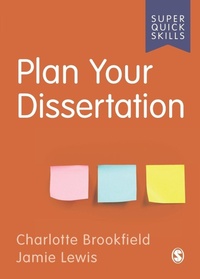
Plan Your Dissertation
1st Edition
Published on 30. December 2021
Book
Paperback/Softback
124 pages
978-1-5297-9082-5 (ISBN)
Description
Planning your dissertation is made simple with this quick, step-by-step guide. Your instant pocket supervisor, this book will help you to:
? Choose a topic you are excited about
? Manage your time and beat procrastination
? Create a step-by-step plan to keep you on track.
Super Quick Skills provides the essential building blocks you need to succeed at university - fast. Packed with practical, positive advice on core academic and life skills, you'll discover focused tips and strategies to use straight away. Whether it's writing great essays, understanding referencing or managing your wellbeing, find out how to build good habits and progress your skills throughout your studies.
Learn core skills quickly
Apply them right away and see results
Succeed in your studies and in life
Super Quick Skills gives you the foundations you need to confidently navigate the ups and downs of university life.
? Choose a topic you are excited about
? Manage your time and beat procrastination
? Create a step-by-step plan to keep you on track.
Super Quick Skills provides the essential building blocks you need to succeed at university - fast. Packed with practical, positive advice on core academic and life skills, you'll discover focused tips and strategies to use straight away. Whether it's writing great essays, understanding referencing or managing your wellbeing, find out how to build good habits and progress your skills throughout your studies.
Learn core skills quickly
Apply them right away and see results
Succeed in your studies and in life
Super Quick Skills gives you the foundations you need to confidently navigate the ups and downs of university life.
More details
Series
Language
English
Place of publication
London
United Kingdom
Target group
College/higher education
Dimensions
Height: 178 mm
Width: 127 mm
Thickness: 8 mm
Weight
127 gr
ISBN-13
978-1-5297-9082-5 (9781529790825)
Copyright in bibliographic data and cover images is held by Nielsen Book Services Limited or by the publishers or by their respective licensors: all rights reserved.
Schweitzer Classification
Other editions
Additional editions
Charlotte Brookfield | Jamie Lewis
Plan Your Dissertation
E-Book
12/2021
1st Edition
SAGE Publications Ltd
€14.49
Available for download
Charlotte Brookfield | Jamie Lewis
Plan Your Dissertation
E-Book
12/2021
1st Edition
SAGE Publications Ltd
€14.49
Available for download
Persons
Charlotte Brookfield is a Reader at Cardiff University's School of Social Sciences. Charlotte is based in the Cardiff Q-Step Centre of Excellence in Quantitative Methods Teaching and Learning. The Centre is one of eighteen across the UK which aim to enhance the quantitative research methods training experience for social science students. The pedagogic activities of the Centre have influenced Charlotte's research interests and in particular, she is interested in exploring the extent to which British sociology engages with quantitative approaches and the possible factors that may contribute toward sociology students' resistance to study and use quantitative techniques.
Charlotte teaches on a range of research methods and substantive modules at both undergraduate and postgraduate level. Specifically, she convenes the Real World Research Placement module, where students are afforded the opportunity to put into practice the quantitative skills they have acquired in lectures in a local work organisation. Organisations involved in this module include the Welsh Government, the Welsh Blood Service and the Welsh Wheelchair Basketball Association. It was through leading this module that Charlotte came to realise the necessity for social science students and graduates to have a greater familiarity with Microsoft Excel.
In her spare time, Charlotte enjoys baking and crafting.
Jamie Lewis is a Reader in Sociology at Cardiff University's School of Social Sciences. His research is mainly situated in the Sociology of Science and Technology Studies (STS), but also extends to the public understanding of science (PUS) and medical sociology. He is presently working on a Expert Citizen Science project on air pollution. He is one of the authors of Psychiatric Genetics: from hereditary madness to big biology and is writing a book examining the development and stabilisation of Bigfootology.
His area of research interests include:
? developments in qualitative research;
? the boundaries between science, pseudo-science and non-science
? the sociology of biomedical knowledge with particular emphasis on the social implications of new genetic and stem cell technologies;
? issues of culture, interdisciplinarity and collaboration in big science;
? public engagement and public understanding of risk;
? aspects of practical accomplishment and modelling in the laboratory
;? science, activism and civic repair.
He is also an editor of the journal, Qualitative Research.
Charlotte teaches on a range of research methods and substantive modules at both undergraduate and postgraduate level. Specifically, she convenes the Real World Research Placement module, where students are afforded the opportunity to put into practice the quantitative skills they have acquired in lectures in a local work organisation. Organisations involved in this module include the Welsh Government, the Welsh Blood Service and the Welsh Wheelchair Basketball Association. It was through leading this module that Charlotte came to realise the necessity for social science students and graduates to have a greater familiarity with Microsoft Excel.
In her spare time, Charlotte enjoys baking and crafting.
Jamie Lewis is a Reader in Sociology at Cardiff University's School of Social Sciences. His research is mainly situated in the Sociology of Science and Technology Studies (STS), but also extends to the public understanding of science (PUS) and medical sociology. He is presently working on a Expert Citizen Science project on air pollution. He is one of the authors of Psychiatric Genetics: from hereditary madness to big biology and is writing a book examining the development and stabilisation of Bigfootology.
His area of research interests include:
? developments in qualitative research;
? the boundaries between science, pseudo-science and non-science
? the sociology of biomedical knowledge with particular emphasis on the social implications of new genetic and stem cell technologies;
? issues of culture, interdisciplinarity and collaboration in big science;
? public engagement and public understanding of risk;
? aspects of practical accomplishment and modelling in the laboratory
;? science, activism and civic repair.
He is also an editor of the journal, Qualitative Research.
Content
What is a dissertation?
Is a dissertation for me?
How do I pick my research topic?
What is the role of the supervisor in the dissertation?
How do I manage my time effectively?
What do I need to read before I start?
How do I produce an ethically sensitive piece of research?
What methods should I use?
Is a dissertation for me?
How do I pick my research topic?
What is the role of the supervisor in the dissertation?
How do I manage my time effectively?
What do I need to read before I start?
How do I produce an ethically sensitive piece of research?
What methods should I use?