

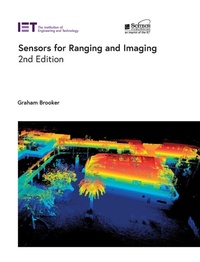
Sensors for Ranging and Imaging
2nd Edition
Published on 16. February 2022
Book
Hardback
881 pages
978-1-83953-199-6 (ISBN)
Description
Sensors for Ranging and Imaging is a comprehensive textbook and professional reference that provides a solid background in active sensing technology. This new edition has been comprehensively updated and expanded to include the latest radar technologies.
Beginning with an introductory section on signal generation, filtering and modulation, the book follows with chapters on radiometry (infrared and microwave) as a background to the active sensing process. The core of the book is concerned with active sensing, starting with active ranging and active imaging sensors (operational principles, components), and goes through the derivation of the radar (and lidar) range equations, and the detection of echo signals, both fundamental to the understanding of radar, sonar and lidar imaging. Further chapters cover signal propagation of both electromagnetic and acoustic energy, and target and clutter characteristics. The remainder of the book involves the basics of the range measurement process, active imaging with an emphasis on noise and linear frequency modulation techniques, Doppler processing, and target tracking.
This systematic and thorough guide to ranging and imaging sensors is invaluable for graduate students studying sensing systems and industry professionals wishing to expand or update their knowledge. It offers clear, detailed explanations alongside worked examples to provide readers with an in-depth understanding of the material.
Beginning with an introductory section on signal generation, filtering and modulation, the book follows with chapters on radiometry (infrared and microwave) as a background to the active sensing process. The core of the book is concerned with active sensing, starting with active ranging and active imaging sensors (operational principles, components), and goes through the derivation of the radar (and lidar) range equations, and the detection of echo signals, both fundamental to the understanding of radar, sonar and lidar imaging. Further chapters cover signal propagation of both electromagnetic and acoustic energy, and target and clutter characteristics. The remainder of the book involves the basics of the range measurement process, active imaging with an emphasis on noise and linear frequency modulation techniques, Doppler processing, and target tracking.
This systematic and thorough guide to ranging and imaging sensors is invaluable for graduate students studying sensing systems and industry professionals wishing to expand or update their knowledge. It offers clear, detailed explanations alongside worked examples to provide readers with an in-depth understanding of the material.
More details
Series
Edition
2nd edition
Language
English
Place of publication
Stevenage
United Kingdom
Target group
College/higher education
Professional and scholarly
Product notice
sewn/stitched
Cloth over boards
Dimensions
Height: 259 mm
Width: 208 mm
Thickness: 47 mm
Weight
2232 gr
ISBN-13
978-1-83953-199-6 (9781839531996)
Copyright in bibliographic data and cover images is held by Nielsen Book Services Limited or by the publishers or by their respective licensors: all rights reserved.
Schweitzer Classification
Other editions
Previous edition
Graham Brooker
Introduction to Sensors for Ranging and Imaging
Book
06/2009
SciTech Publishing Inc
€157.50
Shipment within 3-4 weeks
Person
Graham Brooker is a senior lecturer at the School of Aerospace, Mechanical and Mechatronic Engineering, The University of Sydney, Australia. Dr Brooker has 40-year experience in radar research, teaching and development. His previous work included a broad range of subjects from systems engineering and developing RF components to writing software for radar and EW applications and developing millimetre-wave radar sensors for mining applications. Prior to moving to Sydney, he also ran a laboratory that developed millimetre-wave radar systems for both defence and commercial clients. He now mostly teaches courses in active sensing and biomechatronics along with supervising honours and PhD research projects.
Content
Chapter 1: Introduction to sensing
Chapter 2: Signal processing and modulation
Chapter 3: IR radiometers and image intensifiers
Chapter 4: Millimetre-wave radiometers
Chapter 5: Active ranging sensors
Chapter 6: Active imaging sensors
Chapter 7: Signal propagation
Chapter 8: Target and clutter characteristics
Chapter 9: Detection of signals in noise
Chapter 10: Doppler measurement
Chapter 11: High-range-resolution techniques
Chapter 12: High angular-resolution techniques
Chapter 13: Range and angle estimation and tracking
Chapter 14: Tracking moving targets
Chapter 15: RFID tags and transponders
Chapter 16: Tomography and 3D imaging
Chapter 2: Signal processing and modulation
Chapter 3: IR radiometers and image intensifiers
Chapter 4: Millimetre-wave radiometers
Chapter 5: Active ranging sensors
Chapter 6: Active imaging sensors
Chapter 7: Signal propagation
Chapter 8: Target and clutter characteristics
Chapter 9: Detection of signals in noise
Chapter 10: Doppler measurement
Chapter 11: High-range-resolution techniques
Chapter 12: High angular-resolution techniques
Chapter 13: Range and angle estimation and tracking
Chapter 14: Tracking moving targets
Chapter 15: RFID tags and transponders
Chapter 16: Tomography and 3D imaging