

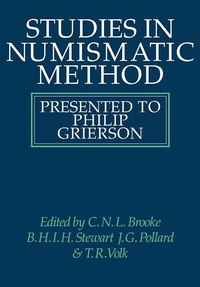
Studies in Numismatic Method
Presented to Philip Grierson
Published on 4. December 2008
Book
Paperback/Softback
372 pages
978-0-521-09133-6 (ISBN)
Description
Coins are one of the most abundant sources for our study of the past, yet their value as historical evidence is relatively neglected because of a general lack of knowledge of numismatic techniques. This volume of essays, offered by a circle of friends, colleagues and pupils working in Britain, Europe and North America, is intended to pay tribute to Philip Grierson's unique contribution to the study of numismatic method. A medievalist by training, through his wide-ranging interests in coins and coinage Grierson has commanded the respect of historians and numismatists of all periods for the originality and good sense of his prolific scholarship. More than any other living scholar, he has been responsible for making available an understanding of numismatic expertise to specialist and non-specialist audiences.
More details
Language
English
Place of publication
Cambridge
United Kingdom
Target group
Professional and scholarly
Product notice
Paperback (trade)
Illustrations
Worked examples or Exercises
Dimensions
Height: 244 mm
Width: 170 mm
Thickness: 20 mm
Weight
641 gr
ISBN-13
978-0-521-09133-6 (9780521091336)
Copyright in bibliographic data and cover images is held by Nielsen Book Services Limited or by the publishers or by their respective licensors: all rights reserved.
Schweitzer Classification
Other editions
Additional editions

C. N. L. Brooke | B. H. I. Stewart | J. G. Pollard
Studies in Numismatic Method
Presented to Philip Grierson
Book
04/1983
Cambridge University Press
€9.91
Article exhausted; check for reprint
Previous edition
C. N. L. Brooke | B. H. I. Stewart | J. G. Pollard
Studies in Numismatic Method
Presented to Philip Grierson
Book
04/1983
Cambridge University Press
€9.91
Article exhausted; check for reprint
Content
1. Thoughts on the beginnings of coinage M. J. Price; 2. The life of obverse dies in the Hellenistic period Otto Morkholm; 3. Roman coinage of the Cyrenaica, first century BC to first century AD T. V. Buttrey; 4. Roman imperial coin types and the formation of public opinion M. H. Crawford; 5. Coin hoards and Roman coinage of the third century AD R. A. G. Carson; 6. Belgian finds of late fourth-century Roman bronze J. Lallemand; 7. The re-use of obsolete coins: the case of Roman imperial bronzes revived in the late fifth century Cecile Morrison; 8. Interpreting the alloy of the Merovingian silver coinage D. M. Metcalf; 9. Carolingian gold coins from the Ilanz hoard Ernesto Bernareggi; 10. The novi denarii and forgery in the ninth century Jean Lafaurie; 11. On the rejection of good coin in Carolingian Europe Stanislaw Suchodolski; 12. AElfred the Great's abandonment of the concept of periodic recoinage Michael Dolley; 13. King or Queen? An eleventh-century pfennig of Duisburg Peter Berghaus; 14. Personal names on Norman coins of the eleventh century: an hypothesis F. Dumas; 15. The Gornoslav hoard, the Emperor Frederick I, and the Monastery of Bachkovo M. F. Hendy; 16. Coinages of Barcelona (1209 to 1222): the documentary evidence T. N. Bisson; 17. Finds of English medieval coins in Schleswig-Holstein G. Hatz; 18. Privy-marking and the trial of the pyx C. E. Blunt; 19. Judicial documents relating to coin forgery Pierre P. Cockshaw; 20. Mint organisation in the Burgundian Netherlands in the fifteenth century Peter Spufford; 21. Coinage in Andrew Halyburton's Ledger Marion M. Archibald; 22. Imitation in later medieval coinage: the influence of Scottish types abroad Ian Stewart; 23. Barter in fifteenth-century Genoa Carlo M. Cipolla.