

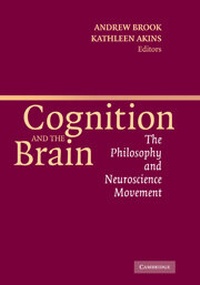
Cognition and the Brain
The Philosophy and Neuroscience Movement
Published on 12. September 2005
Book
Hardback
440 pages
978-0-521-83642-5 (ISBN)
Description
This volume provides an up to date and comprehensive overview of the philosophy and neuroscience movement, which applies the methods of neuroscience to traditional philosophical problems and uses philosophical methods to illuminate issues in neuroscience. At the heart of the movement is the conviction that basic questions about human cognition, many of which have been studied for millennia, can be answered only by a philosophically sophisticated grasp of neuroscience's insights into the processing of information by the human brain. Essays in this volume are clustered around five major themes: data and theory in neuroscience; neural representation and computation; visuomotor transformations; color vision; and consciousness.
More details
Language
English
Place of publication
Cambridge
United Kingdom
Target group
Professional and scholarly
Dimensions
Height: 235 mm
Width: 162 mm
Thickness: 32 mm
Weight
737 gr
ISBN-13
978-0-521-83642-5 (9780521836425)
Copyright in bibliographic data and cover images is held by Nielsen Book Services Limited or by the publishers or by their respective licensors: all rights reserved.
Schweitzer Classification
Other editions
Additional editions
E-Book
04/2011
1st Edition
Cambridge University Press
€97.99
Available for download
Persons
Content
Part I. Date and Theory in Neuroscience: 1. Localization in the brain and other illusions Valerie Gray Hardcastle and C. Matthew Stewart; 2. Neurophenomenology Evan Thompson, Antoine Lutz and Diego Cosmelli; 3. Out of the mouth of autistics Victoria McGeer; Part II. Neural Representation: 4. Moving beyond the metaphors Chris Eliasmith; 5. Brain time and phenomenological time Rick Crush; 6. The puzzle of temporal experience Sean Kelly; Part III. Visuomotor Transformation: 7. Grasping and perceiving objects Pierre Jacob; 8. Action-oriented representation Pete Mandik; Part IV. Colour Vision: 9 Chimerical colours Paul Churchland; 10. Opponent processing, linear models, and the verticality of colour perception Zoltan Jakob; Part V. Consciousness: 11. A neurofunctional theory of consciousness Jesse Prinz; 12. Making consciousness safe for neuroscience Andrew Brook.