

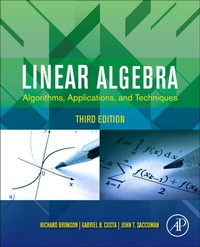
Linear Algebra
Algorithms, Applications, and Techniques
3rd Edition
Published on 27. November 2013
Book
Paperback/Softback
536 pages
978-0-12-391420-0 (ISBN)
Description
In this appealing and well-written text, Richard Bronson starts with the concrete and computational, and leads the reader to a choice of major applications. The first three chapters address the basics: matrices, vector spaces, and linear transformations. The next three cover eigenvalues, Euclidean inner products, and Jordan canonical forms, offering possibilities that can be tailored to the instructor's taste and to the length of the course. Bronson's approach to computation is modern and algorithmic, and his theory is clean and straightforward. Throughout, the views of the theory presented are broad and balanced and key material is highlighted in the text and summarized at the end of each chapter. The book also includes ample exercises with answers and hints.
Prerequisite: One year of calculus is recommended.
Prerequisite: One year of calculus is recommended.
Reviews / Votes
"...presents linear algebra in an accessible and rigorous manner...This is a well-organized textbook that intends to aid a student as much as possible. It strikes me as an excellent book for a first linear algebra course that students would likely also find useful as a reference as they advance through the mathematics curriculum" --MMA.org, July 09, 2014"In this appealing and well-written text, Richard Bronson starts with the concrete and computational, and leads the reader to a choice of major applications...Bronson's approach to computation is modern and algorithmic, and his theory is clean and straightforward...The book also includes ample exercises with answers and hints." --Zentralblatt MATH, 1278.15001
"The quality of the exercises is better than that of Anton. Bronson's exercises seem more original and less trivial. While he does have routine drill problems his non-routine problems require the student to either extend the student's knowledge base or fill in a portion of a proof." --Renee Britt, Louisiana State University
"I appreciate the slow increase in the progression of difficulty with proofs... I regard the exposition as superior. Prof. Bronson's text is the best example I've ever seen of motivating definitions in linear algebra, right from the very first page... Bronson incorporates the application first, thus motivating the definition, going from concrete to abstract, instead of the reverse." --Michael Ecker, The Pennsylvania State University
"In this appealing and well-written text, Richard Bronson starts with the concrete and computational, and leads the reader to a choice of major applications....
Throughout, the views of the theory presented are broad and balanced and
key material is highlighted in the text and summarized at the end of each chapter. The book also includes ample exercises with answers and hints." --zbMATH Open
More details
Edition
3rd edition
Language
English
Place of publication
San Diego
United States
Publishing group
Elsevier Science Publishing Co Inc
Target group
College/higher education
Sophomore- and junior- level students in introductory linear algebra
Dimensions
Height: 235 mm
Width: 191 mm
Weight
1210 gr
ISBN-13
978-0-12-391420-0 (9780123914200)
Copyright in bibliographic data and cover images is held by Nielsen Book Services Limited or by the publishers or by their respective licensors: all rights reserved.
Schweitzer Classification
Other editions
New editions
Richard Bronson | Gabriel B. Costa | John T. Saccoman
Linear Algebra
Algorithms, Applications, and Techniques
Book
06/2023
4th Edition
Academic Press
€138.50
Shipment within 15-20 days
Previous edition
Book
04/2007
2nd Edition
Academic Press
€60.65
Article exhausted; check for reprint
Persons
Richard Bronson is a Professor of Mathematics and Computer Science at Fairleigh Dickinson University and is Senior Executive Assistant to the President. Ph.D., in Mathematics from Stevens Institute of Technology. He has written several books and numerous articles on Mathematics. He has served as Interim Provost of the Metropolitan Campus, and has been Acting Dean of the College of Science and Engineering at the university in New Jersey Gabriel B. Costa is currently a visiting professor at the United States Military Academy at West Point and is on the faculty at Seton Hall. And is an engineer. He holds many titles and fills them with distinction. He has a B.S., M.S. and Ph.D. in Mathematics from Stevens Institute of Technology. He has also co-authored another Academic Press book with Richard Bronson, Matrix Methods. John T. Saccoman is Professor and Chair, Department of Mathematics and Computer Science, Seton Hall University, New Jersey received Ph.D., Stevens Institute of Technology, Hoboken, NJ, 1995 Research work on synthesis results in network reliability theory. He has published in several journals, authored supplementary materials, and is highly involved in the use of technology in applied mathematics. He has worked collaboratively on writings for Transforming the Curriculum Across the Disciplines Through Technology-Based Faculty Development and Writing-Intensive Course Redesign.
Author
Professor of Mathematics and Computer Science, Senior Executive Assistant to the President, Fairleigh Dickinson University, USA
Visiting Professor, Department of Mathematical Sciences, United States Military Academy, West Point, NY, USA
Professor and Chair, Department of Mathematics and Computer Science, Seton Hall University, New Jersey, USA
Content
PREFACE
1. MATRICES
2. VECTOR SPACES
3. LINEAR TRANSFORMATIONS
4. EIGENVALUES, EIGENVECTORS, AND DIFFERENTIAL EQUATIONS
5. EUCLIDEAN INNER PRODUCT
APPENDIX A: DETERMINANTS
APPENDIX B: JORDAN CANONICAL FORMS
APPENDIX C: MARKOV CHAINS
APPENDIX D: THE SIMPLEX METHOD, AN EXAMPLE
APPENDIX E: A WORD ON NUMERICAL TECHNIQUES AND TECHNOLOGY
ANSWERS AND HINTS TO SELECTED PROBLEMS
INDEX
1. MATRICES
2. VECTOR SPACES
3. LINEAR TRANSFORMATIONS
4. EIGENVALUES, EIGENVECTORS, AND DIFFERENTIAL EQUATIONS
5. EUCLIDEAN INNER PRODUCT
APPENDIX A: DETERMINANTS
APPENDIX B: JORDAN CANONICAL FORMS
APPENDIX C: MARKOV CHAINS
APPENDIX D: THE SIMPLEX METHOD, AN EXAMPLE
APPENDIX E: A WORD ON NUMERICAL TECHNIQUES AND TECHNOLOGY
ANSWERS AND HINTS TO SELECTED PROBLEMS
INDEX