

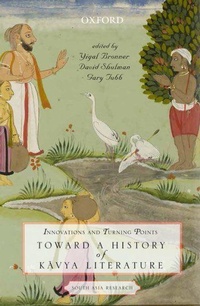
Innovations and Turning Points
Toward a History of Kavya Literature
Published on 8. January 2015
Book
Hardback
816 pages
978-0-19-945355-9 (ISBN)
Description
This volume is the first attempt to offer a panoramic historical overview of South Asian classical poetry, especially in Sanskrit. Many of the essays in this volume are the first serious studies of the great masterpieces of South Asian literature. Moreover, the book as a whole captures the millennium-long developmental logic of kavya literature by identifying a series of critical moments of breakthrough and innovation-that is, moments when the basic rules of composition and the aesthetic and poetic goals underwent dramatic change, allowing the tradition to reinvent itself. Individual sections thus focus on the beginnings of kavya literature and Kalidasa's creation of what came to be its classical form; the new poetic model that emerged from the intense competition and conversation of Bharavi and Magha in the middle of the first millennium; the extended revolutionary period in Kanauj, where Bana and his successors reconceived the meaning and practice of Sanskrit poetry; and the no less transformative period at the beginning of the second millennium, when poets of genius such as Sriharsa were active in the context of India's nascent vernacularization. The scope of the volume extends beyond Sanskrit to early modern Hindi, and beyond the subcontinent and the Himalayas to Java and Tibet, where kavya found a new home and continued to evolve. A general introduction proposes a theoretical framework for the study of this immense literary tradition in terms of its continuous self-reinvention.
Reviews / Votes
One of the merits of many essays in the volume is that their authors carefully read the works they had chosen for study. This might seem to be an obvious prerequisite, and yet there are histories of...literature that do not fulfill this condition. The book is full of quotations both in the original language and in translation (though one might wish to encounter less mistakes in theSanskrit), accompanied by insightful and minute analyses. Lawrence McCrea's closing paragraph of his essay...contains an important methodological observation, which has been put into practice in some of the best essays in the volume: "It is essential that we attempt to make sense of each poem as a unique object in its own right, which, while it may in some cases be usefully elucidated through terms and categories drawn from either western or indigenous critical traditions, can never simply be uncritically reduced to them" (p. 140). * Csaba Dezso, Indo-Iranian Journal * This collection of essays suggests an ambition to draw kavya literature into the orbit of world literature studies in a sensitive and substantive way. Teachers in the global classroom, one surmises, regularly experience the difficulty of presenting kavya to uninitiated students. This is partly due to the linguistic and cultural gulf that separates any literature from readers outside of that literature's culture. This is a problem for all literary traditions experienced in translation. For kavya, however, the hindrance mostly lies in the sense one gets that the k?vya universe in all its variety has not been adequately translated for the general reader. Also lacking seem to be adequate reading strategies that are both compelling and user-friendly. That complex problem remains even with the publication of this book. Without a doubt, however, this collection is a turning point in kavya scholarship. * Deven M. Patel, Journal of the American Oriental Society * the chief delight of this book lies not so much in the range and extent of the area covered, or in the scholarship on display, which is hugely impressive, but in the particular lines quoted or the detailed discussion of a passage that stay in the mind. * Rosinka Chaudhuri, Times Literary Supplement *More details
Series
Language
English
Place of publication
New Delhi
India
Target group
Professional and scholarly
Product notice
sewn/stitched
Cloth over boards
Illustrations
2 b/w illustrations
Dimensions
Height: 244 mm
Width: 159 mm
Thickness: 66 mm
Weight
1137 gr
ISBN-13
978-0-19-945355-9 (9780199453559)
Copyright in bibliographic data and cover images is held by Nielsen Book Services Limited or by the publishers or by their respective licensors: all rights reserved.
Schweitzer Classification
Persons
Yigal Bronner is Associate Professor in the Department of Asian Studies, the Hebrew University of Jerusalem.
David Shulman is Renee Lang Professor of Humanistic Studies at the Hebrew University.
Gary Tubb is Chair and Professor, Department of South Asian Languages and Civilizations, Division of the Humanities, the University of Chicago.
David Shulman is Renee Lang Professor of Humanistic Studies at the Hebrew University.
Gary Tubb is Chair and Professor, Department of South Asian Languages and Civilizations, Division of the Humanities, the University of Chicago.
Content
I. KALIDASA AND EARLY CLASSICISM; II. THE DEVELOPING MAHAKAVYA; III. THE MASTERS OF PROSE; IV. THE SONS OF BANA; V. POETS OF THE NEW MILLENNIUM; VI. REGIONAL KAVYAS