

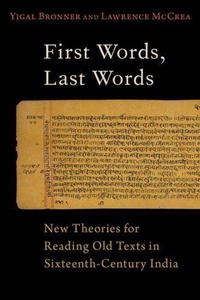
First Words, Last Words
New Theories for Reading Old Texts in Sixteenth-Century India
Published on 20. October 2021
Book
Hardback
208 pages
978-0-19-758347-0 (ISBN)
Description
First Words, Last Words charts an intense "pamphlet war" that took place in sixteenth-century South India. Yigal Bronner and Lawrence McCrea explore this controversy as a case study in the dynamics of innovation in early modern India, a time of great intellectual innovation. This debate took place within the traditional discourses of Vedic Hermeneutics, or Mima?sa, and its increasingly influential sibling discipline of Vedanta, and its proponents among the leading intellectuals and public figures of the period.
Bronner and McCrea examine the nature of theoretical innovation in scholastic traditions by focusing on a specific controversy regarding scriptural interpretation and the role of sequence-what comes first and what follows later-in determining our interpretation of a scriptural passage.
Vyasatirtha and his grand-pupil Vijayindratirtha, writers belonging to the camp of Dualist Vedanta, purported to uphold the radical view of their founding father, Madhva, who believed, against a long tradition of Mima?sa interpreters, that the closing portion of a scriptural passage should govern the interpretation of its opening. By contrast, the Nondualist Appayya Dik?ita ostensibly defended his tradition's preference for the opening. But, as this volume shows, the debaters gradually converged on a profoundly novel hermeneutic-cognitive theory in which sequence played little role, if any.
First Words, Last Words traces both the issue of sequence and the question of innovation through an in-depth study of this debate and through a comparative survey of similar problems in Judaism, Christianity, and Islam, revealing that the disputants in this controversy often pretended to uphold traditional views, when they were in fact radically innovative.
Bronner and McCrea examine the nature of theoretical innovation in scholastic traditions by focusing on a specific controversy regarding scriptural interpretation and the role of sequence-what comes first and what follows later-in determining our interpretation of a scriptural passage.
Vyasatirtha and his grand-pupil Vijayindratirtha, writers belonging to the camp of Dualist Vedanta, purported to uphold the radical view of their founding father, Madhva, who believed, against a long tradition of Mima?sa interpreters, that the closing portion of a scriptural passage should govern the interpretation of its opening. By contrast, the Nondualist Appayya Dik?ita ostensibly defended his tradition's preference for the opening. But, as this volume shows, the debaters gradually converged on a profoundly novel hermeneutic-cognitive theory in which sequence played little role, if any.
First Words, Last Words traces both the issue of sequence and the question of innovation through an in-depth study of this debate and through a comparative survey of similar problems in Judaism, Christianity, and Islam, revealing that the disputants in this controversy often pretended to uphold traditional views, when they were in fact radically innovative.
More details
Series
Language
English
Place of publication
New York
United States
Target group
Professional and scholarly
Product notice
sewn/stitched
Cloth over boards
Dimensions
Height: 244 mm
Width: 157 mm
Thickness: 19 mm
Weight
381 gr
ISBN-13
978-0-19-758347-0 (9780197583470)
Copyright in bibliographic data and cover images is held by Nielsen Book Services Limited or by the publishers or by their respective licensors: all rights reserved.
Schweitzer Classification
Other editions
Additional editions
Yigal Bronner | Lawrence McCrea
First Words, Last Words
New Theories for Reading Old Texts in Sixteenth-Century India
E-Book
08/2021
OUP eBook
€43.49
Available for download
Yigal Bronner | Lawrence McCrea
First Words, Last Words
New Theories for Reading Old Texts in Sixteenth-Century India
E-Book
08/2021
OUP eBook
€43.49
Available for download
Persons
Yigal Bronner is Associate Professor in the Department of Asian Studies at the Hebrew University of Jerusalem. His areas of interest include Sanskrit literature and literary history and Sanskrit poetics and its intellectual history. He is the author of Extreme Poetry: The South Asian Movement of Simultaneous Narration, co-editor of Innovations and Turning Points: Toward a History of K?vya Literature, and of New Directions in South Asian Studies: Critical Engagements with Sheldon Pollock, among other books.
Lawrence McCrea is Professor of Sanskrit Studies in the Department of Asian Studies at Cornell University. He is the author of numerous papers on traditional Indian poetry, poetics, language theory, and hermeneutics. He is the author of The Teleology of Poetics in Medieval Kashmir, co-author of Buddhist Philosophy of Language in India: Jn?na?r?mitra on Exclusion, and co-editor of New Directions in South Asian Studies: Critical Engagements with Sheldon Pollock.
Lawrence McCrea is Professor of Sanskrit Studies in the Department of Asian Studies at Cornell University. He is the author of numerous papers on traditional Indian poetry, poetics, language theory, and hermeneutics. He is the author of The Teleology of Poetics in Medieval Kashmir, co-author of Buddhist Philosophy of Language in India: Jn?na?r?mitra on Exclusion, and co-editor of New Directions in South Asian Studies: Critical Engagements with Sheldon Pollock.
Content
I. Newness in Scholastic Traditions: Sequence and Scripture
II. The Origins of the Debate
III. The New Math: Vy?sat?rtha's Rewriting of M?m??s?'s Case Law
IV. The New Hermeneutics: Appayya's Reinvention of Cognitive Theory
V. The New Attitude: Vijay?ndra's Calling the Game
VI. Behind the Veil of the Old: New Directions in the Study of Scholastic Innovation
Bibliography
II. The Origins of the Debate
III. The New Math: Vy?sat?rtha's Rewriting of M?m??s?'s Case Law
IV. The New Hermeneutics: Appayya's Reinvention of Cognitive Theory
V. The New Attitude: Vijay?ndra's Calling the Game
VI. Behind the Veil of the Old: New Directions in the Study of Scholastic Innovation
Bibliography