

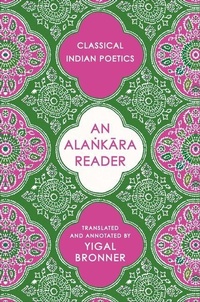
An Ala?kara Reader
Classical Indian Poetics
Will be published approx. on 8. September 2026
Book
Hardback
432 pages
978-0-231-21998-3 (ISBN)
Description
Classical Indian poetics prized the skillful use of ala?karas, or "ornaments"-literary figures of speech. Across more than a millennium, Sanskrit writers developed and elaborated an account of literary embellishment that is perhaps the world's most complex and long-standing theory of figuration. Yet it remains the least studied of India's major classical systems of thought.
An Ala?kara Reader is a groundbreaking panoramic overview of this tradition, presenting extensive and accessible translations of key works that span its history, from the sixth century CE to the eighteenth. These texts vividly show how Indian theorists analyzed simile, metaphor, allegory, and dozens of other figures that are distinctive to their world. Yigal Bronner's commentary makes Sanskrit concepts of ornamentation approachable while placing them in historical context. He provides a new account of the history of Sanskrit poetics, showing how it underwent successive waves of theoretical revolutions and emerged as a prestigious field that attracted a variety of scholars in the early modern era.
Featuring many previously untranslated texts, An Ala?kara Reader is an essential resource for the study of classical Indian thought, the intellectual history of South Asia, and comparative literature. It reveals the depth and nuance of Sanskrit's "science of ornaments" for anyone interested in poetic theory, figuration, and aesthetics across world traditions.
An Ala?kara Reader is a groundbreaking panoramic overview of this tradition, presenting extensive and accessible translations of key works that span its history, from the sixth century CE to the eighteenth. These texts vividly show how Indian theorists analyzed simile, metaphor, allegory, and dozens of other figures that are distinctive to their world. Yigal Bronner's commentary makes Sanskrit concepts of ornamentation approachable while placing them in historical context. He provides a new account of the history of Sanskrit poetics, showing how it underwent successive waves of theoretical revolutions and emerged as a prestigious field that attracted a variety of scholars in the early modern era.
Featuring many previously untranslated texts, An Ala?kara Reader is an essential resource for the study of classical Indian thought, the intellectual history of South Asia, and comparative literature. It reveals the depth and nuance of Sanskrit's "science of ornaments" for anyone interested in poetic theory, figuration, and aesthetics across world traditions.
Reviews / Votes
An Ala?kara Reader is a scholarly masterpiece, unique in its field. Although Sanskrit poetic theory has enjoyed considerable scholarly attention, there has never been such a full-fledged presentation of the discipline. Bronner's reconstruction of the evolution of Sanskrit poetics, beautifully articulated in his very strong introduction, offers a strikingly new perspective. This is a pioneering work that will change the study of premodern South Asian intellectual history. -- David Shulman, author of <i>Tamil: A Biography</i> An Ala?kara Reader instantiates "integrity," a quality cherished by classical Sanskrit literary theorists that becomes evident "when things of the past and of the future that are uniquely amazing take shape, as it were, before one's very eyes." In language friendly to all kinds of readers, Yigal Bronner has given us an integral, groundbreaking history of Sanskrit reflection on poetics, which opens up a bright future in which Indian thinkers can help us understand the ornaments that make literature beautiful. A dazzling achievement. -- Maria Heim, author of <i>Words for the Heart: A Treasury of Emotions from Classical India</i> Bronner has written the best history of Sanskrit poetic theory I have ever read. His translations are at once thoughtful and playful, precise and fun to read. An Ala?kara Reader is an ideal introduction to some of the most sophisticated thinking about poetry the world has ever seen. -- Whitney Cox, author of <i>Politics, Kingship, and Poetry in Medieval South India: Moonset on Sunrise Mountain</i> In The Ala?kara Reader, Yigal Bronner's glittering erudition, evident on every page, is matched only by his luminous translations of Sanskrit poets and theoreticians of language. A book to treasure, to read slowly, attentively, and meditatively, it ought to adorn the bookshelf of anyone interested in literary worlds. -- Archana Venkatesan, author of <i>The Secret Garland: Translations of Tiruppavai and Nacciyar Tirumoli</i>More details
Series
Language
English
Place of publication
New York
United States
Target group
College/higher education
Product notice
Trade binding
Dimensions
Height: 254 mm
Width: 178 mm
ISBN-13
978-0-231-21998-3 (9780231219983)
Copyright in bibliographic data and cover images is held by Nielsen Book Services Limited or by the publishers or by their respective licensors: all rights reserved.
Schweitzer Classification
Person
Yigal Bronner is a Sanskritist whose areas of interest include literature, literary theory, and South Asian intellectual history more generally. He worked on this volume while teaching in the Department of Asian Studies at the Hebrew University of Jerusalem and now teaches in the Department of History, Classics, and Religion at the University of Alberta. His books include Extreme Poetry: The South Asian Movement of Simultaneous Narration (2010) and A Lasting Vision: Dandin's Mirror in the World of Asian Letters (2023).
Content
Preface
Acknowledgments
English Translations of Sanskrit Titles
Abbreviations
Introduction: An Intellectual History of Ornaments
1. Laying the Foundations: Bhamaha's Ornament of Literature
2. Ornaments in Dandin's Mirror
3. Udbhata's Semantic Turn
4. The Analysis of Ornaments in the Kingdom of Kashmir
5. Into and Out of the Light: Ornaments Beyond Kashmir
6. Still Relevant: Ornaments in the Early Modern Period
English-Sanskrit Glossary
Notes
Bibliography
Index
Acknowledgments
English Translations of Sanskrit Titles
Abbreviations
Introduction: An Intellectual History of Ornaments
1. Laying the Foundations: Bhamaha's Ornament of Literature
2. Ornaments in Dandin's Mirror
3. Udbhata's Semantic Turn
4. The Analysis of Ornaments in the Kingdom of Kashmir
5. Into and Out of the Light: Ornaments Beyond Kashmir
6. Still Relevant: Ornaments in the Early Modern Period
English-Sanskrit Glossary
Notes
Bibliography
Index