

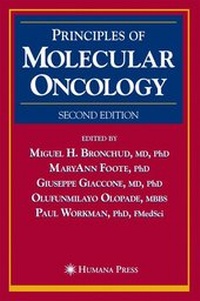
Principles of Molecular Oncology
2nd Edition
Published on 31. December 2003
Book
Hardback
XXI, 709 pages
978-1-58829-279-7 (ISBN)
Description
At the midpoint of the 20th century, our knowledge of cancer was based on epide- ology and pathology, and treatment consisted of surgery and radiation therapy. At mid-century, Medawar and colleagues initiated the understanding of transplantation immunology, Farber described the first use of an antifolic drug to treat leukemia, and Jacobson and coworkers described the irradiation-protection effect of spleen cells. These observations opened the door to the development of chemotherapy and tra- plantation in the treatment of cancer. Despite the rapid development of these new disciplines, progress was usually based on empiric observations and clinical trials. The rapid advances in molecular biology at the end of the 20th century mark a new era in our knowledge of cancer. Molecular immunology, molecular genetics, mole- lar pharmacology, and the Human Genome Project are in the process of providing a level of understanding of cancer undreamed of in the past. Optimism is based on the firm belief that understanding at the molecular level will lead to better and earlier di- nosis, to new forms of treatment, and, most importantly, eventually to prevention of many types of cancer.
Reviews / Votes
this is an excellent book that brings together leading experts in the field who have done a superb job of succinctly describing the advances in the basic sciences over the last few years and in showing how these advances have translated into improvements in cancer care. This book will be useful to anyone who studies cancer biology or takes care of cancer patients. - Doody's Health Sciences Book Review Journal From the foreword: Principles of Molecular Oncology provides valuable information for the continuing education of all oncologists. - Derek Crowther, PhD, MB BChir, FRCP, FRCR, University of Manchester and Christie Cancer Center, Manchester, UK Reviews of the First Edition: All the aspects of this complex and rapidly moving field are covered in this excellent book. Clinical oncologists will find a series of balanced reviews of the current state-of-the-art of the diagnosis and treatment of cancer based on molecular technology, and since cancer touches almost every field of clinical practice, specialists in other disciplines will find a very lucid and readable account of what is happening in one of the genuine success stories of molecular medicine. From the foreword by Sir David Weatherall, FRS, Institute of Molecular Medicine, Oxford University, UK Principles of Molecular Oncology provides a bold new look at the evolution of our knowledge of cancer. Authors from many disciplines are bringing together the facets that provide a comprehensive view of the whole...The reader will enjoy the opportunity to pause and look at the whole field as it stands today. The book will be both informative and intellectually stimulating. From the foreword by E. Donnall Thomas, MD, Fred Hutchinson Cancer Research Center and Nobel Laureate in Medicine/Physiology, 1990 This book is a broad yet comprehensive synopsis of the emerging field of molecular oncology...A detailed framework of the molecular basis of cancer and the potential utility in both diagnosis and treatment is presented. One area covered particularly well is apoptosis, with an emphasis on the clinical relevance of modulating this pathway in human neoplasia. In summary, this text is a nice presentation of the varied pathways that are disrupted in a cancer cell and suggestions of potential clinically useful targets for therapeutic intervention...This is a welcome addition to a clinician's library, facilely read from cover to cover. - Doody's Health Sciences Book Review Journal Practicing physicians and advanced medical students as well as biochemists molecular biologists, and geneticists involved in the identification of molecular markers, therapeutic targets , and the underlying basis of cancer will all benefit from the addition of Principles of Molecular Oncology to their bookshelves. - The LancetMore details
Language
English
Place of publication
NJ
United States
Target group
College/higher education
Professional and scholarly
Edition type
Revised edition
Illustrations
45
45 s/w Abbildungen
Dimensions
Height: 25.4 cm
Width: 17.8 cm
Weight
4 gr
ISBN-13
978-1-58829-279-7 (9781588292797)
DOI
10.1007/978-1-59259-664-5
Schweitzer Classification
Other editions
New editions
Miguel H. Bronchud | MaryAnn Foote | Giuseppe Giaccone
Principles of Molecular Oncology
Book
11/2007
3rd Edition
Humana Press Inc.
€213.99
Shipment within 15-20 days
Previous edition
Miguel H. Bronchud | M. A. Foote | William P. Peters
Principles of Molecular Oncology
Book
02/2000
Humana Press Inc.
€107.88
Article exhausted; check for reprint
Content
Part I. Molecular Markers
Selecting the Right Targets for Cancer Therapy
Miguel H. Bronchud
Clinical Importance of Prognostic Factors: Moving from Scientifically Interesting to Clinically Useful
Daniel F. Hayes
Genetic Markers in Sporadic Tumors
Antonella Aiello, Elena Tamborini, Milo Frattini, Federica Perrone, Maria Oggionni, Silvana Pilotti, and Marco A. Pierotti
Genetic Markers in Breast Tumors with Hereditary Predisposition
Tatyana A. Grushko and Olufunmilayo I. Olopade
Cellular and Tissue Markers in Solid Tumors
Barbro Linderholm, Thomas Lindahl, John Öhd, and Jonas Bergh
Molecular and Pathologic Characterization of Human Tumors
Chris Jones, Ming-Qing Du, and Sunil R. Lakhani
Circulating Tumor Markers
Alan Horwich and Gill Ross
Proteomics-Based Approaches: New Opportunities in Cancer Research
Rachel A. Craven, Peter J. Selby, and Rosamonde E. Banks
Part II. Diseased Regulatory Pathways
Growth Factor Signaling Pathways in Cancer
Daniel Kalderon
Estrogen Action and Breast Cancer
Jennifer E. Fox, Hong Liu, and V. Craig Jordan
Cyclin-Dependent Kinases and Their Regulators as Potential Targets for Anticancer Therapeutics
Miguel H. Bronchud, Leonardo Brizuela, Jeno Gyuris, and Muzammil M. Mansuri
Angiogenesis Switch Pathways
Jaume Piulats and Francesc Mitjans
Invasion and Metastasis
Maria Rosa Bani and Raffaella Giavazzi
Molecular Pathways of Drug Resistance
Linda E. Bröker, José A. Rodriguez, and Giuseppe Giaccone
Genomic Instability, DNA Repair Pathways, and Cancer
Gabriel Capellá and Miguel Angel Peinado
Part III. Future Directions
Immunotherapy for Human Cancer: Evidence and Obstacles
Angelo A. Cardoso, W. Nicholas Haining, Marina Leite, and Sara Maia
Treatment withMonoclonal Antibodies
Gisela Schwab, Lorin Roskos, and C. Geoffrey Davis
Emerging Molecular Therapies: Drugs Interfering with Signal Transduction Pathways
Richard Baird and Paul Workman
Treatment of Carcinogenesis
M. Suzanne Stratton, Steven P. Stratton, Sara O. Dionne, Patricia Thompson, Ian N. Jongewaard, Iman Hakim, Tarrah Dilley, Linda Garland, James Ranger-Moore, David S. Alberts, and Frederick M. Ahmann
Suicide Gene Therapy
Ion Niculescu-Duvaz and Caroline J. Springer
Glossary
Index
Selecting the Right Targets for Cancer Therapy
Miguel H. Bronchud
Clinical Importance of Prognostic Factors: Moving from Scientifically Interesting to Clinically Useful
Daniel F. Hayes
Genetic Markers in Sporadic Tumors
Antonella Aiello, Elena Tamborini, Milo Frattini, Federica Perrone, Maria Oggionni, Silvana Pilotti, and Marco A. Pierotti
Genetic Markers in Breast Tumors with Hereditary Predisposition
Tatyana A. Grushko and Olufunmilayo I. Olopade
Cellular and Tissue Markers in Solid Tumors
Barbro Linderholm, Thomas Lindahl, John Öhd, and Jonas Bergh
Molecular and Pathologic Characterization of Human Tumors
Chris Jones, Ming-Qing Du, and Sunil R. Lakhani
Circulating Tumor Markers
Alan Horwich and Gill Ross
Proteomics-Based Approaches: New Opportunities in Cancer Research
Rachel A. Craven, Peter J. Selby, and Rosamonde E. Banks
Part II. Diseased Regulatory Pathways
Growth Factor Signaling Pathways in Cancer
Daniel Kalderon
Estrogen Action and Breast Cancer
Jennifer E. Fox, Hong Liu, and V. Craig Jordan
Cyclin-Dependent Kinases and Their Regulators as Potential Targets for Anticancer Therapeutics
Miguel H. Bronchud, Leonardo Brizuela, Jeno Gyuris, and Muzammil M. Mansuri
Angiogenesis Switch Pathways
Jaume Piulats and Francesc Mitjans
Invasion and Metastasis
Maria Rosa Bani and Raffaella Giavazzi
Molecular Pathways of Drug Resistance
Linda E. Bröker, José A. Rodriguez, and Giuseppe Giaccone
Genomic Instability, DNA Repair Pathways, and Cancer
Gabriel Capellá and Miguel Angel Peinado
Part III. Future Directions
Immunotherapy for Human Cancer: Evidence and Obstacles
Angelo A. Cardoso, W. Nicholas Haining, Marina Leite, and Sara Maia
Treatment withMonoclonal Antibodies
Gisela Schwab, Lorin Roskos, and C. Geoffrey Davis
Emerging Molecular Therapies: Drugs Interfering with Signal Transduction Pathways
Richard Baird and Paul Workman
Treatment of Carcinogenesis
M. Suzanne Stratton, Steven P. Stratton, Sara O. Dionne, Patricia Thompson, Ian N. Jongewaard, Iman Hakim, Tarrah Dilley, Linda Garland, James Ranger-Moore, David S. Alberts, and Frederick M. Ahmann
Suicide Gene Therapy
Ion Niculescu-Duvaz and Caroline J. Springer
Glossary
Index