

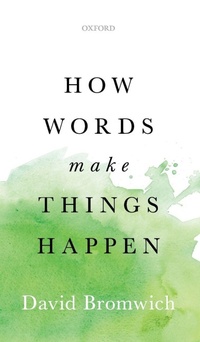
How Words Make Things Happen
Published on 4. April 2019
Book
Hardback
144 pages
978-0-19-967279-0 (ISBN)
Description
Sooner or later, our words take on meanings other than we intended. How Words Make Things Happen suggests that the conventional idea of persuasive rhetoric (which assumes a speaker's control of calculated effects) and the modern idea of literary autonomy (which assumes that 'poetry makes nothing happen') together have produced a misleading account of the relations between words and human action. Words do make things happen. But they cannot be counted on to produce the result they intend.
This volume studies examples from a range of speakers and writers and offers close readings of their words. Chapter 1 considers the theory of speech-acts propounded by J.L. Austin. 'Speakers Who Convince Themselves' is the subject of chapter 2, which interprets two soliloquies by Shakespeare's characters and two by Milton's Satan. The oratory of Burke and Lincoln come in for extended treatment in chapter 3, while chapter 4 looks at the rival tendencies of moral suasion and aestheticism in the poetry of Yeats and Auden. The final chapter, a cause of controversy when first published in the London Review of Books, supports a policy of unrestricted free speech against contemporary proposals of censorship. Since we cannot know what our own words are going to do, we have no standing to justify the banishment of one set of words in favour of another.
This volume studies examples from a range of speakers and writers and offers close readings of their words. Chapter 1 considers the theory of speech-acts propounded by J.L. Austin. 'Speakers Who Convince Themselves' is the subject of chapter 2, which interprets two soliloquies by Shakespeare's characters and two by Milton's Satan. The oratory of Burke and Lincoln come in for extended treatment in chapter 3, while chapter 4 looks at the rival tendencies of moral suasion and aestheticism in the poetry of Yeats and Auden. The final chapter, a cause of controversy when first published in the London Review of Books, supports a policy of unrestricted free speech against contemporary proposals of censorship. Since we cannot know what our own words are going to do, we have no standing to justify the banishment of one set of words in favour of another.
Reviews / Votes
Highly recommended * T. B. Dykeman, CHOICE * The author looks upon politician and poet alike with the same critical eye - or rather, that he listens with the same critical ear. * Colin Marshall, Los Angeles Review of Books * David Bromwich is among the most accomplished literary critics writing in the United States today. More than that, he is a major intellectual voice there. He brings considerable reserves of historical knowledge and philosophical insight to the various issues that concern him...his work extends beyond the confines of any disciplinary boundary....He is a chanllenging and miltifaceted thinker, but he is distinguished, above all, by his moral seriousness. * Richard Bourke, Literary Review *More details
Language
English
Place of publication
Oxford
United Kingdom
Target group
College/higher education
Dimensions
Height: 209 mm
Width: 132 mm
Thickness: 11 mm
Weight
239 gr
ISBN-13
978-0-19-967279-0 (9780199672790)
Copyright in bibliographic data and cover images is held by Nielsen Book Services Limited or by the publishers or by their respective licensors: all rights reserved.
Schweitzer Classification
Other editions
Additional editions
David Bromwich
How Words Make Things Happen
E-Book
04/2019
1st Edition
OUP eBook
€16.49
Available for download
David Bromwich
How Words Make Things Happen
E-Book
03/2019
1st Edition
OUP eBook
€16.49
Available for download
Person
David Bromwich is a scholar of British and American romanticism. He is Sterling Professor of English at Yale University, where he has taught since 1988. Among his books are Hazlitt: The Mind of a Critic, Disowned by Memory: Wordsworth's Poetry of the 1790s, and The Intellectual Life of Edmund Burke.
Content
Preface
1: Does Persuasion Occur? (Austin, Aristotle, Cicero)
2: Speakers Who Convince Themselves (Shakespeare, Milton, James)
3: Pledging Emotion for Conviction (Burke, Lincoln, Bagehot)
4: Persuasion and Responsibility (Yeats, Auden, Orwell)
5: What Should We Be Allowed to Say? (Rushdie, Mill, Savio)
1: Does Persuasion Occur? (Austin, Aristotle, Cicero)
2: Speakers Who Convince Themselves (Shakespeare, Milton, James)
3: Pledging Emotion for Conviction (Burke, Lincoln, Bagehot)
4: Persuasion and Responsibility (Yeats, Auden, Orwell)
5: What Should We Be Allowed to Say? (Rushdie, Mill, Savio)