

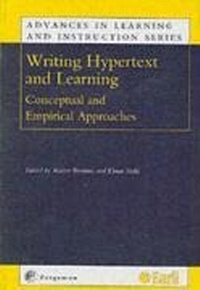
Writing Hypertext and Learning
Conceptual and Empirical Approaches
Published on 3. July 2002
Book
Hardback
214 pages
978-0-08-043987-7 (ISBN)
Description
Once the basic idea of hypertext had spread rapidly throughout the world via the Internet, the reception of hypertexts soon became subject of empirical research among psychologists, cognitive scientists, and educational researchers. As easy to use software for the writing of hypertexts (HTML editors) is now broadly available, there are no longer any technical obstacles for the use of hypertext production in teaching and learning. This book presents and analyses the learning effects that can be anticipated from the production of hypertexts. It includes laboratory experiments, studies on the production of hypertexts in the context of educational institutions, and reports on software environments designed for the production of hypertext. It includes theoretical, empirically and developmentally oriented contributions. The first three chapters link up directly with research on traditional writing while addressing aspects of the interaction between content and rhetoric during hypertext writing. The next three chapters focus on cooperative learning of students in and through the production of hypertexts. The following two chapters look at new technological possibilities, namely, a software environment for transforming textbooks into personalized hypertexts and the design of hypervideos. The final chapter discusses potential methods for further research.
More details
Series
Language
English
Place of publication
London
United Kingdom
Publishing group
Emerald Publishing Limited
Target group
Professional and scholarly
Dimensions
Height: 246 mm
Width: 170 mm
Thickness: 16 mm
Weight
535 gr
ISBN-13
978-0-08-043987-7 (9780080439877)
Copyright in bibliographic data and cover images is held by Nielsen Book Services Limited or by the publishers or by their respective licensors: all rights reserved.
Schweitzer Classification
Content
Writing and learning: hypertext as a renewal of an old and close relationship. Introduction and overview (R. Bromme, E. Stahl). Learning to compose hypertext and linear text: transfer or inhibition? (M. Braaksma et al.). Learning by producing hypertext from reader perspectives: cognitive flexibility theory reconsidered (R. Bromme, E. Stahl). Writing as design: hypermedia and the shape of information space (A. Dillon). Emergent versus presentational hypertext (C. Bereiters). Sleepy links, collaborative grading and trails - shaping hypertext structures by usage processes (K. Wolf). Opening windows in each other's minds: social sharing of hypertext models (A. Talamo, A. Fasula). Slicing books - the authors' perspective (I. Dahn et al.). Authoring hypervideos: design for learning and learning by design (C. Zahn). Methods for assessing cognitive processes during the construction of hypertexts (E. Stahl).