

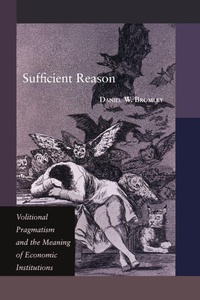
Sufficient Reason
Volitional Pragmatism and the Meaning of Economic Institutions
Published on 26. July 2009
Book
Paperback/Softback
256 pages
978-0-691-14439-9 (ISBN)
Description
In the standard analysis of economic institutions--which include social conventions, the working rules of an economy, and entitlement regimes (property relations)--economists invoke the same theories they use when analyzing individual behavior. In this profoundly innovative book, Daniel Bromley challenges these theories, arguing instead for "volitional pragmatism" as a plausible way of thinking about the evolution of economic institutions. Economies are always in the process of becoming. Here is a theory of how they become. Bromley argues that standard economic accounts see institutions as mere constraints on otherwise autonomous individual action. Some approaches to institutional economics--particularly the "new" institutional economics--suggest that economic institutions emerge spontaneously from the voluntary interaction of economic agents as they go about pursuing their best advantage.
He suggests that this approach misses the central fact that economic institutions are the explicit and intended result of authoritative agents--legislators, judges, administrative officers, heads of states, village leaders--who volitionally decide upon working rules and entitlement regimes whose very purpose is to induce behaviors (and hence plausible outcomes) that constitute the sufficient reasons for the institutional arrangements they create. Bromley's approach avoids the prescriptive consequentialism of contemporary economics and asks, instead, that we see these emergent and evolving institutions as the reasons for the individual and aggregate behavior their very adoption anticipates. These hoped-for outcomes comprise sufficient reasons for new laws, judicial decrees, and administrative rulings, which then become instrumental to the realization of desired individual behaviors and thus aggregate outcomes.
He suggests that this approach misses the central fact that economic institutions are the explicit and intended result of authoritative agents--legislators, judges, administrative officers, heads of states, village leaders--who volitionally decide upon working rules and entitlement regimes whose very purpose is to induce behaviors (and hence plausible outcomes) that constitute the sufficient reasons for the institutional arrangements they create. Bromley's approach avoids the prescriptive consequentialism of contemporary economics and asks, instead, that we see these emergent and evolving institutions as the reasons for the individual and aggregate behavior their very adoption anticipates. These hoped-for outcomes comprise sufficient reasons for new laws, judicial decrees, and administrative rulings, which then become instrumental to the realization of desired individual behaviors and thus aggregate outcomes.
Reviews / Votes
"At last, someone has written a hard-hitting demonstration that formulating the problems of economic policy in the 'old institutionalist' framework of analysis yields far greater insights than do attempts to frame these problems of achieving 'economic efficiency'. Daniel Bromley has written such a book: Sufficient Reason ... and it should be widely read by both the supporters and critics of environmental economics."--Bryan Norton, Environmental Values "In the absence of a consensus there is still the ongoing debate over the making of policy and judgments concerning welfare. To that debate, Bromley's book is a welcome and valuable addition."--Malcolm Rutherford, Journal of Economic MethodologyMore details
Language
English
Place of publication
New Jersey
United States
Target group
College/higher education
Product notice
Paperback (trade)
Illustrations
11 tables.
Dimensions
Height: 234 mm
Width: 156 mm
Thickness: 15 mm
Weight
398 gr
ISBN-13
978-0-691-14439-9 (9780691144399)
Copyright in bibliographic data and cover images is held by Nielsen Book Services Limited or by the publishers or by their respective licensors: all rights reserved.
Schweitzer Classification
Other editions
Additional editions
E-Book
12/2010
1st Edition
Princeton University Press
€36.99
Available for download
Person
Daniel W. Bromley is Anderson-Bascom Professor of Applied Economics at the University of Wisconsin, Madison.
Content
Acknowledgments vii Preface ix PRELUDE 1 CHAPTER ON: Prospective Volition 3 CHAPTER TWO: The Task at Hand 20 PART ONE: On Economic Institutions 29 CHAPTER THREE: Understanding Institutions 31 CHAPTER FOUR: The Content of Institutions 43 CHAPTER FIVE: Institutional Change 67 PART TWO: Volitional Pragmatism 85 CHAPTER SIX: Fixing Belief 87 CHAPTER SEVEN: Explaining 103 CHAPTER EIGHT: Prescribing and Predicting 115 CHAPTER NINE: Volitional Pragmatism 129 PART THREE: Volitional Pragmatism at Work 153 CHAPTER TEN: Thinking as a Pragmatist 155 CHAPTER ELEVEN: Volitional Pragmatism and Explanation 166 CHAPTER TWELVE: Volitional Pragmatism and the Evolution of Institutions 180 CHAPTER THIRTEEN: Volitional Pragmatism and Economic Regulations 199 CHAPTER FOURTEEN: Sufficient Reason 212 Bibliography 225 Index 235