

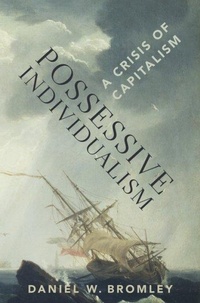
Possessive Individualism
A Crisis of Capitalism
Published on 5. December 2019
Book
Hardback
308 pages
978-0-19-006284-2 (ISBN)
Description
Anxiety and alienation threaten modern democracies. Political anger runs rampant in the United States, Britain voted to leave the European Union, authoritarian governments control several European countries, and millions of desperate migrants are streaming north out of the Middle East, Africa, and Latin America. Many people blame stagnant household incomes and economic inequality. However, Possessive Individualism argues that the origins of world disorder are in the failure of the Enlightenment to anticipate the acquisitive individual as a creature of global capitalism.
Daniel Bromley provides a fundamental critique of contemporary capitalism to explain why the world now finds itself in widespread disorder. Capitalism's basic flaw, he argues, is "possessive individualism." Glorification of the rational individual motivated by acquisitiveness prevents the adoption of necessary government programs that would ease the economic burden on beleaguered households. Meanwhile, possessive individualism enables managerial capitalism-controlled by the "one percent"-to suppress wages and salaries, embrace automation, and move jobs overseas. Capitalism is no longer an engine of improved livelihoods and social hope.
Drawing on evolutionary institutional economics and political theory this book offers two remedies to the crisis of modern capitalism. Escape from the crisis requires that the isolated acquisitive individual rediscovers a sense of loyalty to others-as neighbors, as colleagues, and as participants in the shared social process of living. Escape also requires that the private firm be reimagined as a public trust in which the economic well-being of employees becomes a central part of its purpose. In the absence of these dual transformations, capitalism as we know it cannot endure.
Daniel Bromley provides a fundamental critique of contemporary capitalism to explain why the world now finds itself in widespread disorder. Capitalism's basic flaw, he argues, is "possessive individualism." Glorification of the rational individual motivated by acquisitiveness prevents the adoption of necessary government programs that would ease the economic burden on beleaguered households. Meanwhile, possessive individualism enables managerial capitalism-controlled by the "one percent"-to suppress wages and salaries, embrace automation, and move jobs overseas. Capitalism is no longer an engine of improved livelihoods and social hope.
Drawing on evolutionary institutional economics and political theory this book offers two remedies to the crisis of modern capitalism. Escape from the crisis requires that the isolated acquisitive individual rediscovers a sense of loyalty to others-as neighbors, as colleagues, and as participants in the shared social process of living. Escape also requires that the private firm be reimagined as a public trust in which the economic well-being of employees becomes a central part of its purpose. In the absence of these dual transformations, capitalism as we know it cannot endure.
Reviews / Votes
The book outlines the three most fundamental factors to set up an economy, ranging from explanation, policy prescriptions, and policy predictions (p. 182). These are complemented by various theoretical and practical suggestions for moving towards more evolutionary economics. * Franklin Obeng-Odoom, Evolutionary and Institutional Economics Review *More details
Language
English
Place of publication
New York
United States
Target group
Professional and scholarly
Product notice
sewn/stitched
Cloth over boards
Dimensions
Height: 241 mm
Width: 163 mm
Thickness: 30 mm
Weight
599 gr
ISBN-13
978-0-19-006284-2 (9780190062842)
Copyright in bibliographic data and cover images is held by Nielsen Book Services Limited or by the publishers or by their respective licensors: all rights reserved.
Schweitzer Classification
Other editions
Additional editions
E-Book
10/2019
1st Edition
OUP eBook
€37.99
Available for download
E-Book
10/2019
1st Edition
OUP eBook
€37.99
Available for download
Person
Daniel W. Bromley is Emeritus Professor of Applied Economics at the University of Wisconsin-Madison. He has published fifteen books and almost 100 journal articles on: (1) the philosophical foundations of economics; (2) institutional economics; (3) international economic development; and (4) the legal and philosophical dimensions of property rights.
Content
PREFACE
PART I. THE PROBLEMATIC TRIUMPH OF CAPITALISM
Chapter 1 The Crisis of Capitalism
Chapter 2 Economics: The Dubious Enabler
Chapter 3 Emergence of the Isolated Household
PART II. THE GREAT UNRAVELLING
Chapter 4 The Cleaved Core
Chapter 5 The Isolated Periphery
PART III. RECOVERING HOPE
Chapter 6 Escaping Possessive Individualism
Chapter 7 Reimagining the Private Firm
Chapter 8 Reimagining the Individual
Chapter 9 Recovering Personhood
PART I. THE PROBLEMATIC TRIUMPH OF CAPITALISM
Chapter 1 The Crisis of Capitalism
Chapter 2 Economics: The Dubious Enabler
Chapter 3 Emergence of the Isolated Household
PART II. THE GREAT UNRAVELLING
Chapter 4 The Cleaved Core
Chapter 5 The Isolated Periphery
PART III. RECOVERING HOPE
Chapter 6 Escaping Possessive Individualism
Chapter 7 Reimagining the Private Firm
Chapter 8 Reimagining the Individual
Chapter 9 Recovering Personhood