

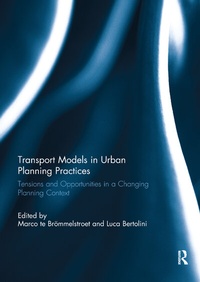
Transport Models in Urban Planning Practices
Tensions and Opportunities in a Changing Planning Context
1st Edition
Published on 23. August 2018
Book
Paperback/Softback
160 pages
978-1-138-37776-9 (ISBN)
Description
This book explores how transportation models can play a role in a changing transport planning and policy making context. Most models are rooted in decades of development work and are geared to offer value-free, academic and explicit knowledge to transport planning experts. However, planning practice has changed dramatically over the years, resulting in a less technical rational view on the use of such knowledge - especially so in early, strategy making phases. More and more complex policy goals, integration of a wide area of other policy domains, a wider, ever-changing and much more mixed group of planning participants and much more focus on 'wicked problems'. The book maps how this influences the effectiveness of transport modelling exercises and explores several state-of-the-art implementations.
This book was published as a special issue of Transport Reviews.
This book was published as a special issue of Transport Reviews.
More details
Language
English
Place of publication
London
United Kingdom
Publishing group
Taylor & Francis Ltd
Target group
College/higher education
Dimensions
Height: 246 mm
Width: 174 mm
Weight
310 gr
ISBN-13
978-1-138-37776-9 (9781138377769)
Copyright in bibliographic data and cover images is held by Nielsen Book Services Limited or by the publishers or by their respective licensors: all rights reserved.
Schweitzer Classification
Other editions
Additional editions
Marco te Broemmelstroet | Luca Bertolini
Transport Models in Urban Planning Practices
Tensions and Opportunities in a Changing Planning Context
E-Book
04/2016
1st Edition
Routledge
€72.49
Available for download
Marco te Broemmelstroet | Luca Bertolini
Transport Models in Urban Planning Practices
Tensions and Opportunities in a Changing Planning Context
E-Book
04/2016
1st Edition
Routledge
€72.49
Available for download
Marco te Broemmelstroet | Luca Bertolini
Transport Models in Urban Planning Practices
Tensions and Opportunities in a Changing Planning Context
Book
07/2013
1st Edition
Routledge
€222.84
Shipment within 15-20 days
Persons
Marco te Broemmelstroet is Assistant Professor in Urban Planning at the University of Amsterdam. His research interests include the role of knowledge in urban strategy making processes. In real world practices and in more experimental environments, strategies to improve the effectiveness of such knowledge use are tested and improved.
Luca Bertolini is Professor in Urban Planning at the University of Amsterdam. His research interests include the integration of land use and transport in urban planning processes. His main focus is on how such planning processes can cope with deep uncertainty and how practitioners can supported in this.
Luca Bertolini is Professor in Urban Planning at the University of Amsterdam. His research interests include the integration of land use and transport in urban planning processes. His main focus is on how such planning processes can cope with deep uncertainty and how practitioners can supported in this.
Content
1. The Role of Transport-Related Models in Urban Planning Practice 2. Analysing Models as a Knowledge Technology in Transport Planning 3. From Macro to Micro-How Much Micro is too Much? 4. Integrating Land Use with Public Transport: The Use of a Discursive Accessibility Tool to Inform Metropolitan Spatial Planning in Perth 5. Transport Models and Urban Planning Practice: Experiences with Albatross 6. Integrated Land Use and Transportation Planning and Modelling: Addressing Challenges in Research and Practice 7. The Third Limfjord Crossing: A Case of Pessimism Bias and Knowledge Filtering 8. The Usefulness of Transport Models in Swedish Planning Practice 9. Modelling with Systems Dynamics as a Method to Bridge the Gap between Politics, Planning and Science? Lessons Learnt from the Development of the Land Use and Transport Model MARS