

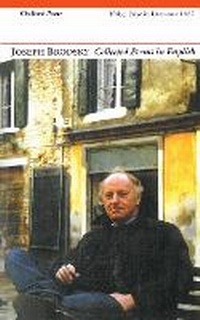
Collected Poems In English
Published on 25. October 2001
Book
Paperback/Softback
542 pages
978-1-903039-55-7 (ISBN)
Description
Edited by Ann Kjellberg; translated by Anthony Hecht, Howard Moss, Derek Walcott, Richard Wilbur and others
Five years after the death of Joseph Brodsky, the heir of the generation of Pasternak, Mandelstam, Tsvetaeva and especially Akhmatova, this Collected Poems in English for the first time collects all his translated and original poems in English. It confirms his unique place in our literature. His abiding addiction to the English language, and particularly to the Metaphysical poets, was manifest in the industry with which he read and translated in both directions. Both his own efforts to translate his work, and the poems he wrote directly in English, are ambitious: the poetic 'conceit' is for him functional as it was in the seventeenth century, a tool for prizing open difficult truths, making vertiginous connections. In the preface to A Part of Speech (Oxford, 1977) he wrote, 'I have taken the liberty of reworking some of the translations to bring them closer to the original, though perhaps at the expense of their smoothness.' Something strange and suggestive is alive in his disrupted prosodies, the pressure of content and of a poet making sense.
Susan Sontag speaks of the poems' 'extraordinary velocity and density of material notation, of cultural reference, of attitude. He insisted that poetry's "job" (a much used word) was to explore the capacity of language to travel farther, faster. Poetry, he said, is 'accelerated thinking.'
Five years after the death of Joseph Brodsky, the heir of the generation of Pasternak, Mandelstam, Tsvetaeva and especially Akhmatova, this Collected Poems in English for the first time collects all his translated and original poems in English. It confirms his unique place in our literature. His abiding addiction to the English language, and particularly to the Metaphysical poets, was manifest in the industry with which he read and translated in both directions. Both his own efforts to translate his work, and the poems he wrote directly in English, are ambitious: the poetic 'conceit' is for him functional as it was in the seventeenth century, a tool for prizing open difficult truths, making vertiginous connections. In the preface to A Part of Speech (Oxford, 1977) he wrote, 'I have taken the liberty of reworking some of the translations to bring them closer to the original, though perhaps at the expense of their smoothness.' Something strange and suggestive is alive in his disrupted prosodies, the pressure of content and of a poet making sense.
Susan Sontag speaks of the poems' 'extraordinary velocity and density of material notation, of cultural reference, of attitude. He insisted that poetry's "job" (a much used word) was to explore the capacity of language to travel farther, faster. Poetry, he said, is 'accelerated thinking.'
More details
Language
English
Place of publication
Manchester
United Kingdom
Publishing group
Carcanet Press Ltd
Target group
College/higher education
Dimensions
Height: 198 mm
Width: 130 mm
Thickness: 34 mm
Weight
698 gr
ISBN-13
978-1-903039-55-7 (9781903039557)
Copyright in bibliographic data and cover images is held by Nielsen Book Services Limited or by the publishers or by their respective licensors: all rights reserved.
Schweitzer Classification
Persons
Joseph Brodsky was born in Leningrad (St Petersburg) in 1940 into a Russian-Jewish family. He left school when he was fifteen and began writing poetry three years later. He lived a year (1964-5) in exile in the Arkhangelsk region of northern Russia. In June 1972 he became an involuntary exile and settled in the United States. He received the Nobel Prize for Literature in 1987 and served as Poet Laureate of the United States in 1991 and 1992. He died in 1996. Anthony Hechtwas born in New York City in 1923. He was educated at Columbia University and is married with three children. He has published eight volumes of poetry, of which the latest is The Darkness and the Light. He is also the author of three volumes of essays and criticism; a fourth, to be called Melodies Unheard, is forthcoming.