

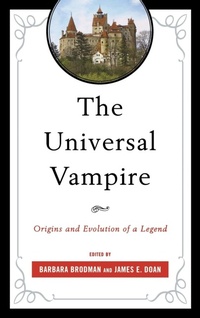
The Universal Vampire
Origins and Evolution of a Legend
Published on 8. March 2013
Book
Hardback
262 pages
978-1-61147-580-7 (ISBN)
Description
Since the publication of John Polidori's The Vampyre (1819), the vampire has been a mainstay of Western culture, appearing consistently in literature, art, music (notably opera), film, television, graphic novels and popular culture in general. Even before its entrance into the realm of arts and letters in the early nineteenth century, the vampire was a feared creature of Eastern European folklore and legend, rising from the grave at night to consume its living loved ones and neighbors, often converting them at the same time into fellow vampires.
A major question exists within vampire scholarship: to what extent is this creature a product of European cultural forms, or is the vampire indeed a universal, perhaps even archetypal figure? In this collection of sixteen original essays, the contributors shed light on this question. One essay traces the origins of the legend to the early medieval Norse draugr, an "undead" creature who reflects the underpinnings of Dracula, the latter first appearing as a vampire in Anglo-Irish Bram Stoker's 1897 novel, Dracula.
In addition to these investigations of the Western mythic, literary and historic traditions, other essays in this volume move outside Europe to explore vampire figures in Native American and Mesoamerican myth and ritual, as well as the existence of similar vampiric traditions in Japanese, Russian and Latin American art, theatre, literature, film, and other cultural productions.
The female vampire looms large, beginning with the Sumerian goddess Lilith, including the nineteenth-century Carmilla, and moving to vampiresses in twentieth-century film, literature, and television series. Scientific explanations for vampires and werewolves constitute another section of the book, including eighteenth-century accounts of unearthing, decapitation and cremation of suspected vampires in Eastern Europe. The vampire's beauty, attainment of immortality and eternal youth are all suggested as reasons for its continued success in contemporary popular culture.
A major question exists within vampire scholarship: to what extent is this creature a product of European cultural forms, or is the vampire indeed a universal, perhaps even archetypal figure? In this collection of sixteen original essays, the contributors shed light on this question. One essay traces the origins of the legend to the early medieval Norse draugr, an "undead" creature who reflects the underpinnings of Dracula, the latter first appearing as a vampire in Anglo-Irish Bram Stoker's 1897 novel, Dracula.
In addition to these investigations of the Western mythic, literary and historic traditions, other essays in this volume move outside Europe to explore vampire figures in Native American and Mesoamerican myth and ritual, as well as the existence of similar vampiric traditions in Japanese, Russian and Latin American art, theatre, literature, film, and other cultural productions.
The female vampire looms large, beginning with the Sumerian goddess Lilith, including the nineteenth-century Carmilla, and moving to vampiresses in twentieth-century film, literature, and television series. Scientific explanations for vampires and werewolves constitute another section of the book, including eighteenth-century accounts of unearthing, decapitation and cremation of suspected vampires in Eastern Europe. The vampire's beauty, attainment of immortality and eternal youth are all suggested as reasons for its continued success in contemporary popular culture.
More details
Language
English
Place of publication
Cranbury
United States
Publishing group
Associated University Presses
Target group
Professional and scholarly
Illustrations
1 b/w photos;
Dimensions
Height: 235 mm
Width: 157 mm
Thickness: 20 mm
Weight
584 gr
ISBN-13
978-1-61147-580-7 (9781611475807)
Copyright in bibliographic data and cover images is held by Nielsen Book Services Limited or by the publishers or by their respective licensors: all rights reserved.
Schweitzer Classification
Other editions
Additional editions
E-Book
03/2013
1st Edition
Fairleigh Dickinson University Press,U.S.
€48.49
Available for download
Persons
Barbara Brodman is professor of humanities at Nova Southeastern University. She has published a variety of scholarly works that deal with international arts and affairs.
James E. Doan is professor of humanities at Nova Southeastern University, where he teaches courses in literature, the arts, folklore and mythology, including a course on the vampire that he has taught for twenty years.
James E. Doan is professor of humanities at Nova Southeastern University, where he teaches courses in literature, the arts, folklore and mythology, including a course on the vampire that he has taught for twenty years.
Content
Contents
Acknowledgements
Barbara Brodman and James E Doan, Introduction
Part 1: The Western Vampire: From Draugr to Dracula
Matthias Teichert,"Draugula": The draugr in Old Norse-Icelandic Saga Literature and His Relationship to the Post-Medieval Vampire Myth
Paul E. H. Davis, Dracula Anticipated: The "Undead" in Anglo-Irish Literature
Alexis M. Milmine, Retracing the Shambling Steps of the Undead: The Blended Folkloric Elements of Vampirism in Bram Stoker's Dracula
Cristina Artenie, Dracula's Kitchen: A Glossary of Transylvanian Cuisine, Language and Ethnography
Part 2: Medical Explanations for the Vampire
Edward O. Keith, Biomedical Origins of Vampirism
Leo Ruickbie, Evidence for the Undead: The Role of Medical Investigation in the 18th-Century Vampire Epidemic
Clemens Ruthner, Undead Feedback: Adaptations and Echoes of Johann Flueckinger's Report, Visum et Repertum (1732), until the Millennium
Part 3: The Female Vampire in World Myth and the Arts
Nancy Schuman
Acknowledgements
Barbara Brodman and James E Doan, Introduction
Part 1: The Western Vampire: From Draugr to Dracula
Matthias Teichert,"Draugula": The draugr in Old Norse-Icelandic Saga Literature and His Relationship to the Post-Medieval Vampire Myth
Paul E. H. Davis, Dracula Anticipated: The "Undead" in Anglo-Irish Literature
Alexis M. Milmine, Retracing the Shambling Steps of the Undead: The Blended Folkloric Elements of Vampirism in Bram Stoker's Dracula
Cristina Artenie, Dracula's Kitchen: A Glossary of Transylvanian Cuisine, Language and Ethnography
Part 2: Medical Explanations for the Vampire
Edward O. Keith, Biomedical Origins of Vampirism
Leo Ruickbie, Evidence for the Undead: The Role of Medical Investigation in the 18th-Century Vampire Epidemic
Clemens Ruthner, Undead Feedback: Adaptations and Echoes of Johann Flueckinger's Report, Visum et Repertum (1732), until the Millennium
Part 3: The Female Vampire in World Myth and the Arts
Nancy Schuman