

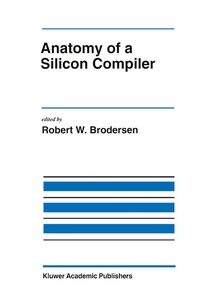
Anatomy of a Silicon Compiler
Published on 30. June 1992
Book
Hardback
XV, 362 pages
978-0-7923-9249-1 (ISBN)
Description
A silicon compiler is a software system which can automatically generate an integrated circuit from a user's specification.
Anatomy of a Silicon Compiler examines one such compiler in detail, covering the basic framework and design entry, the actual algorithms and libraries which are used, the approach to verification and testing, behavioral synthesis tools and several applications which demonstrate the system's capabilities.
Anatomy of a Silicon Compiler examines one such compiler in detail, covering the basic framework and design entry, the actual algorithms and libraries which are used, the approach to verification and testing, behavioral synthesis tools and several applications which demonstrate the system's capabilities.
More details
Series
Edition
1992 ed.
Language
English
Place of publication
New York
United States
Target group
Professional and scholarly
Research
Illustrations
XV, 362 p.
Dimensions
Height: 241 mm
Width: 160 mm
Thickness: 26 mm
Weight
740 gr
ISBN-13
978-0-7923-9249-1 (9780792392491)
DOI
10.1007/978-1-4615-3570-6
Schweitzer Classification
Other editions
Additional editions
Robert W. Brodersen
Anatomy of a Silicon Compiler
E-Book
12/2012
Springer
€149.79
Available for download
Robert W. Brodersen
Anatomy of a Silicon Compiler
Book
10/2012
Springer
€160.49
Shipment within 7-9 days
Content
1 Introduction and History.- 1.1. What is Lager.- 1.2. Users vs. Developers.- 1.3. History.- 1.4. Assembly vs. Behavioral synthesis.- 1.5. Book Organization.- I Framework and Design Entry.- 2 The OCT Data Manager.- 2.1. Basic Structure.- 2.2. Policy Versus Mechanism.- 2.3. The OCT Objects.- 2.4. The OCT Procedural Interface.- 2.5. OCT Physical Policy.- 2.6. OCT Symbolic Policy.- 2.7. Summary.- 3 Lager OCT Policy and the SDL Language.- 3.1. Lager Policies.- 3.2. The Structure_Master View and the SDL Language.- 3.3. The Structure_Instance View.- 3.4. The Physical View.- 3.5. Summary.- 4 Schematic Entry.- 4.1. Schematic Tool Interface.- 4.2. Design Examples.- 4.3. Summary.- 5 Design Management.- 5.1. Parameterization and Library Support.- 5.2. The Design Flow Strategy.- 5.3. Controlling the Design Flow.- 5.4. The Design Management Strategy.- 5.5. Summary.- 6 Design Post-Processing.- 6.1. Capabilities.- 6.2. The Post Processing Tools.- 6.3. Runtime Operation.- 6.4. Summary.- II Silicon Assembly.- 7 Hierarchical Tiling.- 8 Standard Cell Design.- 9 Interactive Floorplanning.- 10 Datapath Generation.- 11 Pad Routing.- III Verification and Testing.- 12 Design Verification.- 13 Behavior and Switch Level Simulation.- 14 Chip and Board Testing.- IV Behavioral Synthesis.- 15 DSP Specification Using the Silage Language.- 16 Synthesis of Datapath Architectures.- 17 From C to Silicon.- 18 An FIR Filter Generator.- V Applications.- 19 The PUMA Processor.- 20 Radon Transform Using the PPPE.- 21 Speech Recognition.- 22 Conclusions and Future Work.- Appendix a Design Example.- A.1. Running Dmoct to Generate a Design.- A.2. Design Post-Processing with Dmpost.- Appendix B Training and Distribution.- B.1. Training.- B.2. Lager Distribution.