

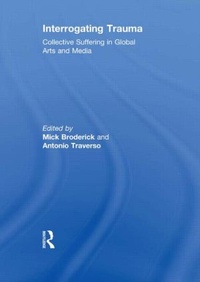
Interrogating Trauma
Collective Suffering in Global Arts and Media
1st Edition
Published on 8. September 2010
Book
Hardback
210 pages
978-0-415-58278-0 (ISBN)
Description
Throughout the past century, traumatic experiences have been re-enacted frequently by evolving media and art forms. Now there is a significant body of theory across academic disciplines focused on the representation of cataclysmic European and US historical events. However, less critical attention has been devoted to the representation of havoc outside the West, even though depictions of Third-World disasters saturate contemporary media and art around the globe.
This book considers traumatic histories internationally in a broad range of creative arts and visual media representations. Deploying diverse applications of the conventional theories of trauma, it examines the theoretical limitations at the same time as considering alternative methodologies. Interrogating Trauma is concerned with the examination of the concept of trauma, and how it is (often unproblematically) used to theorise the cultural representation of disaster and atrocity. It offers a theorisation of trauma, in order to reappraise the relationship between cultural representation and the socio-historical processes which are marked by violence, conflict and suffering.
This book was published as a special issue of Continuum: Journal of Media and Cultural Studies.
This book considers traumatic histories internationally in a broad range of creative arts and visual media representations. Deploying diverse applications of the conventional theories of trauma, it examines the theoretical limitations at the same time as considering alternative methodologies. Interrogating Trauma is concerned with the examination of the concept of trauma, and how it is (often unproblematically) used to theorise the cultural representation of disaster and atrocity. It offers a theorisation of trauma, in order to reappraise the relationship between cultural representation and the socio-historical processes which are marked by violence, conflict and suffering.
This book was published as a special issue of Continuum: Journal of Media and Cultural Studies.
More details
Language
English
Place of publication
London
United Kingdom
Publishing group
Taylor & Francis Ltd
Target group
College/higher education
Professional and scholarly
Illustrations
13 s/w Abbildungen
13 Illustrations, black and white
Dimensions
Height: 246 mm
Width: 174 mm
Weight
570 gr
ISBN-13
978-0-415-58278-0 (9780415582780)
Copyright in bibliographic data and cover images is held by Nielsen Book Services Limited or by the publishers or by their respective licensors: all rights reserved.
Schweitzer Classification
Other editions
Additional editions
E-Book
09/2013
1st Edition
Routledge
€63.49
Available for download
E-Book
09/2013
1st Edition
Routledge
€63.49
Available for download
Book
02/2013
1st Edition
Routledge
€69.20
Shipment within 15-20 days
Persons
Mick Broderick is Associate Professor and Research Coordinator in the School of Media, Communications & Culture at Murdoch University, where he is Deputy Director of the National Academy of Screen & Sound (NASS). He has published editions of the reference work Nuclear Movies and, as editor, Hibakusha Cinema.
Antonio Traverso is Senior Lecturer in Film and Television studies in the School of Media, Culture and Creative Arts at Curtin University, Perth, Australia. He co-edited a special issue of Social Identities: "Living Through Terror: (Post)Conflict, (Post)Trauma and the South", and has produced several short films, including the award-winning Tales from the South.
Antonio Traverso is Senior Lecturer in Film and Television studies in the School of Media, Culture and Creative Arts at Curtin University, Perth, Australia. He co-edited a special issue of Social Identities: "Living Through Terror: (Post)Conflict, (Post)Trauma and the South", and has produced several short films, including the award-winning Tales from the South.
Content
1. Interrogating trauma: Towards a critical trauma studies - Mick Broderick and Antonio Traverso 2. 'Cache': Or what the past hides - Susannah Radstone 3. Torturous dialogues: Geographies of trauma and spaces of exception - Suvendrini Perera 4. Moving testimonies and the geography of suffering: Perils and fantasies of belonging after Katrina - Janet Walker 5. After the Apology: Re-framing violence and suffering in 'First Australians', 'Australia', and 'Samson and Delilah' - Felicity Collins 6. Confronting 'choiceless choices' in Holocaust videotestimonies: Judgement, 'privileged' Jews, and the role of the interviewer - Adam Brown 7. The guilt zone: Trauma, masochism and the ethics of spectatorship in Brian De Palma's 'Redacted' - Mark Straw 8. When places have agency: Roadside shrines as traumascapes - Catherine Ann Collins and Alexandra Opie 9. Trauma, bodies, and Performance Art: Towards an embodied ethics of seeing - Sophie Oliver 10. Poetic witnessing in the archive: The database narrative of 'Life After Wartime' - David Carlin 11. Bearing witness to the trauma of slavery in Kara Walker's videos: 'Testimony', 'Eight possible beginnings', and 'I Was Transported' - Vivien Fryd 12. Depiction or erasure? Violence and trauma in contemporary Peruvian film - Iliana Pagan-Teitelbaum 13. Dictatorship memories: Working through trauma in Chilean post-dictatorship documentary - Antonio Traverso