

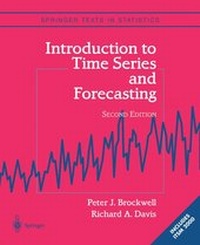
Introduction to Time Series and Forecasting
2nd Edition
Published on 29. April 2010
Book
Mixed media product
XIV, 437 pages
978-0-387-95351-9 (ISBN)
Description
This book is aimed at the reader who wishes to gain a working knowledge of time series and forecasting methods as applied in economics, engineering, and the natural and social sciences. The book assumes knowledge only of basic calculus, matrix algebra and elementary statistics. This second edition contains detailed instructions on the use of the new totally windows-based computer package ITSM2000. Expanded treatments are also given of several topics treated only briefly in the first edition. These include regression with time series errors, which plays an important role in forecasting and inference, and ARCH and GARCH models, which are widely used for the modeling of financial time series. These models can be fitted using the new version of ITSM. The core of the book covers stationary processes, ARMA and ARIMA processes, multivariate time series and state-space models, with an optional chapter on spectral analysis. Additional topics include the Burg and Hannan-Rissanen algorithms, unit roots, the EM algorithm, structural models, generalized state-space models with applications to time series of count data, exponential smoothing, the Holt-Winters and ARAR forecasting algorithms, transfer function models and intervention analysis. Brief introductions are also given to cointegration and to non-linear, continuous-time and long-memory models.
Reviews / Votes
From the reviews:"The emphasis is on hands-on experience and the friendly software that accompanies the book serves the purpose admirably. ...
The authors should be congratulated for making the subject accessible and fun to learn. The book is a pleasure to read and highly recommended. I regard it as the best introductory text in town." ISI Short Book Reviews
More details
Series
Edition
2nd ed. 2002, Corr. 9th printing 2010
Language
English
Place of publication
New York
United States
Target group
College/higher education
Graduate
Edition type
Revised edition
Illustrations
biography
Dimensions
Height: 26 cm
Width: 19.5 cm
Weight
1146 gr
ISBN-13
978-0-387-95351-9 (9780387953519)
DOI
10.1007/b97391
Schweitzer Classification
Other editions
New editions
Peter J. Brockwell | Richard A. Davis
Introduction to Time Series and Forecasting
Book
09/2016
3rd Edition
Springer
€96.29
Shipment within 10-15 days
Additional editions
Peter J. Brockwell | Richard A. Davis
Introduction to Time Series and Forecasting
Book
04/2013
2nd Edition
Springer
€96.29
Shipment within 15-20 days
Peter J. Brockwell | Richard A. Davis
Introduction to Time Series and Forecasting
E-Book
04/2006
2nd Edition
Springer
€96.29
Available for download
Previous edition

Peter J. Brockwell | Richard A. Davis
Introduction to Time Series and Forecasting
Book
09/1996
Springer
€85.59
Article exhausted; check for reprint
Persons
Content
Preface 1 INTRODUCTION 1.1 Examples of Time Series 1.2 Objectives of Time Series Analysis 1.3 Some Simple Time Series Models 1.3.3 A General Approach to Time Series Modelling 1.4 Stationary Models and the Autocorrelation Function 1.4.1 The Sample Autocorrelation Function 1.4.2 A Model for the Lake Huron Data 1.5 Estimation and Elimination of Trend and Seasonal Components 1.5.1 Estimation and Elimination of Trend in the Absence of Seasonality 1.5.2 Estimation and Elimination of Both Trend and Seasonality 1.6 Testing the Estimated Noise Sequence 1.7 Problems 2 STATIONARY PROCESSES 2.1 Basic Properties 2.2 Linear Processes 2.3 Introduction to ARMA Processes 2.4 Properties of the Sample Mean and Autocorrelation Function 2.4.2 Estimation of $\gamma(\cdot)$ and $\rho(\cdot)$ 2.5 Forecasting Stationary Time Series 2.5.3 Prediction of a Stationary Process in Terms of Infinitely Many Past Values 2.6 The Wold Decomposition 1.7 Problems 3 ARMA MODELS 3.1 ARMA($p,q$) Processes 3.2 The ACF and PACF of an ARMA$(p,q)$ Process 3.2.1 Calculation of the ACVF 3.2.2 The Autocorrelation Function 3.2.3 The Partial Autocorrelation Function 3.3 Forecasting ARMA Processes 1.7 Problems 4 SPECTRAL ANALYSIS 4.1 Spectral Densities 4.2 The Periodogram 4.3 Time-Invariant Linear Filters 4.4 The Spectral Density of an ARMA Process 1.7 Problems 5 MODELLING AND PREDICTION WITH ARMA PROCESSES 5.1 Preliminary Estimation 5.1.1 Yule-Walker Estimation 5.1.3 The Innovations Algorithm 5.1.4 The Hannan-Rissanen Algorithm 5.2 Maximum Likelihood Estimation 5.3 Diagnostic Checking 5.3.1 The Graph of $\t=1,\ldots,n\ 5.3.2 The Sample ACF of the Residuals