

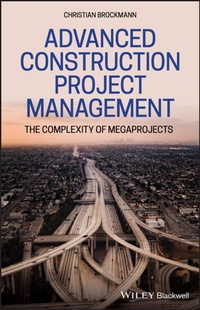
Advanced Construction Management
The Complexity of Megaprojects
1st Edition
Published on 17. December 2020
Book
Hardback
288 pages
978-1-119-55476-9 (ISBN)
Description
Advanced Construction Management covers all aspects of megaproject management from the contractor's perspective, providing all stakeholders with a better understanding of the complexity of megaprojects and contractors with better concepts and tools for achieving impeccable implementation. It describes the structure, mechanics and dynamics of megaprojects and the management activities required, as well as giving the reader appropriate tools for the management of megaprojects and for managing stakeholder integration.
More details
Other editions
Additional editions
E-Book
12/2020
1st Edition
Wiley
€89.99
Available for download
E-Book
12/2020
1st Edition
Wiley
€89.99
Available for download
Content
1. Introduction 1
1.1. Let me start with a story 3
1.2. Status of megaprojects 6
1.3. Purpose 8
1.4. Methodological approach 9
1.5. Readership 11
1.6. Structure of the text 14
2. Theoretical background 17
2.1. Definitions 17
2.2. Cognitive maps 18
2.3. Descriptive management research 19
2.4. Guiding theories 20
2.4.1. Luhmannian systems theory 20
2.4.2. Contingency theory 21
2.4.3. New institutional economics 22
3. Advanced construction project management 26
3.1. Construction 27
3.2. Management 29
4. Characteristics of megaprojects 34
4.1. Project typology 35
4.1.1. Conceptualizing criteria 36
4.1.2. Choice of dimensions 37
4.1.3. Typical cases 38
4.1.4. Typology 39
4.2. Complexity of megaprojects 43
4.2.1. Defining complexity 44
4.2.2. Construct dimensions of complexity 46
4.2.3. Factors of the construct dimensions 47
4.2.4. Complexity development 49
5. International construction management 52
5.1. International construction joint ventures 52
5.2. Global contractors 54
5.3. Goals for international construction joint ventures 56
5.4. Success factors for megaprojects 60
5.5. Key personnel 63
5.6. Expatriate life 65
6. Megaproject phases and activity groups 67
6.1. Project idea and project development 70
6.2. Design phases 71
6.3. Market contacts, bidding period and contract negotiations 72
6.3.1. Market contacts 72
6.3.2. Bidding period 74
6.3.3. Contract negotiations 75
6.4. Construction and maintenance 76
6.4.1. Planning and procurement 78
6.4.2. Testing the construction technology 82
6.4.3. Mastering the construction technology 85
6.4.4. Stabilization of all construction processes 87
6.4.5. Routine processes 89
6.4.6. Demobilization of the project 90
6.4.7. Management roles during construction 91
6.4.8. The course of complexity throughout the activity groups 93
7. Descriptive megaproject management model 97
7.1. Management functions 98
7.1.1. Complex engineering tasks 98
7.1.2. Management functions 100
7.1.3. Meta-functions 101
7.1.4. Basic functions 102
7.1.5. Cultural dimensions 103
7.2. Management functions and complexity 104
7.2.1. Management functions and task complexity 105
7.2.2. Management functions and social complexity 106
7.2.3. Cultural dimensions and cultural complexity 107
7.2.4. Management functions and cognitive complexity 109
7.2.5. Management functions and operative complexity 110
7.2.6. Combining management and complexity 110
8. Engineering management 113
8.1. Design 114
8.1.1. Design management 114
8.1.2. Design 117
8.2. Project management 119
8.2.1. Integration management 121
8.2.2. Scope management 121
8.2.3. Time management 122
8.2.4. Cost management 122
8.2.5. Quality management 124
8.2.6. Human resource management 125
8.2.7. Communication management 127
8.2.8. Risk management 128
8.2.9. Procurement management 130
8.2.10. Stakeholder management 131
8.2.11. Health, safety and environmental management 133
8.2.12. Contract management 133
8.3. Production planning 135
8.4. Site installation 141
8.5. Construction 146
9. Management functions 150
9.1. Planning 152
9.1.1. SWOT analysis 154
9.1.2. Developing new plans 155
9.1.3. Analytical framework for planning 156
9.1.4. Planning system for megaprojects 157
9.2. Controlling 162
9.3. Organizing 167
9.3.1. Organizational structure 170
9.3.2. Process organization 175
9.3.3. Organizational rules 176
9.4. Staffing 178
9.5. Directing 181
10. Meta-functions 185
10.1. Decision-making 186
10.2. Communication 192
10.2.1. Megaproject communication 192
10.2.2. Communication models 193
10.2.3. Communication methods 197
10.2.4. Communication organization 200
10.3. Coordination 204
10.3.1. Coordination methods 205
10.3.2. Fragmented supply chain 207
10.4. Learning 210
11. Basic functions 216
11.1. Project knowledge 216
11.2. Trust 219
11.3. Sensemaking 224
11.4. Commitment 227
12. Cultural management 232
13. Innovation in construction megaprojects 241
13.1. Aspects of innovation 242
13.1.1. Methodology and Case Study Choice 245
13.1.2. Innovations and trajectories 248
13.1.3. Conclusions and implications 256
13.2. The innovation process 258
13.2.1. Introduction 259
13.2.2. Approaches to generate innovation and definition 260
13.2.3. Innovation process models and barriers to innovation 261
13.2.4. Data summary 263
13.2.5. The general model of the innovation process 264
13.2.6. Product and process innovations for the BangNa Expressway 269
13.2.7. Process innovations for the Great Belt Tunnel 270
13.2.8. Conclusions 272
13.3. Progress functions 274
13.3.1. Theory and terminology 274
13.3.2. Literature review 276
13.3.3. Research 279
13.3.4. Data analysis and discussion 285
13.3.5. Discussion and conclusion 289
14. All in all, what does it mean? 292
15. References 294