

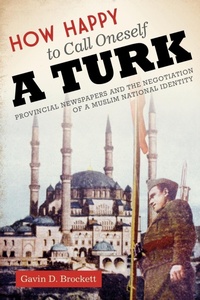
How Happy to Call Oneself a Turk
Provincial Newspapers and the Negotiation of a Muslim National Identity
Published on 1. May 2011
Book
Paperback/Softback
311 pages
978-0-292-74400-4 (ISBN)
Description
The modern nation-state of Turkey was established in 1923, but when and how did its citizens begin to identify themselves as Turks? Mustafa Kemal AtatUErk, Turkey's founding president, is almost universally credited with creating a Turkish national identity through his revolutionary program to "secularize" the former heartland of the Ottoman Empire. Yet, despite Turkey's status as the lone secular state in the Muslim Middle East, religion remains a powerful force in Turkish society, and the country today is governed by a democratically elected political party with a distinctly religious (Islamist) orientation.
In this history, Gavin D. Brockett takes a fresh look at the formation of Turkish national identity, focusing on the relationship between Islam and nationalism and the process through which a "religious national identity" emerged. Challenging the orthodoxy that AtatUErk and the political elite imposed a sense of national identity from the top down, Brockett examines the social and political debates in provincial newspapers from around the country. He shows that the unprecedented expansion of print media in Turkey between 1945 and 1954, which followed the end of strict, single-party authoritarian government, created a forum in which ordinary people could inject popular religious identities into the new Turkish nationalism. Brockett makes a convincing case that it was this fruitful negotiation between secular nationalism and Islam-rather than the imposition of secularism alone-that created the modern Turkish national identity.
In this history, Gavin D. Brockett takes a fresh look at the formation of Turkish national identity, focusing on the relationship between Islam and nationalism and the process through which a "religious national identity" emerged. Challenging the orthodoxy that AtatUErk and the political elite imposed a sense of national identity from the top down, Brockett examines the social and political debates in provincial newspapers from around the country. He shows that the unprecedented expansion of print media in Turkey between 1945 and 1954, which followed the end of strict, single-party authoritarian government, created a forum in which ordinary people could inject popular religious identities into the new Turkish nationalism. Brockett makes a convincing case that it was this fruitful negotiation between secular nationalism and Islam-rather than the imposition of secularism alone-that created the modern Turkish national identity.
More details
Series
Language
English
Place of publication
Austin, TX
United States
Target group
Professional and scholarly
Product notice
Paperback (trade)
Dimensions
Height: 229 mm
Width: 152 mm
Thickness: 18 mm
Weight
509 gr
ISBN-13
978-0-292-74400-4 (9780292744004)
Copyright in bibliographic data and cover images is held by Nielsen Book Services Limited or by the publishers or by their respective licensors: all rights reserved.
Schweitzer Classification
Other editions
Previous edition

Gavin D. Brockett
How Happy to Call Oneself a Turk
Provincial Newspapers and the Negotiation of a Muslim National Identity
Book
05/2011
University of Texas Press
€75.80
Article exhausted; check for reprint
Person
Gavin D. Brockett is Associate Professor of Middle East and Islamic History at Wilfrid Laurier University. He is editor, with Touraj Atabaki, of Ottoman and Republican Turkish Labour History.
Content
List of Illustrations
Preface
Acknowledgments
Introduction
Chapter 1. Imagining the Secular Nation: Mustafa Kemal and the Creation of Modern Turkey
Chapter 2. Narrating the Nation: Print Culture and the Nationalist Historical Narrative
Chapter 3. Provincial Newspapers and the Emergence of a National Print Culture
Chapter 4. Religious Print Media and the National Print Culture
Chapter 5. Muslim Turks against Russian Communists: The Turkish Nation in the Emerging Cold War World
Chapter 6. Mustafa Kemal AtatUErk and Mehmed the Conqueror: Negotiating a National Historical Narrative
Chapter 7. Religious Reactionaries or Muslim Turks?: Print Culture and the Negotiation of National Identity
Conclusion. A Muslim National Identity in Modern Turkey
Notes
Bibliography
Index
Preface
Acknowledgments
Introduction
Chapter 1. Imagining the Secular Nation: Mustafa Kemal and the Creation of Modern Turkey
Chapter 2. Narrating the Nation: Print Culture and the Nationalist Historical Narrative
Chapter 3. Provincial Newspapers and the Emergence of a National Print Culture
Chapter 4. Religious Print Media and the National Print Culture
Chapter 5. Muslim Turks against Russian Communists: The Turkish Nation in the Emerging Cold War World
Chapter 6. Mustafa Kemal AtatUErk and Mehmed the Conqueror: Negotiating a National Historical Narrative
Chapter 7. Religious Reactionaries or Muslim Turks?: Print Culture and the Negotiation of National Identity
Conclusion. A Muslim National Identity in Modern Turkey
Notes
Bibliography
Index