

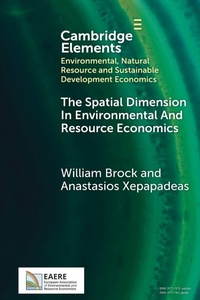
The Spatial Dimension In Environmental and Resource Economics
Published on 11. June 2026
Book
Paperback/Softback
86 pages
978-1-009-69438-4 (ISBN)
Description
Although the spatial dimension is embedded in most issues studied by environmental and resource economics, its incorporation into economic models is not widespread. As a result, significant aspects of important problems remain hidden, which could lead to policy failures. This Element fills this gap by exploring how space can be integrated into environmental and resource economics. The emergence of spatial patterns in economic models through Turing's mechanism is explained and an extension of Pontryagin's maximum principle under spatial dynamics is provided. Examples of the use of spatial dynamics serve to illustrate why space matters in environmental policy design. Moreover, the differentiation of policy when spatial transport mechanisms are considered is made clear. The tools presented, along with their applications, provide foundations for future research in spatial environmental and resource economics in which the underlying spatial dimension - which is very real - is fully taken into account.
More details
Series
Language
English
Place of publication
Cambridge
United Kingdom
Product notice
Paperback (trade)
Illustrations
Worked examples or Exercises
Dimensions
Height: 229 mm
Width: 152 mm
Thickness: 6 mm
Weight
142 gr
ISBN-13
978-1-009-69438-4 (9781009694384)
Copyright in bibliographic data and cover images is held by Nielsen Book Services Limited or by the publishers or by their respective licensors: all rights reserved.
Schweitzer Classification
Other editions
Additional editions
William Brock | Anastasios Xepapadeas
The Spatial Dimension In Environmental and Resource Economics
Book
06/2026
Cambridge University Press
€75.30
Shipment within 15-20 days
Persons
Content
1. Introduction; Part I. Theory: 2. Modeling Spatial Transport; 3. Dynamic Optimization in Space-Time: A Spatial Maximum Principle under Diffusion and Long- Range Transport; 4. Spatial Pattern Formation; Part II. Applications: 5. Environmental and Resource Management Policy under Spatial Dynamics; 6. Spatially Differentiated Regulation for Transboundary and Global Externalities; 7. Uncertainty and Space; 8. Concluding Remarks; 9. Appendix; References.