

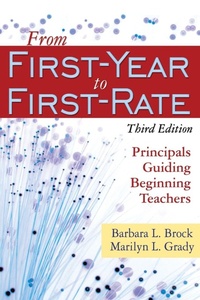
From First-Year to First-Rate
Principals Guiding Beginning Teachers
3rd Edition
Published on 6. March 2007
Book
Paperback/Softback
160 pages
978-1-4129-1603-5 (ISBN)
Description
Praise for the Second Edition:
"Finally, a book that is realistic and provides superb assistance. A must for every principal."
-Ronald Jockel, Executive Director, Phi Delta Kappa International
"Compelling rationale and practical steps for developing a first-year teacher induction program."
-Linda L. Lyman, Associate Professor, Department of Educational Leadership and Human Development, Bradley University
Help new teachers be the best they can be!
Beginning teachers are often filled with self-doubt and questions regarding school culture and principals' expectations. From First-Year to First-Rate: Principals Guiding Beginning Teachers, Third Edition helps you answer teachers' questions and gain strategies to prevent the isolation that many new instructors experience.
Updated to meet the challenges facing new teachers today, this revision of the bestseller helps administrators develop a first-year induction plan to help teachers succeed. This vital resource provides:
Ideas for initial orientation
Strategies for measuring program success
A greater focus on practical applications for the classroom
You hold the key to the professional development of your teachers. Use it to unlock their potential for growth!
"Finally, a book that is realistic and provides superb assistance. A must for every principal."
-Ronald Jockel, Executive Director, Phi Delta Kappa International
"Compelling rationale and practical steps for developing a first-year teacher induction program."
-Linda L. Lyman, Associate Professor, Department of Educational Leadership and Human Development, Bradley University
Help new teachers be the best they can be!
Beginning teachers are often filled with self-doubt and questions regarding school culture and principals' expectations. From First-Year to First-Rate: Principals Guiding Beginning Teachers, Third Edition helps you answer teachers' questions and gain strategies to prevent the isolation that many new instructors experience.
Updated to meet the challenges facing new teachers today, this revision of the bestseller helps administrators develop a first-year induction plan to help teachers succeed. This vital resource provides:
Ideas for initial orientation
Strategies for measuring program success
A greater focus on practical applications for the classroom
You hold the key to the professional development of your teachers. Use it to unlock their potential for growth!
Reviews / Votes
"Provides a timely and significant update to the field of new teacher induction, an accurate portait of first-year teachers and their diverse set of needs, and ways principals can support new teachers so they emerge as strong, capable professionals." -- Greg Chatlain, Superintendent of EducationMore details
Edition
3rd Revised edition
Language
English
Place of publication
Thousand Oaks
United States
Publishing group
SAGE Publications Inc
Target group
Professional and scholarly
Edition type
Revised edition
Dimensions
Height: 229 mm
Width: 152 mm
Thickness: 9 mm
Weight
245 gr
ISBN-13
978-1-4129-1603-5 (9781412916035)
Copyright in bibliographic data and cover images is held by Nielsen Book Services Limited or by the publishers or by their respective licensors: all rights reserved.
Schweitzer Classification
Other editions
Additional editions
Barbara L. Brock | Marilyn L. Grady
From First-Year to First-Rate
Principals Guiding Beginning Teachers
Book
03/2007
3rd Edition
Corwin Press Inc
€71.98
Article exhausted; check different version
Previous edition
Barbara L. Brock | Marilyn L. Grady
From First-Year to First Rate
Principals Guiding Beginning Teachers
Book
03/2001
2nd Edition
Corwin Press Inc
€42.27
Article exhausted; check for reprint
Persons
Barbara L. Brock is a professor of education at Creighton University in Omaha, Nebraska. She has held a variety of positions in education, including education department chair, director of school administration, elementary principal, and K-12 teacher. She presents nationally and internationally on topics of beginning teacher induction, leadership succession, teacher and principal burnout, and educators with disabilities. She is coauthor with Marilyn Grady of Principals in Transition: Tips for Surviving Succession, From First-Year to First-Rate: Principals Guiding New Teachers, Rekindling the Flame: Principals Combating Teacher Burnout, Avoiding Burnout: A Principal's Guide to Keeping the Fire Alive, and Launching Your First Principalship. She has published in a number of journals, including The Journal of the Mid-Western Research Association, Educational Considerations, Connections, Clearinghouse, and Catholic Education: A Journal of Inquiry and Practice. She received her bachelor of arts degree in art education from Briar Cliff University, a master of arts with a specialty in school administration from Creighton University, and a doctorate in administration, curriculum, and instruction from the University of Nebraska-Lincoln. Marilyn L. Grady, is professor of educational administration at the University of Nebraska-Lincoln (UNL). She is the author or coauthor of 23 books, including From Difficult Teachers to Dynamic Teamwork (2009) with Brock, Getting it Right from the Start (2009) with Kostelnik From First Year to First Rate (2007) with Brock, 194 High-Impact Letters for Busy Principals (2006), 20 Biggest Mistakes Principals Make and How to Avoid Them (2004) and Launching Your First Principalship (2004) with Brock. Her research areas include leadership, the principalship, and superintendent-board relations. She has more than 175 publications to her credit. She is the editor of the Journal of Women in Educational Leadership. Her editorial board service has included Educational Administration Quarterly, International Studies in Educational Administration, International Journal of Learning, Rural Educator, Journal of At-Risk Issues, Journal of School Leadership, Advancing Women in Leadership On-Line Journal, Journal for Rural School and Community Renewal, International Journal of Learning, and Journal for a Just and Caring Education. She is the recipient of the Stanley Brzezinski Research Award, NCPEA's Living Legend Award, the Donald R. and Mary Lee Swanson Award for Teaching Excellence, UNL's Distinguished Teaching Award, and UNL's Award for Outstanding Contributions to the Status of Women.
Grady coordinates an annual conference on women in educational leadership that attracts national attendance and is in its 24th year. She has been an administrator in K-12 schools as well as at the college and university levels. She received her bachelor's degree in history from Saint Mary's College, Notre Dame, Indiana, and her doctorate in educational administration with a specialty in leadership from The Ohio State University.
Grady coordinates an annual conference on women in educational leadership that attracts national attendance and is in its 24th year. She has been an administrator in K-12 schools as well as at the college and university levels. She received her bachelor's degree in history from Saint Mary's College, Notre Dame, Indiana, and her doctorate in educational administration with a specialty in leadership from The Ohio State University.
Content
Acknowledgments
About the Authors
Introduction
1. Understanding the Beginning Teacher
The Mature Beginner
Alternative Certification
Beginning Teachers From Minority Groups
Reentry to Teaching
Experienced Teachers in a New School
Summary
2. Helping Beginning Teachers Face Problems and Barriers
Reality Shock
Theoretical Knowledge Base
Administrators and Expectations
Isolation
New Kid on the Block
Classroom Dilemmas
Addressing Differing Student Needs
Assessment
Setup for Failure
Inferior Working Conditions
Are You Old Enough to Be a Teacher?
Nonpublic Schools
Rural Schools
Overwhelmed
Summary
3. Acclimating the Beginning Teacher
The Strength of School Cultures
Socializing the Beginning Teacher
Summary
4. Working With Beginning Teachers: The Role of the Principal
The Power of the Principal
The Leadership of the Principal
Why Should Principals Work With Beginning Teachers?
What Expectations Do Principals Have?
What Is the Principal's Role With Beginning Teachers?
What Problems Are Within the Control of the Principal?
Formative and Summative Evaluation
Support for the Principal
How Do Principals Find the Time to Help?
Assessing Time Spent
Taking Charge of Your Time
Summary
5. Starting Orientation Before the School Year Begins
The Orientation Phase
Orientation Meetings: Setting the Stage
The Role of the Principal in Orientation
Summary
6. Developing a Good Induction Program
What Is Developmental Induction?
Organizational Structure
Program Delivery
Summary
7. Building a Teacher-Mentor Support Team
Where Did the Idea of Mentors Originate?
How Do We Know That Mentoring Works?
What Are the Benefits of Mentorships?
Beginning a Teacher-Mentor Program
The Needs of New Teachers
The Framework of a Mentor Program
What Are the Requirements for a Mentor?
Matching Mentors With Entry-Year Teachers
The Process of Mentoring
How Should Mentors Be Oriented?
Training of Mentors
Diagnosing Problems
Conferencing With Beginners
The Role of Other Faculty
Administrative Support
University Consultants
Program Evaluation
Summary
8. Helping Beginning Teachers With Common Problems
Helping With Specific Problems
The Principal's Role
The Teacher's Role--And Ways the Principal Can Help
Summary
9. Measuring Induction Program Success
Needs Assessment
Goals
Year-End Evaluation
Principals' Self Assessments
Summary
10. Integrating Induction and Career-Long Development
Development That Spans a Teaching Career
Strategies for Adult Learners
Meeting the Needs of the Developing Adult
When Reflection and Renewal Diminish
Fostering a Culture for Growth
A Model for Continuous Development
A Model for Continuous Learning
Summary
References
About the Authors
Introduction
1. Understanding the Beginning Teacher
The Mature Beginner
Alternative Certification
Beginning Teachers From Minority Groups
Reentry to Teaching
Experienced Teachers in a New School
Summary
2. Helping Beginning Teachers Face Problems and Barriers
Reality Shock
Theoretical Knowledge Base
Administrators and Expectations
Isolation
New Kid on the Block
Classroom Dilemmas
Addressing Differing Student Needs
Assessment
Setup for Failure
Inferior Working Conditions
Are You Old Enough to Be a Teacher?
Nonpublic Schools
Rural Schools
Overwhelmed
Summary
3. Acclimating the Beginning Teacher
The Strength of School Cultures
Socializing the Beginning Teacher
Summary
4. Working With Beginning Teachers: The Role of the Principal
The Power of the Principal
The Leadership of the Principal
Why Should Principals Work With Beginning Teachers?
What Expectations Do Principals Have?
What Is the Principal's Role With Beginning Teachers?
What Problems Are Within the Control of the Principal?
Formative and Summative Evaluation
Support for the Principal
How Do Principals Find the Time to Help?
Assessing Time Spent
Taking Charge of Your Time
Summary
5. Starting Orientation Before the School Year Begins
The Orientation Phase
Orientation Meetings: Setting the Stage
The Role of the Principal in Orientation
Summary
6. Developing a Good Induction Program
What Is Developmental Induction?
Organizational Structure
Program Delivery
Summary
7. Building a Teacher-Mentor Support Team
Where Did the Idea of Mentors Originate?
How Do We Know That Mentoring Works?
What Are the Benefits of Mentorships?
Beginning a Teacher-Mentor Program
The Needs of New Teachers
The Framework of a Mentor Program
What Are the Requirements for a Mentor?
Matching Mentors With Entry-Year Teachers
The Process of Mentoring
How Should Mentors Be Oriented?
Training of Mentors
Diagnosing Problems
Conferencing With Beginners
The Role of Other Faculty
Administrative Support
University Consultants
Program Evaluation
Summary
8. Helping Beginning Teachers With Common Problems
Helping With Specific Problems
The Principal's Role
The Teacher's Role--And Ways the Principal Can Help
Summary
9. Measuring Induction Program Success
Needs Assessment
Goals
Year-End Evaluation
Principals' Self Assessments
Summary
10. Integrating Induction and Career-Long Development
Development That Spans a Teaching Career
Strategies for Adult Learners
Meeting the Needs of the Developing Adult
When Reflection and Renewal Diminish
Fostering a Culture for Growth
A Model for Continuous Development
A Model for Continuous Learning
Summary
References