

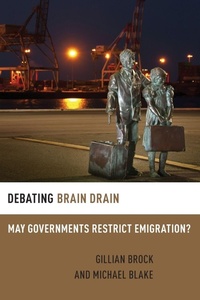
Debating Brain Drain
May Governments Restrict Emigration?
Published on 29. January 2015
Book
Paperback/Softback
312 pages
978-0-19-931562-8 (ISBN)
Description
Many of the best and brightest citizens of developing countries choose to emigrate to wealthier societies, taking their skills and educations with them. What do these people owe to their societies of origin? May developing societies legitimately demand that their citizens use their skills to improve life for their fellow citizens? Are these societies ever permitted to prevent their own citizens from emigrating?
These questions are increasingly important, as the gap between rich and poor societies widens, and as the global migration of skilled professionals intensifies. This volume addresses the ethical rights and responsibilities of such professionals, and of the societies in which they live. Gillian Brock and Michael Blake agree that the phenomenon of the brain drain is troubling, but offer distinct arguments about what might be permissibly done in response to this phenomenon.
These questions are increasingly important, as the gap between rich and poor societies widens, and as the global migration of skilled professionals intensifies. This volume addresses the ethical rights and responsibilities of such professionals, and of the societies in which they live. Gillian Brock and Michael Blake agree that the phenomenon of the brain drain is troubling, but offer distinct arguments about what might be permissibly done in response to this phenomenon.
Reviews / Votes
This book contributes to one of the central questions of our time, and deserves to be read by a wide audience. * Gabriele Vogt, University of Hamburg * [A] welcome addition to the literature on justice in global migration ... Debating Brain Drain is a highly engaging book. Brock and Blake deserve praise for the seriousness and sensitivity with which they approach the controversial and underexplored topic of restrictions on emigration. In virtue not only of this but also its provocative arguments, Debating Brain Drain ought to be regarded as an important contribution to the development of a new direction in the study of the normative dimensions of global migration. * Peter W. Higgins, Ethics * Debating Brain Drain does an excellent job at raising some of the key issues that are essential to understanding the nature of brain drain, the normative challenges it poses, and what sorts of strategies can be legitimately deployed to defend against its supposed harms. Both thinkers offer compelling and sophisticated arguments to justify their respective positions. The back-and-forth between Brock and Blake is extraordinarily helpful for readers attempting to understand the nuanced views that both theorists offer. * Patti Leonard, Contemporary Political Theory * ... this volume is overall a lively and challenging work that has much to teach most any reader. It will be particularly valuable in courses on political philosophy, where it will spur difficult debate while enabling the instructor to pick up the threads and use them to explain many of the most important issues in the field. For that reason this volume is particularly highly recommended. * Notre Dame Philosophical Reviews Online * The authors provide an interesting set of arguments for their positions and responses to each other's critiques in a very readable format ... Recommended. * Choice * ...an important book. Both authors take seriously the dangers that unfettered individualism in migration may bring. The book presents a nuanced counterweight to arguments for open borders that are simply based on individual gains, and which neglect the social consequences that can derive from such migration. * Christine Straehle, Developing World Bioethics *More details
Series
Language
English
Place of publication
New York
United States
Target group
College/higher education
Dimensions
Height: 210 mm
Width: 140 mm
Thickness: 19 mm
Weight
433 gr
ISBN-13
978-0-19-931562-8 (9780199315628)
Copyright in bibliographic data and cover images is held by Nielsen Book Services Limited or by the publishers or by their respective licensors: all rights reserved.
Schweitzer Classification
Other editions
Additional editions
Book
01/2015
Oxford University Press Inc
€210.80
Shipment within 15-20 days
E-Book
11/2014
1st Edition
OUP eBook
€22.99
Available for download
E-Book
11/2014
1st Edition
OUP eBook
€22.99
Available for download
Persons
Gillian Brock is Professor of Philosophy at the University of Auckland in New Zealand. Her recent and current research focuses on global justice and related fields. Her most recent works with Oxford University Press include Global Justice: A Cosmopolitan Account (2009) and Cosmopolitanism versus Non-Cosmopolitanism (2013).
Michael Blake is Professor of Philosophy and Public Affairs at the University of Washington. He writes about international distributive justice and the ethics of immigration. He is the author of Justice and Foreign Policy (OUP, 2013).
Michael Blake is Professor of Philosophy and Public Affairs at the University of Washington. He writes about international distributive justice and the ethics of immigration. He is the author of Justice and Foreign Policy (OUP, 2013).
Content
Introduction ; Part I ; By Gillian Brock ; 1. Introduction to Part I ; 2. What Does Global Justice Require? ; 3. Prosperity in Developing Countries, the Effects Departing Individuals Have on Those Left Behind, and Some Policy Options ; 4. Whose Responsibility is it to Remedy Losses Caused by the Departure of Skilled Migrants? ; 5. Consideration of Central Anticipated Objections ; 6. Summary of Conclusions from Part I ; Part II ; By Michael Blake ; 7. The Right to Leave: Looking Back ; 8. The Right to Leave: Looking Forward ; 9. The Right to Leave and What Remains ; Part III ; Responses by Gillian Brock and Michael Blake ; 10. Brock Responds to Blake ; 11. Blake Responds to Brock ; Index