

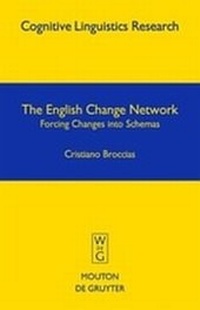
The English Change Network
Forcing Changes into Schemas
1st Edition
Published on 1. January 2003
Book
Mixed media product
XVIII, 408 pages
978-3-11-180341-8 (ISBN)
Description
This book introduces the notion of change construction and systematically studies, within a Cognitive Grammar framework, the rich inventory of its instantiations in English, from well-known structures such as the so-called resultative construction to a variety of largely ignored types such as asymmetric resultatives, sublexical change constructions and mildly causal constructions.
More details
Other editions
Additional editions
E-Book
07/2013
1st Edition
De Gruyter Mouton
€149.95
Available for download
Book
07/2003
1st Edition
De Gruyter Mouton
€149.95
Shipment within 7-9 days
Person
Cristiano Broccias teaches at the Universities of Genova and Pavia, Italy.
Content
Chapter 1 Introduction
1. Two constructions1.1 The resultative construction1.2 The at-construction1.3 The notion of change
2. Cognitive Grammar2.1. Basic assumptions2.2. Predication2.3. Composite structures
3. Preview
Chapter 2 Resultative constructions and change constructions
1. Resultative constructions and phrases1.1. Transitive resultative constructions1.2. Intransitive resultative constructions1.3. Conceptual distance1.4. Paraphrases for the resultative construction1.5. Summary
2. The billiard-ball model2.1. The syntactic realisation of the resultative phrase2.2. States and positions2.3. Reverse causal ordering2.4. Causality and manipulable entities2.5. A first schematic representation2.6. Summary
3. The change phrase3.1. A host of constructions3.2. Sublexical change3.3. LIKE change constructions3.4. Emission verbs3.5. Summary
4. Conclusion
Chapter 3 Asymmetric resultatives and the change complex
1. Transitivity1.1. A preliminary analysis based on Levin and Rappaport Hovav (1995)1.2. The direct object restriction1.3. Some problematic data1.4. Summary
2. Summary2.1. Allative and ablative prepositions2.2. Prepositions in the change complex2.3. The problematic examples2.4. Summary
3. Impossible combinations3.1. An aesthetic paradox3.2. Affectedness and objectivity: When properties are not in the eye of the beholder3.3. Goldberg's (1995) Unique Path Constraint
4. Conclusion
Chapter 4 Motion and idiosyncrasy
1. The motion scenario1.1. The motion scenario is evoked by the onstruction1.2. The motion scenario is evoked by the verb1.3. Summary
2. Tight links and information retrieval2.1. Transitivity and motion2.2. Linking events
3. Lexical variation3.1. Wechsler's (2001) approach3.2. Gestalt versus part-whole properties3.3. Summary
4. Interim conclusion4.1. Transitivity4.2. Temporality
Chapter 5
1. The Force Change Schema and the Event Change Schema1.1. The Force Change Schema1.2. Subcategorised objects1.3. Mild causality and specification1.4. Goldberg's (1995) analysis
2. The Event Change Schema2.1. Temporal coextensiveness2.2. Temporal sequencing2.3. The transitive Event Change Schema and subject orientation
3. Conclusion
Chapter 6 The Event Force Change Schema and verb classes
1. The Event Force Change Schema1.1. The causal variant1.2. The noncausal variant
2. The lack of object orientation2.1. On satisfaction and love2.2. to the point of2.3. Part-whole variants
3. On indeterminacy and complexity
4. Verb classes4.1. Middle verbs4.2. Verbs of manner of motion4.3. Verbs of accompaniment4.4. Emission verbs4.5. Verbs of transformation and creation
5. Conclusion
Chapter 7 at-constructions
1. The conative alternation1.1. Levin's (1993) definition and list1.2. Van der Leek's (1996) analysis
2. The allative and ablative scenarios2.1. The Allative Schema: Translational motion with possible contact2.2. The Ablative Schema: Necessary contact without translational motion2.3. The Allative/Ablative Schema: Translational motion with necessary contact
3. Pesetsky's (1995) paradox
4. Conclusion
Chapter 8 Conclusion