

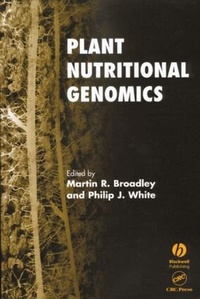
Plant Nutritional Genomics
1st Edition
Published on 8. March 2005
Book
Hardback
321 pages
978-0-8493-2362-1 (ISBN)
Description
A 'textbook' plant typically comprises about 85% water and 13.5% carbohydrates. The remaining fraction contains at least 14 mineral elements, without which plants would be unable to complete their life cycles.
Understanding plant nutrition and applying this knowledge is essential to increasing crop production to meet growing demands for food. Genotypic approaches, based on crop selection and / or breeding have recently begun to benefit from technological advances, including the completion of plant genome sequencing projects.
Plant Nutritional Genomics provides a timely overview of plant nutritional genomics, which is defined as the interaction between a plant's genome and its nutritional characteristics. Optimising mineral nutrition during crop production is vital to the development of healthy and nutritional pest and disease resistant crops without relying on chemical input. The judicious selection and breeding of fit-for-purpose varieties of crops will play a huge role in meeting these objectives, and advances in plant nutritional genomics will allow the full potential of crop selection and breeding strategies to be realized.
Understanding plant nutrition and applying this knowledge is essential to increasing crop production to meet growing demands for food. Genotypic approaches, based on crop selection and / or breeding have recently begun to benefit from technological advances, including the completion of plant genome sequencing projects.
Plant Nutritional Genomics provides a timely overview of plant nutritional genomics, which is defined as the interaction between a plant's genome and its nutritional characteristics. Optimising mineral nutrition during crop production is vital to the development of healthy and nutritional pest and disease resistant crops without relying on chemical input. The judicious selection and breeding of fit-for-purpose varieties of crops will play a huge role in meeting these objectives, and advances in plant nutritional genomics will allow the full potential of crop selection and breeding strategies to be realized.
More details
Persons
Martin R. Broadley, Philip J. White
Content
1. NitrogenFrançoise Daniel-Vedele and Sylvain Chaillou, Plant Nitrogen Nutrition Unit, INRA Versailles, Frances2. PotassiumSabine Zimmermann and Isabelle Chérel, INRA - Biochimie et Physiologie Moléculaire des Plantes, Montpellier, France3. CalciumPhilip J. White, Horticulture Research International, Wellesbourne, Warwick, UK4. SulphurMalcolm J. Hawkesford, Agriculture and the Environment Division, Rothamsted Research, Harpenden, UK5. PhosphorusKashchandra G. Raghothama, Department of Horticulture and Landscape Architecture, Purdue University, West Lafayette, Indiana, USA6. SodiumHuazhong Shi, Ray A. Bressan, Paul M. Hasegawa and Jian-Kang Zhu, Department of Horticulture and Landscape Architecture, Purdue University, West Lafayette, Indiana, USA7. Mapping links between the genome and ionome in plantsBrett Lahner and David E. Salt, Department of Horticulture and Landscape Architechture, Purdue University, West Lafayette, Indiana, USA8. Transcriptional profiling of membrane transportersFrans J.M. Maathuis, Department of Biology, University of York, UK and Anna Amtmann, Laboratory of Plant Physiology and Biophysics, University of Glasgow, UK9. Exploring natural genetic variation to improve plant nutrient contentDick Vreugdenhil, Mark G.M. Aarts and Maarten Koornneef, Laboratory of Genetics, Wageningen University, The Netherlands10. Mapping nutritional traits in crop plantsMatthias Wissuwa, International Rice Research Institute, Manila, The Philippines11. Sustainable crop nutrition: constraints and opportunitiesR. Ford Denison and E. Toby Kiers, Agronomy & Range Science Department, University of California, Davis, USA12. Methods to improve the crop-delivery of minerals to humans and livestockMichael A. Grusak, Baylor College of Medicine, Houston, Texas, USA and Ismail Cakmak, Faculty of Engineering and Natural Sciences, Sabanci University, Istanbul, Turkey13. Using plants t